
Real Cash Online Pokies in Australia: What the Law Allows
 Available in AU
- Legal and Regulatory Landscape for Real‑Cash Online Casinos in Australia
- Deposits, No‑Deposit Bonuses and Instant Cash‑Outs
- Licensing, Fairness and Security of Crypto Casinos
- Game Variety: From Classic Casino Games to Modern Crypto Titles
- Slot Machines: Themes, Features and Real‑Cash Play
- Cash‑Paying Casino Apps and Games
- Pokies in Australia: Real‑Cash Online Options for 2026
- Free Slots with Real-Cash Win Potential
- Playing for Free: Accessing Real‑Cash Online Casinos Without Deposit
- Winning Real Cash: Strategies and Platform Choices
Legal and Regulatory Landscape for Real‑Cash Online Casinos in Australia
Australia has some of the strictest online gambling laws among developed countries, and the framework is not symmetric: it draws a hard line between what operators may do and what individual players may do. Understanding that distinction is the starting point for any discussion of real-cash online play.
The law: what operators cannot do
The Interactive Gambling Act 2001 (IGA) is the primary Commonwealth law governing online gambling in Australia. It was introduced with a public-protection focus and an emphasis on harm minimisation. Under the IGA, online casino-style games — including pokies, poker, blackjack and roulette — are prohibited. It is illegal to offer online casino gambling to Australian residents, and there is no mechanism to obtain a licence to operate an online casino domestically. In short: there are no domestically licensed real-money online casino operators available to Australian players. Any site presenting itself as an Australian-licensed online casino is presenting something that cannot exist.
Enforcement sits with the Australian Communications and Media Authority (ACMA), which targets unlicensed offshore operators that actively offer online casino services to Australian residents. The regulator’s leverage is over the supply side — advertising, payment channels and the operators themselves — not over the people who play.
One point of confusion in secondary sources: some materials refer to an Interactive Gambling Act 1997 rather than 2001. The correct Commonwealth statute governing online gambling is the 2001 Act; the 1997 reference appears to be an error carried through third-party summaries rather than a separate law.

The player’s position
The law targets providers, not players. It is not illegal for individual Australians to play at offshore-licensed online casinos, and there is no criminal penalty for accessing offshore crypto casinos. This asymmetry is deliberate: the policy goal is harm minimisation at the point of supply, not prosecution of individuals.
What remains legally available under local regulation is narrower. Online sports betting is legal under state and territory licences, though in-play betting is unavailable at locally regulated sites. Lotteries fall under their own licensing arrangements. Online casino play, poker and in-play betting remain prohibited federally — but that prohibition binds the operator, not the person at the keyboard.
Why this matters for 2026
Because no domestic licence exists for online casinos, every real-cash casino option available to an Australian player in 2026 is, by definition, operating from offshore licensing — typically jurisdictions such as Curacao or Malta. That fact does not change the player’s legal position, but it changes where the practical questions live: deposit mechanics, withdrawal speed, fairness of games and dispute resolution all shift from a domestic regulator to the offshore operator itself. Those are the subjects of the sections that follow.
Deposits, No‑Deposit Bonuses and Instant Cash‑Outs
How crypto banking actually works
A crypto casino moves money differently from a card-led operator. There is no acquiring bank in the middle, no chargeback window and no payment provider deciding whether the transaction clears. The deposit is a transfer on a blockchain, which changes both the speed and the responsibilities.

Deposits can be confirmed very quickly, often within minutes. Once the network registers the transaction, the balance is credited and play can start. Bitcoin is the most widely accepted cryptocurrency, and many crypto casinos also support Ethereum, Litecoin, USDT, Dogecoin, Solana, Ripple and other altcoins — a wider range of payment options than most traditional systems offer.
Withdrawals are where the picture splits. One account of crypto casinos describes cash-outs as usually instant or processed within hours, often clearing in minutes with low fees. Another account notes that withdrawals depend on casino approval and blockchain processing, which may delay them. Both are describing the same pipeline: the blockchain leg is fast, but the operator’s own approval step sits in front of it, and its duration is set by the casino, not by the currency. A platform that reviews withdrawal requests manually will never match the speed of the chain it pays out on.
Three mistakes that cost money
- Sending funds on the wrong blockchain. Many assets exist on more than one network. A deposit routed to the wrong chain can be unrecoverable. The receiving address and its network must match before the transfer is sent, not after.
- Overlooking transaction fees. Every transfer carries a network fee. It is visible before confirmation; whether the player checks it is a separate matter.
- Assuming crypto removes identity checks. It does not. Crypto changes the payment rail, not the operator’s verification obligations — a point that carries particular weight under the compliance changes affecting the gambling sector.
The no-deposit question
Search demand for "no deposit" offers — free spins, bonus credit, slots playable without a deposit — is persistent, and the mechanics deserve a direct statement. A no-deposit bonus is not free money withdrawn on demand. It is a promotion with conditions attached: the operator credits a small balance or a set of spins, and withdrawal of anything won from it is governed by the terms attached to that specific offer. Those terms vary by operator, and no general claim about their generosity or severity survives contact with a specific casino’s conditions. Wagering requirements and any withdrawal conditions must be displayed up front before a bonus is offered — that is the point at which the offer can actually be evaluated, and the point at which most of these promotions show their arithmetic.
The same logic applies to low-deposit play. A small entry amount changes nothing about the withdrawal pipeline: the approval step, the network fee and the verification requirement are identical regardless of how the balance was opened.
Sending funds on the wrong blockchain, overlooking transaction fees, and assuming crypto removes identity checks are the three most common mistakes that can lead to lost money.
Licensing, Fairness and Security of Crypto Casinos
A fast withdrawal means little if the operator can refuse to pay it. This is the layer where real cash online casinos actually differ from each other: who licenses them, whether the games can be checked, and who holds the money while a round is in progress.
Offshore licensing and what it does
There are no domestically licensed real-money online casino operators available to Australian players, so every crypto casino serving this market operates under offshore licensing, typically issued in jurisdictions such as Curacao or Malta. An offshore licence does not carry the backing of an Australian regulator, and it is worth being precise about what it does provide: a legal entity that can be held to its own licence conditions, a set of rules on disputes and payouts, and an address to serve a complaint on. What it does not provide is access to Australian remedies. A dispute with an offshore operator is resolved under that operator’s licence terms, which is why those terms deserve a read before the first deposit rather than after a withheld payout.
Provably fair algorithms
The more verifiable layer of protection sits inside the games themselves. Reputable crypto casinos use provably fair algorithms — a mechanism built on cryptographic hashes. Before a round, the casino publishes a hash of the outcome seed; after the round, the player can check that the published result matches the original hash. The maths runs one way, so a hash published in advance cannot be reverse-engineered to fit a result afterwards. A game that supports this cannot quietly adjust an outcome once the bet is placed, which is a stronger guarantee than any operator’s promise. Verification is done by the player, not by an auditor, and it does not depend on trusting anyone.
Provably‑fair algorithms let players verify each spin by comparing the published hash with the outcome after the round, providing transparent proof that the result was not altered.
Decentralized protocols
Some crypto casino platforms go further and operate on decentralized protocols, where no single company controls funds or outcomes. Deposits sit in smart contracts rather than a corporate wallet; game results execute on-chain rather than on a server the operator can reach. The practical consequence: there is no treasurer to abscond and no server to quietly reseed. The trade-off is that when something breaks, there is also no manager to call — the code is the operator. Whether that arrangement suits a particular player is a question of preference, but the structural difference is real.
What each layer covers
- Offshore licence — governs the operator’s conduct, dispute handling and solvency; the weakest layer for an Australian player, since enforcement runs through a foreign jurisdiction.
- Provably fair games — governs each individual outcome; the strongest layer, since verification requires no trust at all.
- Decentralized protocols — removes the intermediary entirely; strongest protection against operator misconduct, weakest recourse when the code misbehaves.
For real cash slots and table games played from Australia, the sensible arrangement stacks these: an operator with a traceable offshore licence, games that publish verifiable hashes, and — where available — settlement on a protocol rather than in a corporate account. Speed of banking, covered earlier, is the easy part to compare. Fairness and control of funds are the parts worth comparing, because they are the ones that decide whether a balance in an account is money or a number on a screen.
Game Variety: From Classic Casino Games to Modern Crypto Titles
Real-cash casino gaming for Australians in 2026 is, almost entirely, an offshore affair. No domestic licence exists for online casino games — slots, poker, blackjack and roulette are prohibited under the Interactive Gambling Act 2001 for operators based or licensed in Australia — so the range of games available for real cash sits on platforms licensed elsewhere, in jurisdictions such as Curacao or Malta. The player is not the target of that law; the provider is. What follows is what the menu actually looks like once that offshore door is open.
The Classic Table Category
Table games form the backbone of any real-money casino lobby, and offshore platforms serving Australians carry the standard set:
- Blackjack — the closest thing to a skill game in a casino lobby, with the house edge lower than most other table offerings, which is why it sits at the top of most “best odds” discussions.
- Roulette — European, American and French variants; the difference between them is one zero pocket and, with it, the price of every spin.
- Baccarat — a low-decision game with a small set of bets, one of which is notably worse than it looks.
- Poker formats — video poker and casino poker variants, distinct from peer-to-peer online poker, which is itself prohibited federally for Australian-facing operators.
Every one of these is, on paper, a game the Interactive Gambling Act 2001 bars Australian-licensed sites from offering. Offshore, they run in dozens of variants, with live-dealer tables streaming in real time and bet limits set by the operator rather than by any Australian regulator. That last point is worth registering: nobody onshore is capping what a player can stake at an offshore table.
Live Dealer Games
Live casino content deserves its own line in the catalogue because it operates differently from the rest. Real dealers, real cards, real roulette wheels, streamed from studios and land-based floors. The category has expanded well beyond the classics into game-show formats — money wheels, dice-box games, card-guessing formats with multipliers attached. These are neither table games in the traditional sense nor slots; they occupy the middle ground and, on crypto-led platforms, they are increasingly the largest section of the lobby.
One mechanic particular to this category: multipliers attached to side bets, where a base game with a modest payout structure carries occasional multiplied wins. The base game pays as it always did; the multiplier is where the marketing lives. The maths of the side bet is set by the game studio, and studios publish their own rules — the payout tables are visible in-game before a cent is committed.
Game-Show and Crash Formats
The genuinely new category, and the one most associated with crypto casinos, is the fast-round, single-mechanic game: crash-style titles, mine- sweeper formats, plinko, dice with adjustable risk settings. The shared traits:
- A round measured in seconds, not minutes.
- A cash-out decision made mid-round rather than at the end.
- Provably fair verification — the outcome is hashed before the round begins, and the hash can be checked afterwards. This is the mechanism that made the format synonymous with crypto platforms: it was built for them, and the verification step only works because the casino publishes a cryptographic commitment up front.
These titles exist in live format as well — crash mechanics now sit alongside game-show tables in some studios’ catalogues — which blurs the live/original boundary that used to be clean.
Crypto-Enhanced Titles and What "Enhanced" Actually Means
The term "crypto casino" describes the banking rails more than the games. Bitcoin is the most widely accepted cryptocurrency on such platforms, and many operators also support Ethereum, Litecoin, USDT, Dogecoin, Solana, Ripple and other altcoins. The game portfolio, in most lobbies, is the same set of table games, live tables and slots available anywhere else — the cryptocurrency is how funds arrive and leave, not a genre of game.

Where the games themselves diverge from the traditional catalogue:
- Provably fair originals — the crash and instant-win formats described above, where the randomness check is exposed to the player rather than held by the operator. Traditional RNG table games do not offer this; the fairness argument there rests on third-party auditing and the licence.
- Native tokens — by the account of one industry review, a few platforms go further and run their own tokens, with staking rewards and governance rights attached. That is a single-source claim about a moving target, not an established market feature, and it is not something most Australian-facing platforms advertise in their own terms. Treat it as a possibility, not a baseline.
- Decentralised platforms — some operate on decentralised protocols where no single company controls funds or outcomes. These are a minority of the market and behave differently on the practical questions — deposits go to a contract rather than an operator wallet, and dispute resolution has no licence authority behind it. The trade is transparency of the mechanism against the absence of anyone to complain to.
Free Play and Real Cash in the Same Lobby
The search pattern "free casino games win real cash" points at a real product structure: most offshore lobbies carry demo modes alongside the real-money versions of the same titles, and the switch between them is a toggle, not a separate site. Demo play settles nothing in cash. The win-real-cash path runs through the deposit balance — with the one exception covered later in this article: no-deposit offers, where a balance exists without a deposit, and where the terms attached to withdrawing anything from it are the part worth reading. Free play, in short, is a rehearsal room; the wagering happens in the same game, funded differently.
What free play does establish is the game itself: rules, payout tables, pace, and — for the provably fair originals — how the verification step presents in practice. That information is identical in demo and cash mode; the only variable that changes is whose money is on the table.
Reading the Lobby Before Reading the Terms
The catalogue a platform advertises is a decent proxy for what it is. A lobby weighted toward licensed studio content — the games with published rules, audited RNGs and recognisable names — is a different proposition from one built entirely on in-house originals, however fair the hash verification. The strongest lobbies carry both: audited traditional games for the table and slot categories, provably fair originals for the crypto-native formats, and terms that state wagering requirements up front before any bonus is taken.
By the account of one industry review, the platforms most often named for Australian players include GoldEx, King Johnnie and Stellar Spins — a single-source list, and one that shifts as promotions shift. The durable filter is structural, not nominal: which studios supply the games, whether the provably fair function is exposed in the game interface, and whether the payout tables are visible before the first bet. Those three questions sort a lobby faster than any ranking, and they apply equally to a table game, a live dealer show and a crash title.
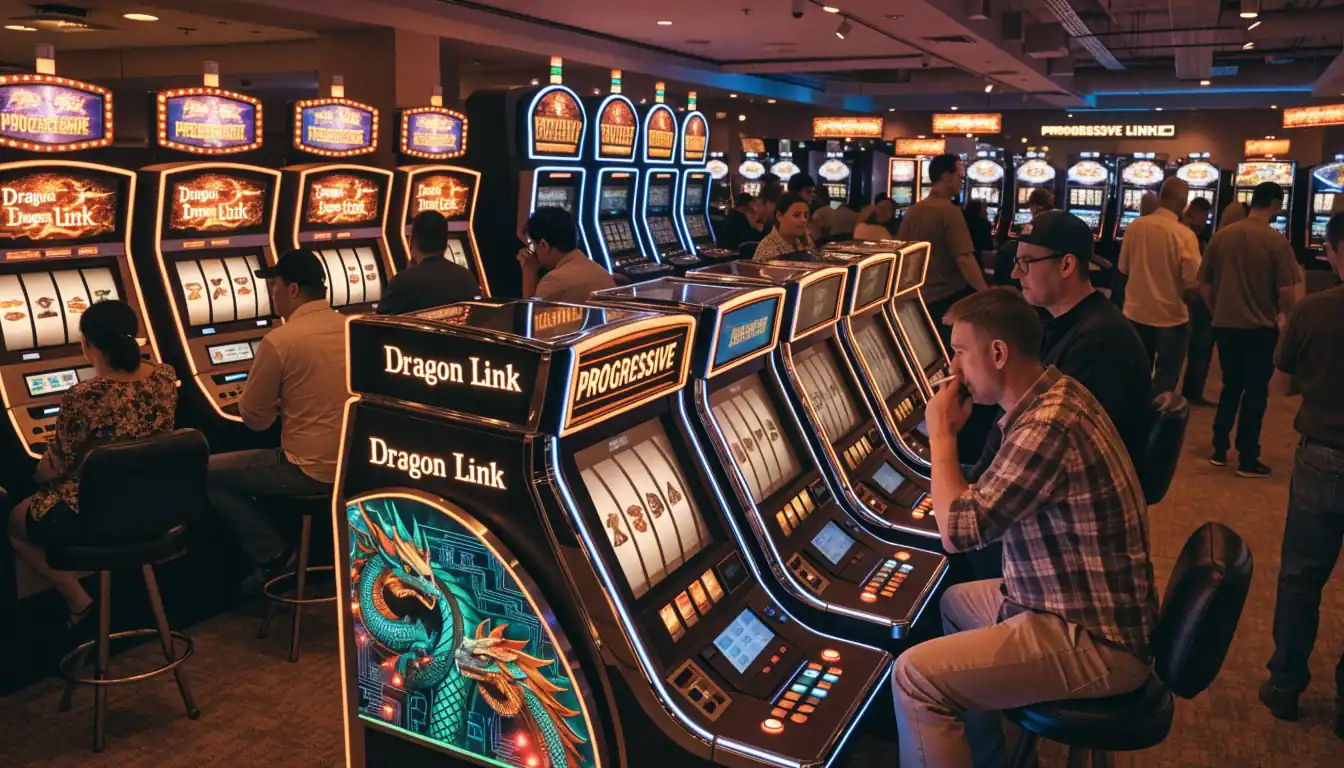
The next section narrows to the slot category specifically — themes, features and RTP — which carries its own rules of engagement.
Slot Machines: Themes, Features and Real‑Cash Play
Slot machines sit at the centre of any real-cash casino conversation, and they are also the category most often confused with everything around it. A slot is not a table game, not a lottery product and not a poker variant: it is a game where the outcome of each spin is determined by a random number generator, the payout structure is fixed in advance, and the player’s only input is the size of the bet. Understanding what that means in practice — and what it does not — is the difference between treating slots as entertainment with a price tag and treating them as a source of income they cannot be.
What counts as a slot
The core mechanics are consistent across the category: reels with symbols, paylines or ways-to-win clusters, and a paytable that maps symbol combinations to payouts. Everything else is a layer built on top of that skeleton.
- Classic three-reel slots mirror the original mechanical machines. Fewer symbols, fewer features, payouts that are easy to follow line by line.
- Five-reel video slots dominate modern catalogues. They carry the themes, the animation and the bonus rounds that define the category today.
- Progressive jackpot slots pool a share of each bet into a growing prize that pays out when a specific combination or trigger lands.
- Megaways-style games change the number of symbols on each reel per spin, which changes the number of possible winning combinations from spin to spin.
The distinctions matter because they change what a session actually costs and how outcomes are distributed. A classic slot and a jackpot slot can take the same bet and deliver entirely different patterns of results — not because one is "luckier", but because their payout tables are built differently.
Themes: packaging, not performance
Themes are the most visible part of any slot and the least consequential financially. Ancient civilisations, mythology, wildlife, outer space, crime capers, branded titles built on films and bands — the theme affects the symbols on the reels and the artwork around them. It does not affect the math.
This is worth stating plainly because theme is exactly what marketing leans on. A slot with an elaborate cinematic intro sequence is not, by virtue of that sequence, a better-paying game. Two slots on the same platform, one lavishly produced and one bare-bones, can be built on payout structures that favour the plain one. The theme decides whether a game is pleasant to look at; the paytable and the RTP decide what it returns. These are separate questions, and the industry has a commercial interest in blurring the line between them.
RTP: the number that matters
Return to Player is the share of all money wagered on a game that its payout structure is designed to return over the long run. It is a statistical property of the game, not a promise about any individual session. A player can run far above or far below it over hundreds of spins; the figure describes what the machine does at scale, across every player and every spin, not what any one account experiences on a Tuesday night.
What RTP does allow is comparison. Between two slots with the same bet size, the one with the higher published RTP is structured to return more of what is wagered over time. That comparison is only meaningful if the figures come from the same source — the game’s own information screen or the provider’s published specifications — and only over periods long enough for the statistics to express themselves.
One structural point that applies in this market: RTP and house edge are two views of the same number. The house edge is what remains after the RTP is paid back. There is no version of a slot where both sides win over the long run; the structure guarantees otherwise. A game can be entertaining, transparent and fair, and still be built so that the aggregate of players loses money to it. Those facts are not in tension.
Volatility and how it shapes a session
RTP tells you the long-run average. Volatility tells you the shape of the road. A low-volatility slot produces frequent small returns, so a balance drains slowly and steadily. A high-volatility slot produces long stretches of nothing punctuated by larger hits, so the same budget can disappear quickly or survive on a single feature round. Neither is better in any absolute sense; they are different distributions of the same expected outcome. Matching volatility to budget is one of the few decisions in slots play that is actually under the player’s control.
Where verification is possible
Traditional online slots run on random number generators that players cannot inspect. The player sees a spin, not the algorithm behind it, and trust rests on the operator and its regulator.
Crypto casinos introduce an alternative. Reputable platforms in this space use provably fair algorithms, which allow players to verify the randomness of outcomes through cryptographic hashes. In practical terms: before a spin, the platform publishes a hashed commitment; after the spin, the player can check that the outcome matched what was committed to. The randomness was fixed before the bet was placed, and the hash proves it was not altered afterwards.
This does not change the payout structure — a provably fair slot with a given RTP returns exactly what its paytable says, no more. What it removes is a specific category of doubt: whether the operator manipulated the outcome of an individual round. For a game category where the entire product is an unobservable random process, that is a meaningful form of transparency, and it is the one structural advantage crypto casinos hold over legacy slot sites. The verification, it should be noted, applies to the fairness of the draw — not to the attractiveness of the game.
Real-cash play: the mechanics
Playing slots for real cash works the same way in Australia’s offshore-accessible environment as anywhere else: an account, a deposit, and wagers drawn from the balance, with winnings credited back to it. Deposits in supported cryptocurrencies — Bitcoin being the most widely accepted, with Ethereum, Litecoin, USDT, Dogecoin, Solana and Ripple also supported across many platforms — can be confirmed quickly, often within minutes. What the player receives at the slot itself is unchanged by the payment rail: the same games, the same paytables, the same math.
The slot-specific discipline is narrower than the general bankroll advice that belongs elsewhere. It amounts to three things: read the paytable before wagering, know the RTP as published by the game itself, and treat volatility as a budget decision rather than a preference in the abstract. None of this changes the expected outcome of the game. It changes how much of the session is spent informed versus guessing.
What slots are, honestly
A real-cash slot is a priced experience with a variable, occasionally positive, structurally negative outcome. The themes are decoration, the features are pacing, and the RTP is the only number in the room that describes the deal being offered. Anyone who reads that number and still chooses to play is making an informed entertainment purchase. Anyone who plays without reading it is making the same purchase blind — and the game will happily take the same money either way.
Cash‑Paying Casino Apps and Games
Australians searching for casino apps that pay real cash run into a structural problem before they run into anything else: no app operating on an Australian licence can offer casino games for money. The Interactive Gambling Act 2001 prohibits online slots, poker, blackjack and roulette for residents, and no domestic licence exists that would allow an operator to change that. Every real‑cash casino app reachable from Australia is therefore hosted by an offshore operator, typically licensed in jurisdictions such as Curacao or Malta. That is a fact of the market, not a defect of a particular app.
What a real-cash app actually is
The distinction worth keeping straight is between three categories that search results tend to blur:
- Real-cash casino apps and mobile sites — offshore platforms offering slots and table games where deposited funds are wagered and withdrawn in money. These sit outside the Australian licensing system but are not illegal for the player to access; the law targets operators, not individuals.
- Apps from locally licensed wagering operators — legal Australian products, but they cover sports betting and lotteries, not casino games. They cannot offer slots for cash, and per the June 2024 amendments they cannot accept crypto or credit cards either.
- “Play for fun” casino apps — games with in-app purchases where winnings exist only inside the app. No money out. These are legal because nothing is won.
Apps advertised as "free casino games that pay real cash" usually sit in the third category, or in a grey zone where "real cash" refers to promotional credit rather than withdrawable money. Wagering requirements, where they apply, decide whether a withdrawal is possible at all — and under Australian rules those requirements must be displayed clearly up front before a bonus is offered. An app that hides them is not offering a bonus; it is offering a wagering obligation with a bonus attached.
Payments: where apps differ from desktop
Mobile play changes the banking mechanics more than it changes the games. The relevant differences:
- Crypto-first banking. Offshore casino apps generally offer faster banking and wider payment flexibility than card‑led systems. Bitcoin is the most widely accepted cryptocurrency, and many platforms also support Ethereum, Litecoin, USDT, Dogecoin, Solana and Ripple. Deposits can be confirmed within minutes.
- Withdrawal speed is a two-stage process. Casino approval comes first, blockchain processing second. Sources disagree on how fast the second stage is — one describes withdrawals as instant or cleared within hours, another notes that approval and network processing can delay them. Both can be true simultaneously; the honest summary is that speed depends on the operator’s approval queue as much as on the network.
- Mobile-specific mistakes. Sending funds on the wrong blockchain, overlooking transaction fees, and assuming crypto removes identity checks are the common errors — and small screens make address errors easier, not harder. The identity assumption is the costly one: verification with government‑issued ID is required before any withdrawal regardless of how the deposit was made. Crypto changes the payment rail, not the compliance layer.

The 2026 AML/CTF wrinkle
According to one industry review, AML/CTF changes in 2026 introduce additional reporting requirements for the gambling sector, mainly affecting providers rather than players. For an app user, the practical consequence is indirect: operators facing heavier reporting obligations tend to formalise their verification and withdrawal procedures, which argues against any app marketed on the promise that cash-outs skip scrutiny entirely. "No KYC" in an app’s marketing copy describes onboarding, not withdrawal — the two are routinely confused in exactly the way that costs people their money.
Selection criteria that survive scrutiny
For a mobile platform paying out real cash, the checklist is short and verifiable:
- An offshore licence (Curacao and Malta are the common ones) stated in the app or site footer — not as an Australian endorsement, since none exists, but as evidence the operator answers to some regulator.
- Provably fair algorithms for the games, allowing outcomes to be verified via cryptographic hashes.
- Wagering requirements disclosed before a bonus is claimed, not after.
- Clear complaint procedures and dispute-resolution information.
- Age restriction at 18, enforced rather than decorative.
What this checklist cannot contain is a domestic licence check. There is no Australian registry of casino operators to search, because there are no licensed online casino operators to list. Any guide suggesting players "verify the operator’s Australian licence" is describing a document that does not exist — a stronger warning sign than no advice at all.
The final category in search results — free slot games that pay real cash — is covered separately in the sections that follow, along with the specific mechanics of pokies for Australian players in 2026.
Pokies in Australia: Real‑Cash Online Options for 2026
Choosing where to play real cash pokies online means weighing licensing, bonus structure, and payout terms before you deposit a single dollar. Here’s a quick verdict on each operator to help you see what stands out.
License: Curacao Gaming Control Board OGL/2023/174/0082 (Dama N.V.) · Bonus: up to A$5,000 + 300 free spins across 4 deposits Licensed under the Curacao Gaming Control Board through Dama N.V., this operator backs its offering with a solid welcome package spread across four deposits, giving new players room to explore before committing fully.
License: Curacao Gaming Authority (Jumpman Gaming Ltd) · Bonus: up to A$6,600 + up to 250 free spins across 4 deposits Operating under a Curacao Gaming Authority license via Jumpman Gaming Ltd, it pairs a sizeable multi-deposit bonus with a generous free spins allowance, appealing to players who like to stretch their bankroll over several deposits.
Bonus: 240% up to A$4,100 + 300 free spins This one leans into a high-percentage match bonus paired with a large free spins bundle, making it notable for players drawn to bold introductory offers.
License: Curacao eGaming OGL/2023/174/0082 (Dama N.V.) · Bonus: up to A$10,000 + 500 free spins across 4 deposits · Min. deposit: A$15 Licensed through Curacao eGaming under Dama N.V., it stands out for one of the larger welcome packages on this list, spread across multiple deposits, with a modest minimum deposit requirement keeping entry accessible.
License: Curacao Gaming Control Board OGL/2023/176/0095 (Hollycorn N.V.) · Bonus: up to A$5,000 + 300 free spins across 4 deposits Regulated by the Curacao Gaming Control Board via Hollycorn N.V., it offers a balanced welcome bonus across four deposits, suited to players who prefer a steady, structured start.
License: Curacao Gaming Control Board OGL/2023/176/0095 (Hollycorn N.V.) · Bonus: up to A$1,500 + 200 free spins across 3 deposits Also under Hollycorn N.V.’s Curacao Gaming Control Board license, this operator offers a more modest but straightforward welcome bonus spread across three deposits.
License: Curacao eGaming OGL/2024/923/0383 (Antillephone N.V.) · Bonus: up to A$2,000 + 100 free spins across 2 deposits · Min. deposit: A$30 Licensed via Curacao eGaming under Antillephone N.V., it keeps its welcome offer compact across two deposits, with a defined minimum deposit that suits players wanting a simpler entry point.
Bonus: up to A$750 + 50 jackpot spins, 35x wagering · Payout speed: crypto ~90 minutes, fiat 1-5 days · Min. deposit: A$30 Notable for its clearly stated payout speeds, with crypto withdrawals processed quickly and fiat within a defined window, plus a jackpot-spins bonus carrying transparent wagering terms and an accessible minimum deposit.
License: Curacao · Bonus: up to A$2,000 Holding a Curacao license, this operator offers a straightforward welcome bonus without excessive complexity, fitting players who prefer simplicity.
License: Curacao Gaming Control Board (TechSolutions Group N.V.) · Bonus: 100% up to A$250 + 100 free spins (1st deposit) Licensed by the Curacao Gaming Control Board through TechSolutions Group N.V., it offers a first-deposit bonus combining a matched amount with free spins, aimed at newcomers testing the waters.
"Pokies" is the Australian word for slot machines, and in 2026 it remains the most searched-for category of online gambling in the country. The term covers everything from classic three-reel games to modern video slots, but for Australian players the practical question is narrower: where can these games be played for real cash, given that no Australian licence exists for online casino gambling.
The domestic situation
The Interactive Gambling Act 2001 prohibits online casino services, pokies included, from being offered to Australian residents. There are no domestically licensed real-money online casino operators, and it is not possible to obtain such a licence. What is legal domestically is sports betting under state or territory licences and lotteries — pokies themselves exist legally only in physical venues such as clubs, pubs and casinos.
The law targets operators, not players. It is not illegal for an individual Australian to play pokies at an offshore-licensed casino, and there is no criminal penalty for doing so. That gap is what defines the online pokies market in 2026: the supply is offshore, the demand is local, and the enforcement pressure falls on the operator side.
Where the games actually are
The online pokies available to Australians sit on offshore platforms, many of them crypto casinos licensed in jurisdictions such as Curacao or Malta. Bitcoin is the most widely accepted cryptocurrency on these sites, and many also support Ethereum, Litecoin, USDT, Dogecoin, Solana and Ripple. Whether a specific operator belongs to the group worth considering is a matter of individual assessment — one industry review has compiled its own list of leading crypto casinos for Australian players, but that is one source’s ranking, not an established market consensus, and names on such lists change with affiliate arrangements.
What is verifiable is the mechanism. Reputable crypto casinos use provably fair algorithms: the outcome of each spin is generated with a cryptographic hash the player can check afterwards. For pokies — a game category where the player traditionally has no way to confirm anything — this is the one structural difference between an offshore crypto platform and an unverified one. A pokies site that offers no fairness verification and no licence information is not offering a cheaper version of the same product; it is offering an unverifiable one.
Pokies and payment rails
Pokies are the fastest game category to play and, on crypto casinos, the banking is built to match. Deposits are confirmed quickly, often within minutes. Withdrawals are where the accounts differ: some platforms advertise instant or near-instant payouts with low fees, while withdrawals elsewhere depend on casino approval and blockchain processing, which may delay them. These two descriptions conflict, and the honest summary is that payout speed depends on the specific operator’s approval process rather than on the technology alone.
One note on the domestic side of payments: cryptocurrencies and credit cards are banned on Australian licensed gambling sites — the ban applies to locally regulated betting operators, not to offshore casinos. A player looking for crypto pokies will not find them in the licensed Australian sector, because that sector does not carry pokies at all.
What "real cash" means here
Real-cash pokies play means deposits and withdrawals in actual currency — fiat or crypto — with wins paid out the same way. It stands apart from the social-casino and free-play versions of pokies, which use virtual credits with no cash-out. The distinction matters because many apps marketed as "pokies" in app stores belong to the second category, and the words on the icon do not disclose which one it is.
For 2026, the operating picture for Australian players is unchanged in its structure: pokies for real cash are played offshore, the legality of playing sits with the player without penalty, and the choice between platforms comes down to licence jurisdiction, provably fair verification and withdrawal processing — the three things an operator can demonstrate rather than promise.
Free Slots with Real-Cash Win Potential
The phrase "free slots that pay real cash" sounds like a contradiction, and in most cases it is — but not in all of them. The distinction is worth spelling out, because the free-play modes and the cash-capable versions sit side by side at the same offshore casinos Australian players can legally access.
Demo modes are the most common form of free slots. A demo runs on the same reels, paylines and mechanics as the paid version, but the balance is virtual: nothing goes in, nothing comes out. A demo win of any size is a number on a screen with no withdrawal attached. Its use is limited to checking how a title behaves — how often features trigger, how the volatility feels — before any real money is committed.
The version where free play can turn into real cash is the no-deposit offer: an offshore crypto casino credits a playable balance without requiring a deposit first. Winnings from that balance can become withdrawable, but only through the offer’s own terms. Section 2 covers the mechanics and the realistic expectations of these bonuses, so two points suffice here: the terms are where the money lives, and a withdrawal will not be processed without identity verification, regardless of how the balance was funded.
On the legal side, the position is stable. Online casino-style games, slots included, are prohibited under the Interactive Gambling Act 2001 — but the prohibition binds operators, not players. Certain forms of online gambling are legal in Australia, and individuals are not penalised for playing at offshore-licensed casinos. Free-play slots with real-cash win potential exist only on the offshore side of that line.
One caution rounds this out. Sites advertising "free slots, guaranteed real cash" with no conditions attached are not describing a product that exists. Every legitimate path from free play to a payout runs through a licensed offshore operator, stated terms and a verification step. Where a site offers all three of those minus the terms, the terms are simply hidden — and the payout with them.
Playing for Free: Accessing Real‑Cash Online Casinos Without Deposit
Free access to a real-cash casino, in the strict sense, means one thing: a platform that requires no deposit before play. In Australia this sits inside an unusual legal structure. The Interactive Gambling Act 2001 (IGA) — the primary Commonwealth law governing online gambling, written with harm minimisation as its stated purpose — prohibits locally licensed operators from offering casino-style games to residents. It targets providers, not players, and no domestic licence for an online casino exists at all. The result: Australia has some of the strictest online gambling laws among developed countries, yet the individual player faces no criminal penalty for accessing an offshore-licensed casino.
That distinction defines what "free" realistically means here. A no-deposit route is not a product sold by Australian-licensed sites — there are none to sell it. It comes from offshore operators, where account creation and trial play typically require no initial transfer of funds.
Two practical notes follow from the structure itself. First, "free" access and "free" verification are separate matters: identity checks before withdrawal remain standard, and crypto banking does not remove them. Second, free play at a real-cash casino is still gambling under a law built on harm minimisation — the access is legal for the player, but the ordinary risks of real-money wagering are unchanged.
Winning Real Cash: Strategies and Platform Choices
Winning real cash at an online casino is not a strategy problem first; it is a selection problem. Games with verifiable rules, published return parameters and audited randomness give a payout structure a player can at least read. Anything that hides those parameters is not a strategy opportunity at any price.
The legal frame comes first, though. Online casino-style games — slots, poker, blackjack, roulette — are prohibited under the Interactive Gambling Act 2001, and it is not possible to obtain a domestic licence to operate an online casino in Australia. Sources disagree on the date of the statute: one cites an Interactive Gambling Act 1997, while the prevailing version is the 2001 Act. The prohibition applies to operators; individual players accessing offshore-licensed casinos are not criminalised.
Within that frame, practical choices are few and concrete:
- Provably fair games. Cryptographic hash verification lets a player check each outcome rather than trust the operator.
- Fast settlement. Crypto withdrawals processed within hours or minutes shorten the window between a win and the cash actually arriving.
- Bonus terms read in full. Wagering conditions displayed up front are the difference between a real-cash win and a promotional balance.
There is no strategy that turns a negative-expectation game positive. Bankroll limits, defined session ends and withdrawal of winnings on arrival are the tools that keep a real-cash win real.
Are crypto casinos legal in Australia in 2026?
Yes, for players. The Interactive Gambling Act 2001 targets operators, not individuals, so there is no criminal penalty for Australians accessing offshore crypto casinos — it is simply illegal for operators to offer online casino services to Australian residents domestically.
Are there no deposit bonuses at crypto casinos?
Yes, but they are promotions with conditions, not free money. Withdrawal of anything won from a no-deposit bonus is governed by the specific offer’s terms, and wagering requirements must be displayed up front before the bonus is offered.
What cryptocurrencies do casinos accept?
Bitcoin is the most widely accepted, and many crypto casinos also support Ethereum, Litecoin, USDT, Dogecoin, Solana, Ripple and other altcoins.
How fast are crypto withdrawals?
Usually instant or processed within hours, often clearing in minutes with low fees — but the casino’s own approval step sits in front of the blockchain transfer, so a platform that reviews withdrawals manually will be slower than the chain itself.
Prepared by the Casino Regional Guide editorial staff.