
Casino Dice Games in Australia: Legal Status Explained
- Online Availability of Casino Dice Games in Australia
- Casino Dice Game Variants and Their Classification
- How to Play Casino Dice Games Online
- Understanding the Casino Dice Game Landscape in 2026
- Craps and Table Dice Games: What Australian Players Need to Know
- Casino Games That Incorporate Dice
- What Types of Casino Games Use Dice?
- Core Rules of Popular Casino Dice Games
- Live Dice Games: Availability and Legal Status
- Where Do Players Actually Roll the Dice in Australian Casinos?
Online Availability of Casino Dice Games in Australia
Dice games occupy an awkward position in the Australian gambling market. In a physical casino they are unremarkable: craps tables and Sic Bo pits operate under state licences like any other table game. Online, the same games fall on the wrong side of a federal prohibition that has been in place for more than two decades and shows no sign of moving. Understanding where a casino dice game can legally be offered — and where it merely exists without a licence — requires separating three layers of law that most players never see separately: Commonwealth legislation, state and territory regulators, and the offshore operators who sit outside both.
The federal prohibition on online dice games
The primary Commonwealth law governing online gambling is the Interactive Gambling Act 2001 (IGA). Its stated purpose is public protection with a focus on harm minimisation, and its method is blunt: it prohibits the provision of online casino-style games to Australian residents. The prohibition covers slots — pokies, in local parlance — poker, blackjack and roulette, and it extends to any casino dice game offered over the internet. Craps online, Sic Bo online, and every proprietary dice product built by software studios for internet play fall within the same category.
Before spinning the dice at any online casino, it helps to know how each platform is licensed, what its welcome offer looks like, and what conditions apply to your first deposits.
License: Curacao Gaming Control Board OGL/2023/174/0082 (Dama N.V.) · Bonus: up to A$5,000 + 300 free spins across 4 deposits Operates under a Curacao Gaming Control Board licence held by Dama N.V., and offers a welcome package worth up to A$5,000 plus 300 free spins spread across four deposits.
License: Curacao Gaming Authority (Jumpman Gaming Ltd) · Bonus: up to A$6,600 + up to 250 free spins across 4 deposits Licensed by the Curacao Gaming Authority through Jumpman Gaming Ltd, with a sizeable welcome bonus of up to A$6,600 and up to 250 free spins across four deposits.
Bonus: 240% up to A$4,100 + 300 free spins Stands out for a 240% match bonus up to A$4,100 alongside 300 free spins, making its welcome offer one of the more generous percentage-based deals.
License: Curacao eGaming OGL/2023/174/0082 (Dama N.V.) · Bonus: up to A$10,000 + 500 free spins across 4 deposits · Min. deposit: A$15 Holds a Curacao eGaming licence via Dama N.V. and pairs it with a large welcome package of up to A$10,000 plus 500 free spins over four deposits, with a low minimum deposit of A$15.
License: Curacao Gaming Control Board OGL/2023/176/0095 (Hollycorn N.V.) · Bonus: up to A$5,000 + 300 free spins across 4 deposits Licensed by the Curacao Gaming Control Board under Hollycorn N.V., offering up to A$5,000 in bonus funds and 300 free spins across four deposits.
License: Curacao Gaming Control Board OGL/2023/176/0095 (Hollycorn N.V.) · Bonus: up to A$1,500 + 200 free spins across 3 deposits Also operating under a Hollycorn N.V. Curacao Gaming Control Board licence, with a welcome offer of up to A$1,500 and 200 free spins spread over three deposits.
License: Curacao eGaming OGL/2024/923/0383 (Antillephone N.V.) · Bonus: up to A$2,000 + 100 free spins across 2 deposits · Min. deposit: A$30 Licensed through Antillephone N.V. under Curacao eGaming, providing up to A$2,000 plus 100 free spins across two deposits, with a minimum deposit of A$30.
Bonus: up to A$750 + 50 jackpot spins, 35x wagering · Payout speed: crypto ~90 minutes, fiat 1-5 days · Min. deposit: A$30 Notable for fast payouts, with crypto withdrawals processed in around 90 minutes and fiat within one to five days; the welcome offer includes up to A$750 plus 50 jackpot spins under 35x wagering, with a A$30 minimum deposit.
License: Curacao · Bonus: up to A$2,000 Holds a Curacao licence and offers a straightforward welcome bonus of up to A$2,000.
License: Curacao Gaming Control Board (TechSolutions Group N.V.) · Bonus: 100% up to A$250 + 100 free spins (1st deposit) Licensed by the Curacao Gaming Control Board through TechSolutions Group N.V., with a first-deposit bonus of 100% up to A$250 plus 100 free spins.
One point of confusion is worth naming directly, because sources disagree: some references cite an Interactive Gambling Act 1997 as the law prohibiting online casino games for Australians. The most commonly cited and enforced statute is the Interactive Gambling Act 2001, and it is the law regulators act under. The 1997 reference appears in some materials, but the operative federal framework as enforced today is the IGA 2001. Where a source says 1997, it is either describing a superseded or misattributed instrument; nothing in current enforcement practice suggests two parallel Acts.
The practical consequence of the IGA is simple and worth stating plainly: it is illegal to offer online casino gambling in Australia, and it is not possible to obtain a licence to operate an online casino domestically. There is no Australian licence for a dice game offered over the internet, no application pathway, and no regulatory category under which such a product could be approved. This is not a gap in the market awaiting a licence holder. The licence does not exist by design.
That fact does a great deal of work in this article, and it does the same work for players. Any online venue offering real-money craps or Sic Bo to Australians is operating without an Australian licence — not because it failed to obtain one, but because no such licence can be obtained. The venue may hold a licence elsewhere, issued by a foreign authority, but that licence confers no status under Australian law.
Players are not the target
The IGA’s enforcement logic is directed at supply, not demand. It is not illegal for individual Australians to play at offshore-licensed online casinos; the law targets operators, not players. A person in Sydney or Perth who opens an account with an offshore casino and plays a dice game online commits no offence under Commonwealth law. The offence sits with whoever provides the service.
This asymmetry explains the structure of the Australian online gambling market. On one side: domestically licensed online wagering. Sports betting and race betting are legal under state and territory licences, and most national online bookmakers are licensed by the Northern Territory Racing Commission, which functions as Australia’s de-facto online gambling regulator — a role it holds not by statute but because it licenses the majority of national operators, who benefit from its lower tax settings. On the other side: everything casino-related, including every casino dice game online, which is prohibited federally and available only through offshore venues that Australian regulators do not licence and cannot tax.

The result is a two-tier market. An Australian can legally place a bet on a horse race through a licensed bookmaker on their phone, then switch to an offshore casino site and play craps — one activity fully within the licensed system, the other entirely outside it, and no legal consequence for the player in either case.
Who enforces what
There is no single overarching statute or single overarching gambling authority regulating gambling in Australia. Regulation is split between the federal level and each state and territory, and the split runs along a line that matters for dice games: online casino games on one side, land-based gambling on the other.
At the federal level, the Australian Communications and Media Authority (ACMA) enforces the Interactive Gambling Act 2001. ACMA’s jurisdiction covers prohibited interactive gambling services — the offshore online casinos that offer dice games, pokies and other casino products to Australians. It can investigate those services and act against them.
At the state and territory level, each jurisdiction has its own separate gambling regulator, and land-based casinos — including any craps tables or Sic Bo pits on their floors — answer to those state regulators and law enforcement agencies, not to ACMA. This is the same division that applies to a casino’s poker tables and its pokies: the physical venue is a state-regulated business; the online version of the same game is a federal enforcement matter.
The division is not theoretical. A land-based casino in Australia can offer dice games quite legally under its state casino licence. The same company could not offer the same craps table as an online product to Australians, and no state regulator could authorise it, because the prohibition is Commonwealth law. The physical and virtual versions of an identical game sit under different regulators, different statutes, and opposite legal outcomes.
What "availability" actually means online
This is where the framing used by many gambling websites falls apart. Online casino reviews aimed at Australians routinely discuss which offshore sites offer the "best" dice games, implying a regulated selection comparable to the licensed wagering market. There is no such selection. There are no domestically licensed real-money online casino operators available to Australian players — none, in any category, including dice. Whatever an Australian accesses online is offered by an operator based outside the country, licensed (if at all) by a foreign authority, and treated by Australian regulators as a prohibited service.
The games themselves — the digital craps tables, the animated Sic Bo cages, the various three-dice and multi-dice products — are built by international software studios and distributed to offshore operators. What varies between offshore venues is which of those products they carry. What does not vary is their legal position in Australia: all of it is prohibited to provide, none of it is licensed, and all of it relies on the same enforcement gap — the player commits no offence, the operator stays offshore.
Land-based availability, by contrast
Against this, the land-based picture is straightforward. Australia’s licensed casinos operate under state government regulation, and table games — including dice games — are part of the licensed casino product in the same way as roulette and blackjack. The casino floor is the one place in the country where a casino dice game is offered within a fully licensed, domestically regulated framework, with the state regulator overseeing the venue and the games it runs.
Whether a particular casino operates craps or Sic Bo on its floor is a commercial decision for that venue, and not every Australian casino carries every dice game. But the legal question has a clean answer: offered on a licensed casino floor, a dice game sits entirely within the system. Offered over the internet to an Australian resident, the identical game sits entirely outside it.
The position in summary
The availability of casino dice games in Australia, as a matter of law rather than of marketing, reduces to four statements:
- Online provision is prohibited. The Interactive Gambling Act 2001 bars the provision of online casino-style games, including all casino dice games, to Australian residents.
- No domestic licence exists. It is not possible to obtain a licence to operate an online casino in Australia, so no online dice game offered to Australians is domestically licensed.
- Playing is not an offence. The IGA targets operators, not players; an Australian who plays a dice game at an offshore casino commits no offence under federal law.
- Land-based is a different regime. Physical casinos are regulated by state authorities, and dice games on their floors are lawful, licensed offerings under that separate framework.
Everything else written elsewhere about "online dice casinos for Australians" — the rankings, the comparisons, the bonus terms — is a description of the offshore market that fills the space the IGA creates. That market exists, and Australians use it, but it exists outside Australian licensing rather than within it. The distinction is not pedantry. It determines who regulates the venue, who answers if something goes wrong, and what protection a player can actually call on: for a licensed wagering operator, an Australian regulator; for an online dice game, no one within reach of Australian law. The game is available; the framework around it is not.
Casino Dice Game Variants and Their Classification
Dice games sit at the edge of the casino floor that regulation treats least consistently. In Australia, that inconsistency is not an accident of drafting — it follows from the structure of the law itself, which separates games by where they are offered rather than by what is being played. A game of craps in a Melbourne casino and the same game streamed from a studio overseas fall under two entirely different regulatory regimes, even though the dice and the rules are identical.
Games such as craps and its variants that are played on a physical table with a dealer and betting layout.
Sic Bo and similar three‑dice games that use a betting board and are common in Asian‑focused casino floors.
Operator‑designed dice products built for online platforms, often with unique betting structures.
Games that combine dice with cards, reels or wheels, using dice only as a bonus trigger or side feature.
The Four Working Categories
Any useful classification of casino dice games starts with the mechanics, because mechanics determine how a game is regulated, audited and, where relevant, prohibited. On that basis, four categories cover the field.
Traditional table dice games. This is the oldest group: craps and its variants, plus a handful of historical games preserved mainly in high-limit rooms. One or more dice are thrown by a player or a croupier, bets are placed on the outcome or a sequence of outcomes, and the table itself — its layout, its staffed positions, its physical boundaries — is part of the game. These games are labour-intensive to run, which is why land-based casinos in Australia carry them selectively rather than universally.
Dice-and-tile games of Asian origin. Sic Bo is the reference point here: three dice, a betting layout, outcomes settled in a single throw. The game belongs to the same family as grand hazard and chuck-a-luck, which survive now mostly as historical footnotes. Sic Bo matters for the Australian context because it appears both on the floors of casinos catering to Asian patronage and in the catalogues of offshore online operators — the same game, two legal worlds.
Proprietary and original-format dice games. These are products built around dice rather than inherited from them. The roll resolves the round; the betting structure around it is the operator’s own design. This category exists almost entirely online, because a digital platform makes it cheap to settle a wager on a single verified roll. It is also the category least visible to regulators, for the same reason: proprietary formats appear and disappear faster than classification frameworks adapt to them.
Hybrid games where dice are a secondary mechanic. Some products use dice alongside cards, wheels or reels — as a bonus trigger, a multiplier draw or a side resolution. The dice do not define the game; they decorate it. Hybrid formats raise a genuine classification question, and it is worth stating plainly: from a regulatory standpoint, the question "does it use dice?" is almost never the operative one. The operative question is whether the product is a casino game offered online to Australians — at which point the presence of dice is legally irrelevant. Section 6 of this article treats hybrids in detail; for classification purposes, they collapse into the same bucket as everything else.

What Regulation Actually Classifies
This is where the taxonomy of games and the taxonomy of law diverge, and the divergence is the whole point.
Australian gambling regulation has no category for "dice games" at all. The split runs along two axes instead.
Federal axis — the Interactive Gambling Act. The IGA is the primary Commonwealth law governing online gambling, introduced with a public-protection and harm-minimisation focus. It prohibits the provision of online casino-style games to Australian residents — slots, poker, blackjack, roulette, and dice games along with them. The Act does not care whether the game resolves through dice, cards or a random number generator. A craps table streamed live and an Sic Bo simulation are equally outside what a licensed operator may lawfully offer to Australians online. Enforcement sits with the Australian Communications and Media Authority (ACMA), which polices the digital side of this line.
State and territory axis — physical venues. Land-based casinos in Australia are regulated by state government regulators and law enforcement agencies, entirely separate from ACMA’s remit over online gambling. Dice tables on a casino floor are approved, supervised and audited at the state level. The Victorian Gambling and Casino Control Commission (VGCCC), for example, monitors wagering service providers — including providers based in other states — for compliance with the National Consumer Protection Framework, and its counterparts in other jurisdictions, such as Liquor & Gaming NSW, hold comparable responsibilities within their borders.
The result is a classification that looks odd until the logic is seen: craps played in a Sydney casino is a state-regulated product; craps played on a website is a federal prohibition matter. Same dice. Same rules. Two categories.
The Offshore Gap
A third classification, unwritten but real, fills the space between those two axes. There is no Australian licence for an online casino, and it is not possible to obtain one. Dice games offered online to Australians therefore come from operators licensed elsewhere, in jurisdictions Australian authorities do not recognise for this purpose. State and territory regulators like the VGCCC and Liquor & Gaming NSW have limited power over these offshore operators — a constraint that is structural, not discretionary, since the enforcement toolkit (blocking orders, warning notices, referrals to federal police) sits with ACMA, not with the states.
On the player side, the law is asymmetric by design: it is not illegal for individual Australians to play at offshore-licensed online casinos. The statute targets operators, not players. A player choosing between Sic Bo and a proprietary dice roll on an offshore site commits no offence under Australian law; the operator offering the site does. This asymmetry shapes the entire practical landscape of online dice play in Australia, and later sections of this article deal with it directly.
Why the Classification Matters
Grouping dice games by mechanics — table, tile-based, proprietary, hybrid — is convenient for anyone comparing products. It says nothing about legality. Grouping them by regulatory treatment — state-supervised physical tables, federally prohibited online provision, offshore grey-market access — says everything about legality and nothing about how the games play. Both classifications are needed, and holding both in view at once is the only honest way to describe where dice games stand for Australian players in 2026. A table game with dice and an online dice game are, for the purposes of Australian law, different subjects; the sections that follow keep them apart accordingly.
How to Play Casino Dice Games Online
Playing dice games online from Australia is a sequence of practical steps, and the legal position of the person taking them differs from the legal position of the platform hosting them. That distinction shapes everything below, so it is worth stating first.
Legal risk
Playing dice games on offshore sites that are prohibited in Australia can lead to loss of funds with no Australian regulatory recourse.
The Legal Baseline
The Interactive Gambling Act 2001 (IGA) prohibits the provision of online casino games to Australian residents. It is not illegal for an individual Australian to play at an offshore-licensed online casino — the law targets operators, not players. No one holding an Australian licence offers real-money dice games online, because such a licence does not exist domestically. What exists instead are offshore platforms that accept Australian accounts, operating outside any Australian regulatory oversight.
This has consequences worth counting before depositing money rather than after:
- No Australian regulator will recover funds or settle disputes. ACMA investigates and blocks prohibited services, but it cannot return money to players or arbitrate complaints against offshore operators.
- Blocking is active. Since November 2019, ACMA has ordered internet service providers to block illegal offshore gambling sites. A platform accessible today may not be tomorrow, along with any balance held on it.
- No domestic recourse exists. A complaint about an offshore casino goes to the operator or nowhere.
Step-by-Step: What Playing Actually Involves
1. Identify the legal setting. Confirm the understanding above: playing is not an offence for the individual; running the platform is. This determines that any protection comes from the operator’s own offshore licence and terms, not from Australian law.
2. Select a platform with its jurisdiction in mind. Since no public Australian register of licensed casino operators exists, there is nothing to check a casino against locally. The relevant question is which foreign regulator issued the platform’s licence and what its complaint process covers. An operator with no identifiable regulator and no stated dispute procedure is a deposit with no recovery path.
3. Register and verify identity. Expect government-issued ID verification before any withdrawal — this is standard anti-money-laundering practice, not optional courtesy. Accounts are restricted to users aged 18 and over, which matches the minimum legal gambling age in Australia.
4. Deposit under the operator’s stated conditions. Check deposit terms before transferring anything: accepted payment methods, whether credit cards or digital currencies are excluded, and any conditions attached to bonuses. Wagering requirements should be displayed clearly before a bonus is accepted — where they are not, that omission is itself information about the operator.
5. Choose the dice game. Sections elsewhere in this article cover the variants in detail — craps, Sic Bo and proprietary dice games — so the short version here: each has its own betting layout and rule set. Free demo versions of dice games exist on many platforms and serve a real function: they let a player learn the betting layout and outcomes without money at risk. Practising on a free version costs nothing except time, which is the cheapest tuition available in this niche.
6. Set limits before playing. Operators are expected to provide tools for bankroll and time limits. The functional reason to use them before the first bet rather than after a losing streak is arithmetic: limits decided in advance are conditions; limits decided mid-session are negotiations with oneself, and the house edge does not participate in those negotiations.
7. Withdraw and expect verification friction. Withdrawals require ID verification, can take longer than deposits, and depend entirely on the offshore operator processing them — there is no Australian authority to escalate to if they stall.
Where the Responsibility Actually Falls
The structure of the IGA produces a market where the operator carries legal risk and the player carries financial risk. ACMA has demonstrated it will refer matters to the Australian Federal Police where illegal gambling products are offered in Australia, and it can notify border protection agencies about the directors of offending offshore operators. None of that machinery works in reverse: it does not compensate, insure or retrieve. One source, theiaga.org, has reported that more than 100 illegal gambling services — including online casinos — exited the Australian market since ACMA began enforcing its rules in 2017; whether that figure is current is a separate question, and the direction of the trend it describes is not in doubt.
Free Versions Versus Real Money
The query many players type — a casino dice game online free — has a legitimate answer: demo modes on offshore platforms, and dice-based games on sites with no wagering at all. The distinction between a free version and a real-money version of the same game is one line in the balance display and the entire legal analysis above. The dice fall the same way; the consequences do not.
For those who do play with real money, support services such as Gambling Help Online and BetStop exist independently of any operator, and their usefulness does not depend on where a platform is licensed.

Understanding the Casino Dice Game Landscape in 2026
The market for dice-based casino games in Australia in 2026 is defined less by what players can access than by what operators are permitted to provide. That distinction shapes every trend worth noting.
On the land-based side, the picture is stable. Dice games sit on casino floors regulated by state and territory regulators — the Victorian Gambling and Casino Control Commission, Liquor & Gaming NSW, and their counterparts — under rules that have not shifted materially for table games. What has changed is the pressure around those regulators: scrutiny of the broader casino sector has tightened, and compliance expectations are higher than they were a few years ago.
The online side is where movement is concentrated, and it moves in one direction.
The ACMA Enforcement Trajectory
The Australian Communications and Media Authority enforces the Interactive Gambling Act 2001, and since November 2019 it has had the power to order internet service providers to block illegal offshore gambling sites. The numbers tell the story of an escalating campaign:
- Figures published in 2024 put the number of blocked illegal gambling and affiliate websites at 975 since November 2019.
- A later count, as of August 2025, put the figure at 1,296 blocked sites and affiliates since 2019, according to iclg.com.
- The same source reports 220 illegal services voluntarily exiting the Australian market; boomaff.com reports over 220 services ceasing operations due to ACMA’s enforcement.
The sources disagree on the count, and the discrepancy itself is the data point that matters: the numbers keep climbing, and the enforcement has not plateaued. By 2026, the practical consequence for anyone following the dice-game market online is a shrinking pool of accessible offshore platforms and a growing share of blocked domains — including affiliate sites that merely point to them.
What the Numbers Mean for Dice Games Specifically
Online casino games — craps, Sic Bo, and any other dice product delivered over the internet — are prohibited under the Interactive Gambling Act 2001. There is no domestic licence an operator can hold to offer them, and none is on the table for 2026. The enforcement figures above therefore describe the environment in which every offshore dice offering to Australians operates: technically reachable, legally targeted, and periodically blocked.
ACMA’s toolkit extends beyond site blocking. It can instigate civil proceedings, notify border protection agencies about the directors of offending offshore operators, liaise with foreign regulators, issue letters to software developers and third parties deemed ancillary to a contravention, and refer matters to the Australian Federal Police. What it cannot do is recover funds or settle individual disputes with offshore operators — a limit that stays fixed regardless of how many sites get blocked.
Trend Lines Worth Naming
Three currents characterise the 2026 landscape:
Consolidation offshore. As blocking orders accumulate and services exit, the remaining offshore operators are the ones willing to absorb regulatory risk. That is not a quality signal; it is a selection filter, and it selects for operators indifferent to legal exposure.
Fuzzy jurisdiction, clear prohibition. No single statute or authority governs Australian gambling as a whole — regulation splits between the Commonwealth (ACMA, the IGA) and the states and territories. State regulators like the VGCCC, which monitors wagering providers for compliance with the National Consumer Protection Framework, have limited reach over offshore casinos. The structure creates gaps in oversight, not gaps in the prohibition itself.

Player behaviour stays outside the enforcement perimeter. It is not illegal for an individual Australian to play at an offshore-licensed online casino. The law targets operators, not players. Every enforcement figure in this section is a count of actions against services, not people.
The Honest Gaps
Two things this overview cannot supply, because no official source publishes them: which specific dice titles offshore platforms currently offer to Australians, and how those offerings compare in conditions or limits. The operators do not disclose this in a verifiable form, and ACMA’s public reporting does not itemise blocked sites by game type. Any page claiming a ranked list of dice games "available in Australia in 2026" is filling that gap with invention.
What can be stated is structural: land-based dice games operate under state regulation without federal interference; online dice games operate under a federal prohibition enforced with increasing intensity; and the gap between those two facts is the entire market story of 2026.
Craps and Table Dice Games: What Australian Players Need to Know
Craps sits in an unusual position in the Australian gambling landscape. It is one of the most recognisable table dice games in the world, yet in this country it exists in two entirely separate legal contexts — a licensed, regulated one inside land-based casinos, and a prohibited one online. The distinction is not subtle, and it is worth setting out plainly, because a great deal of promotional material written for overseas audiences blurs it.
The land-based side: legal and state-regulated
Inside Australian casinos, craps and other table dice games operate under state and territory regulation. Each jurisdiction has its own gambling regulator — the Victorian Gambling and Casino Control Commission, Liquor & Gaming NSW, and their counterparts elsewhere — and physical casino floors answer to those bodies, not to the federal regulator that polices online gambling. This division of authority is not an accident of drafting; Australia has no single overarching gambling statute or authority, and table games inside licensed premises fall squarely on the state side of that line.
Land‑based dice games operate under state licences, providing consumer protection and oversight that online offshore operators lack.
A craps table in a licensed casino is therefore a fully lawful product, run under supervision, with a croupier and boxperson managing the game. The house edge is built into the rules of the bets themselves and is publicly documented in the game’s paytables. What the casino offers is a game of dice handled by physical equipment under observation — a category regulators understand well and have supervised for decades.
The online side: prohibited, regardless of the game
Move the same game onto a screen and the legal position inverts. The Interactive Gambling Act 2001 prohibits the provision of online casino-style games to Australian residents, and craps — along with Sic Bo and every other dice-based casino product delivered over the internet — falls inside that prohibition. There is no domestic licence an operator could hold to offer it. Any craps table an Australian encounters online is being run from offshore, outside the reach of state regulators.
The Australian Communications and Media Authority (ACMA) enforces this at the federal level. It can request the blocking of websites offering games not permitted under Australian law, including online casinos, and it issues notices to internet service providers to that effect. A craps offering on an offshore site is treated exactly like an offshore pokie offering or an offshore roulette wheel: the game’s format does not soften its legal status. Dice are not a loophole.
Two further points of ACMA’s powers matter for anyone weighing this up. The regulator can investigate and block prohibited interactive gambling services, but it cannot recover funds or settle individual disputes with offshore operators. A dispute over a craps bet placed on an unlicensed offshore site has no Australian forum. Separately, ACMA has no power to require platforms like Facebook to block gambling advertisements targeting Australia, owing to the wording of the law prohibiting advertising "in Australia" — which is part of the reason promotion of these sites remains visible despite the underlying prohibition.

What this means for the player
The law targets operators, not individuals. An Australian who plays craps at an offshore site is not committing an offence under the IGA; the person who offered the game is. That asymmetry is deliberate, but it should not be read as an endorsement. The practical consequence is that the player bears the entire counterparty risk: no Australian regulator will intervene in a payout dispute, no local scheme applies, and the site’s own offshore licence — if one exists — is the only recourse.
On "casino dice strategy" claims
Strategy content for craps circulates widely, and most of it concerns bet selection at the table. Within the rules of the game, the mathematical case is settled: certain bets carry a lower house edge than others, and no betting pattern changes the dice. Nothing in that maths, however, changes the legal analysis above. A well-chosen bet on a prohibited offshore table is still a bet with no regulatory protection behind it. Inside a licensed Australian casino, the same bet carries the full weight of state supervision. Same dice, same rules, entirely different sets of consequences — and that, rather than any wagering system, is the calculation that matters.
Casino Games That Incorporate Dice
Not every dice-based product on an operator’s menu is a pure dice game. A significant slice of the category consists of hybrids: games where dice share the table with cards, or where a dice roll sits inside a format otherwise built around pokies or game-show mechanics. Understanding how these hybrids are built matters less for the playing experience than for the legal one — because in Australia, the classification of a game does not depend on which component produces the outcome.
How hybrids are constructed
Two-dice mechanics most often appear as an overlay on another game: a card hand is dealt, then a pair of dice is rolled to modify the payout, unlock a side bet, or trigger a bonus round. Three-dice configurations tend to borrow from the traditional Sic Bo structure — totals, combinations and triple predictions — but wrap those bets in a faster, simplified interface that resembles a pokie more than a table. Some studios have gone further and embedded animated dice into reel-based formats, where the dice roll acts as a pick-a-multiplier or a determinant of which bonus feature activates.
The common thread is that none of these hybrids invents a new category of gambling. The dice are a mechanic. The product is still a casino game of chance played for real money online, and that is what Australian law looks at.
Why the regulatory treatment is identical
The Interactive Gambling Act 2001 prohibits the provision of online casino-style games to Australians. The prohibition is defined by the nature of the service — a game of chance played for money online — not by the equipment used to generate the outcome. A hybrid that replaces a roulette wheel with a pair of dice, or that adds a card deal to a Sic Bo variant, is still a prohibited interactive gambling service. There is no variant of dice integration that lifts a game outside the framework, and no licence exists domestically that would allow an operator to offer one legally.
This is also why the regulator’s tools apply to hybrids without distinction. The Australian Communications and Media Authority (ACMA) issues notices to internet service providers to block offending sites — typically online casinos — and those blocking requests are not filtered by game type. A platform hosting a card-and-dice hybrid is treated the same as one hosting craps or roulette. ACMA can also instigate civil proceedings, notify border protection agencies about the directors and principals of offending offshore operators, and liaise with foreign regulators — enforcement levers aimed at operators rather than at the games themselves.
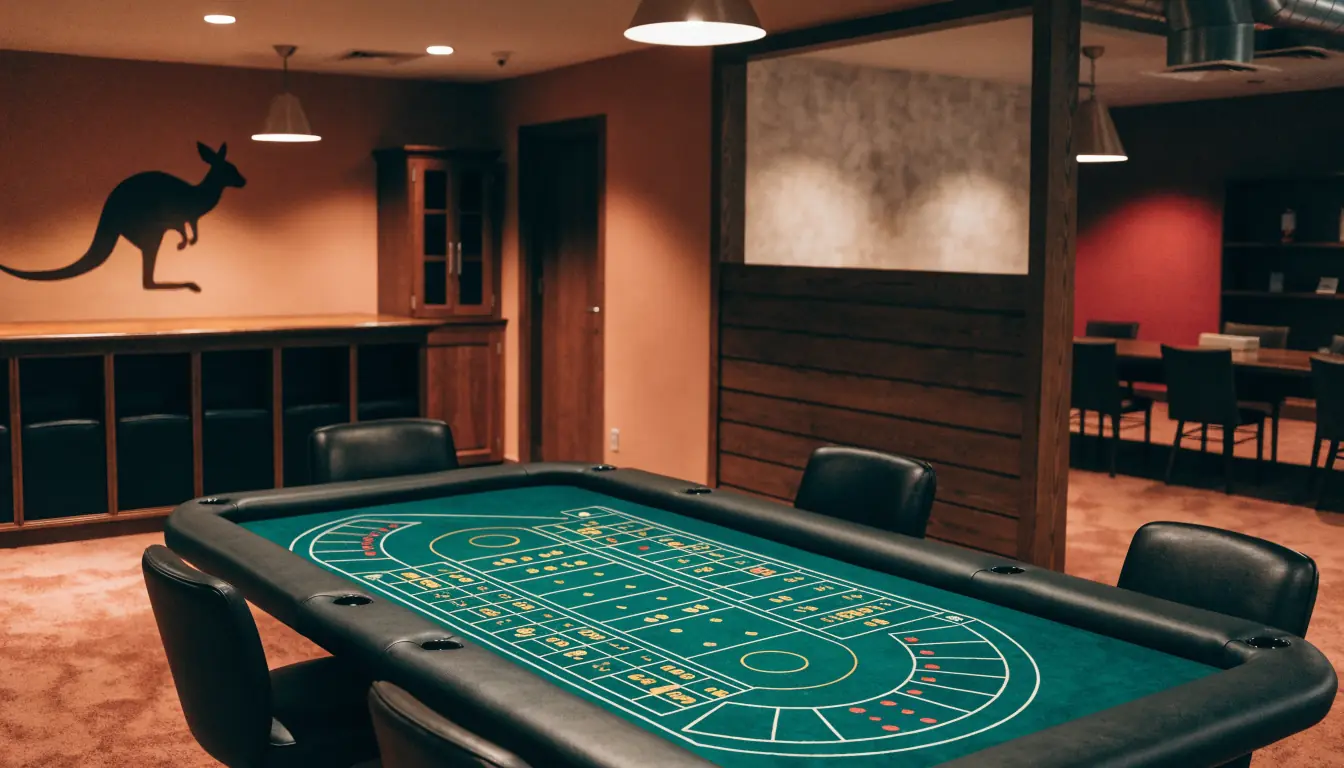
What follows from this
For an Australian resident, the practical position is unchanged by game design. Hybrid dice games sit in the same legal category as pure dice games and every other online casino product: offered illegally from offshore platforms, with the prohibition directed at the operator, not the player. Reading a game’s description for its mechanics is worthwhile; reading it for a legal distinction is not, because no such distinction exists.
What Types of Casino Games Use Dice?
A casino dice game, in the strict sense, is any casino product where the dice themselves generate the outcome — the player’s wager is settled on the roll, and nothing else. A looser sense includes games where dice sit inside a larger mechanism: a bonus round, a side bet, a randomiser layered over cards or reels. The distinction is not cosmetic. Under Australian law, both categories fall inside the definition of casino-style interactive gambling, and both are prohibited from being offered online to Australian residents under the Interactive Gambling Act 2001 — regardless of whether dice do all the work or only part of it.
Games where dice decide everything
These are the pure forms. The roll of the dice is the entire game:
- Craps — the classic table dice game; the shooter rolls, and the whole table bets on sequences of outcomes.
- Sic Bo — a game of Chinese origin where three dice are rolled and players bet on totals, combinations and specific numbers.
- Chuck-a-luck — a simpler three-dice variant built around betting on individual numbers.
- Dice duels and proprietary dice games — head-to-head or multiplier-style formats where the dice alone determine the result.
In each of these, remove the dice and nothing remains. There is no board state, no card hand, no reel position that matters independently.
Games where dice are a secondary mechanic
Here the dice are a component, not the game:
- Hybrid table products that use dice alongside cards to resolve a hand or trigger a bonus.
- Electronic and pokies-style formats where a dice roll appears as a bonus feature or a randomised multiplier on top of the base game.
- Lottery-style draws where numbered balls or dice are used as the drawing mechanism — though these sit in a different licensing category from casino games.
The wager in these products is not on the dice as such. It is on the combined outcome, of which the roll is one input.
Why the distinction doesn’t change the legal position
From a regulator’s standpoint, the classification makes little practical difference. The Australian Communications and Media Authority (ACMA) enforces the Interactive Gambling Act 2001 against prohibited interactive gambling services — a category defined by the nature of the product, not by which randomisation device it uses. A dice-themed game, a dice-mechanics game and a pokie with a dice bonus are treated alike. ACMA can request internet service providers to block sites offering such games, issue letters to software developers and third parties believed to be ancillary to a contravention of the Act, serve warning notices, and refer matters to the Australian Federal Police where illegal gambling products are offered in Australia.
The practical upshot: the question "which casino game uses dice" has a short answer — craps, Sic Bo, chuck-a-luck and their derivatives, plus a range of hybrids — but for an Australian player accessing anything online, the mechanism inside the game changes nothing about who may lawfully offer it.
Core Rules of Popular Casino Dice Games
The rule sets behind dice games are short by casino standards, which is part of their appeal. The differences between them are also what place them on different sides of the Australian regulatory line, since no domestic licence exists for any real-money online casino product.

Craps
The game runs in two phases. On the come-out roll, a pass line bet wins on a 7 or 11 and loses on a 2, 3 or 12. Any other total becomes the point, and the shooter keeps rolling until that point repeats (a win) or a 7 appears (a loss). Don’t pass bets take the opposite side. Proposition bets in the centre of the layout pay more and lose more often — the house edge is the price of the simplicity.
Sic Bo
Three dice, one roll. Players bet on totals, doubles, triples and combinations displayed on a layout, and the croupier reveals the result. There is no shooting, no phases and no decisions after the bet is placed — a random number game in its purest form.
Hybrid dice products
Proprietary online titles built around a single die or a pair typically reduce the mechanic further: pick an outcome, watch the roll, settle. Nothing in the rule set distinguishes them from pokies in regulatory terms — under the Interactive Gambling Act 2001, the prohibition covers online casino games as a category, not by mechanics.
That distinction matters for regulators, not players. The IGA targets operators offering these games to Australians; it does not criminalise the individual placing the bet. The rules of craps and Sic Bo travel unchanged to offshore platforms — the legal weight sits entirely on whoever runs the table.
Live Dice Games: Availability and Legal Status
Live dealer dice games — craps and Sic Bo streamed from a studio with a croupier on camera — sit in the same legal category as every other online casino product in Australia. The Interactive Gambling Act 2001 prohibits offering online casino games to Australian residents, and there is no domestic licence an operator could hold to run them lawfully. Whatever live dice tables Australians encounter online are hosted by offshore operators, and the law targets those operators, not the individual player.

The regulator with enforcement power here is the Australian Communications and Media Authority (ACMA). It can request internet service providers to block websites offering games not permitted under Australian law, and live dealer casino content falls squarely within that scope. This is distinct from sports betting: live in-play wagering online is prohibited while the same bet placed by phone is legal, a split that applies to wagering on events, not to dice tables.
One distinction worth recording: what is blocked is the offering, not the rolling. An offshore live dice stream keeps functioning until ACMA’s blocking notices catch up with the domain.
Where Do Players Actually Roll the Dice in Australian Casinos?
Physically, dice are rolled on the floors of land-based casinos, which sit under state and territory regulators — the same bodies that license poker machines and table games in each jurisdiction. A craps table in a Melbourne or Sydney casino is a state-regulated product, and the regulatory chain ends there.
Virtually, the situation is different. Every online venue offering a dice game to Australians operates from offshore, because a domestic online casino licence does not exist under the Interactive Gambling Act 2001. The website hosting the roll is licensed elsewhere, often in a foreign jurisdiction.
The two settings carry different consequences for the player. On a casino floor, a dispute goes to the state regulator. Offshore, it goes nowhere official: the Australian Communications and Media Authority (ACMA) can investigate and block prohibited interactive gambling services, but it cannot recover funds or settle individual disputes with offshore operators. Its leverage runs toward the operator — civil proceedings, notifications to border protection agencies about directors, liaison with foreign regulators — not toward restitution.
So the dice are rolled in two places, but only one of them has an Australian regulator standing behind the table.
Are crypto casinos legal in Australia in 2026?
No. It is illegal to offer online casino gambling in Australia under the Interactive Gambling Act 2001, and no domestic licence for an online casino — crypto or otherwise — can be obtained. However, individual Australians who play at offshore-licensed casinos commit no offence under Commonwealth law, since the statute targets operators, not players.
Can I legally play online craps or Sic Bo in Australia?
You won’t be prosecuted for playing. The Interactive Gambling Act 2001 makes it illegal to provide online casino games to Australians, but it targets operators, not players, so playing dice games at an offshore casino carries no legal consequence for you under Commonwealth law.
Who regulates online gambling in Australia?
There is no single overarching gambling authority. The federal regulator ACMA enforces the Interactive Gambling Act 2001 against offshore online casinos, while each state and territory has its own regulator for land-based gambling — including craps and Sic Bo tables in physical casinos.
Can ACMA block online casino sites in Australia?
Yes. Since November 2019 ACMA has ordered internet providers to block illegal offshore gambling sites — 1,296 illegal gambling and affiliate websites as of August 2025 — and over 220 illegal services have voluntarily exited the Australian market due to its enforcement actions.