
$2 Minimum Deposit Casino Australia: How It Works
 Available in AU
- What $2 Deposit Online Pokies and Slots Mean in Australia
- Australian Online Casinos: Licensing, Regulation and Player Protection
- $2 Minimum Deposit for Australian Online Pokies and Bitcoin Options
- $2 Casino Deposit Mechanics and Limits
- $2 Deposit Pokies: Which Games Accept the Minimum
- Mobile $2 Deposit Casinos in Australia
- Finding the Best $2 Deposit Casinos in Australia
- Understanding $2 Minimum Deposit Options at Australian Casinos
- $2 Dollar Deposit Casinos – What to Expect
- $2 Deposit for New Players – Bonuses and Restrictions
What $2 Deposit Online Pokies and Slots Mean in Australia
A two-dollar deposit sits at the bottom edge of what online casinos in Australia will accept as a real-money transaction. It is not a marketing gimmick or a rounding error: it is a defined entry point into pokies and slots play, with its own mechanics, its own set of accepted payment methods, and its own limitations. This section explains what that entry point actually is, how it relates to the broader category of low deposit casinos, and what it buys in terms of game access — before any discussion of regulation, bonuses or specific operators.
Where $2 Sits on the Low-Deposit Scale
Low deposit casinos in Australia form a spectrum rather than a single product category. The term covers operators whose minimum deposit falls between $1 and $20, and first deposits at low deposit online casino sites generally start from $1 to $10. A $2 minimum deposit therefore sits comfortably inside the established range — close enough to the floor that it qualifies as an ultra-low entry amount, but not so extreme that it requires an operator running a novelty promotion.

That placement matters for a simple reason: a $2 threshold is low enough to be reachable by every payment method an operator supports, while $1 thresholds are sometimes restricted to a narrower set of deposit options. The difference between one dollar and two dollars is rarely about the games — it is about which banking channels can process the transaction without the operator losing money on processing fees.
The practical meaning of the $2 figure is straightforward. It is the smallest amount an Australian player can load into an account and still have that balance count as real money, playable on pokies and slots for genuine cash returns. Everything that follows — wagering, winning, withdrawing — operates on the same legal and financial rails as a $200 deposit. The amount is small; the transaction is not a different kind of transaction.
Real-Money Play at the Two-Dollar Level
The phrase "real money" deserves precision here, because it is the part of the arrangement that separates a $2 deposit from free play. When a player deposits $2 into an offshore-licensed online casino that accepts Australian players, that balance is denominated in actual currency. Spins on pokies deduct from it, wins add to it, and the resulting balance can be withdrawn once the operator’s withdrawal conditions are met.

Low-deposit pokies in Australia allow real-money play with minimal deposit amounts — that is the defining feature of the category, not an occasional side benefit. The deposit does not buy demo credits, play money or a locked trial balance. It buys the same spin, on the same game, with the same theoretical return, that a high-roller’s balance buys. The random number generator does not check the size of the wallet behind the bet.
What the small deposit changes is scale, not status. A $2 balance supports a session of low-stakes spins; it does not support sustained high-stakes play. Whether that session is worthwhile depends on the per-spin cost of the games involved, which is where pokies and slots show their particular suitability for this deposit level.
Why Pokies and Slots Fit a Two-Dollar Deposit
Pokies are the natural home of low-deposit play for a structural reason: minimum deposits for low-deposit pokies in Australia can be as low as AUD 0.01 per line. A game that accepts wagers of one cent per line turns a $2 deposit into a bankroll measured in dozens, potentially hundreds, of individual spins. Table games rarely work this way — their minimum bets are typically set at levels that would exhaust a $2 balance within a handful of hands.

The per-line pricing model is worth understanding, because it explains how the maths of a small deposit plays out. A pokie with multiple paylines lets the player choose how many lines to activate and how much to stake on each. A conservative configuration — fewer lines, minimum per-line stake — stretches the deposit across many spins. An aggressive configuration burns through the same deposit in minutes. The deposit amount is fixed; the burn rate is a player decision.
This is also why the distinction between "pokies" and "slots" carries little practical weight in this context. The terms refer to the same class of game; "pokies" is simply the word Australian usage settled on. The mechanics — spinning reels, paylines, per-line stakes, return percentages — are identical, and both accept the same range of stake sizes that makes a $2 deposit viable. An online casino advertising itself as a $2 deposit destination is, in almost every case, advertising a pokies-and-slots destination, because those are the games the maths supports.
A $2 deposit can be lost quickly on low‑stakes pokies; players should only wager money they can afford to lose.
Low-deposit pokies have also shown a particular durability in this role: they have demonstrated resilience during economic downturns, offering entertainment with minimal financial commitment. A $2 deposit is an entertainment purchase on the scale of a coffee, and the games that service it are built around exactly that scale of spending.
What the Deposit Buys — and What It Doesn’t
A $2 deposit is best understood as a specific purchase with specific boundaries.
It buys:
- Access to real-money pokies and slots. The full game library available to any depositing player, subject only to each game’s own minimum stake.
- A genuine balance. Wins are credited as real money and enter the same withdrawal process as wins from any other deposit.
- A testing position. For a player assessing an unfamiliar operator, $2 is the cheapest possible way to verify that deposits register, games load, and the platform behaves as described — with real money on the line rather than demo credits.
It does not buy:
- High-stakes play. The balance supports low-stakes spins; that is the entire design of the category.
- Guaranteed bonus eligibility. Whether a $2 deposit triggers any welcome offer depends on the operator’s bonus terms — a matter covered separately, and one on which operators set their own thresholds. It is worth stating plainly: the bonus conditions attached to small deposits vary between operators, and the terms of each specific offer are the only reliable source on what a $2 deposit unlocks at that operator.
- Immunity from withdrawal conditions. Winnings from a $2 deposit are subject to the same identity verification and withdrawal requirements as any other funds.
The honest framing of the $2 deposit is that of a low-commitment entry into real-money play, not a shortcut to anything. The amount limits the downside; it does not alter the odds, the mechanics, or the obligations attached to the account.
Payment Methods That Support a Two-Dollar Transfer
A $2 deposit is only as accessible as the payment channels that will process it, and this is one area where low-deposit casinos in Australia show a consistent pattern. Supported payment methods include PayID, Neosurf, POLi, Visa, Mastercard, and cryptocurrency.

Each of these handles small transfers differently, and the differences matter at the two-dollar level:
- PayID processes bank transfers using a payer identifier rather than account numbers, which suits small repeat transactions.
- Neosurf is a prepaid voucher system — buying a voucher for a fixed small amount and redeeming the code at the casino sidesteps card details entirely.
- POLi facilitates direct online banking payments without a credit card.
- Visa and Mastercard provide the standard card route, though card processing has minimum viable transaction sizes of its own.
- Cryptocurrency offers transfers that are not tied to a card or bank intermediary, which some operators position as suited to small deposits.
The relevant point for this section is not a comparison of speed or fees — that belongs to the detailed treatment of deposit options — but the fact that a $2 deposit is processable through every major channel the low-deposit sector supports. The transaction size does not exclude a player from any of the standard payment categories. Which specific method an operator pairs with its $2 minimum is set per operator, and the deposit page of the platform is the authoritative source on that pairing.
The Two-Dollar Threshold and the Wider Market
Setting the $2 figure in context clarifies what kind of product it represents. Below roughly this level, operators are running $1 minimums — the absolute floor of the market, where the range of workable payment methods narrows and the offer becomes more of a specialist proposition. Above it, the market thickens quickly: deposits from $5 and $10 open a wider selection of operators and, at some platforms, eligibility for welcome bonuses, since bonus terms at various operators attach minimum deposit requirements above the $2 mark — one industry review of a major operator, for instance, records a $10 minimum attached to its welcome package, while another lists $5 as its bonus-qualifying threshold.
The $2 position is therefore the point where a deposit is small but not exceptional. It is low enough to serve the player whose budget is genuinely two dollars, and high enough to be processed through mainstream banking channels without special arrangements. That combination — minimal commitment, full payment-method access, real-money status, and full library of low-stake pokies — is what defines the category this page examines.
What This Section Does Not Cover
Precision about scope prevents confusion with the sections that follow. This section has defined what a $2 deposit is and why pokies and slots are the games built for it. It has deliberately not addressed:
- the regulatory and licensing framework under which online casinos operate in Australia — the legal context, including the fact that no domestic online casino licences exist, is covered in the next section;
- the specific mechanics of processing a $2 deposit, wagering requirements attached to bonuses, and transaction limits;
- which named pokies accept the minimum stake at this level;
- mobile-specific deposit options;
- the criteria for distinguishing a worthwhile $2 deposit operator from a poor one.
Each of those subjects has its own treatment, and the $2 threshold interacts differently with each. What holds constant across all of them is the foundation established here: two dollars is a real-money deposit at the ultra-low end of an established market range, and pokies — with their per-line minimum stakes reaching down to a single cent — are the game type engineered to make that deposit playable.
A Note on Expectations
The final word belongs to arithmetic rather than enthusiasm. A $2 deposit buys a low-stakes session on real-money pokies, processed through standard payment channels, with winnings subject to standard withdrawal conditions. The deposit level does not change the games, the odds, or the operator’s obligations. It changes only the amount at risk — which is, for the player choosing this category, precisely the point.
Australian Online Casinos: Licensing, Regulation and Player Protection
A $2 minimum deposit casino in Australia operates inside a regulatory system that is more layered than most players assume. There is no single overarching statute and no single overarching gambling authority for the country: gambling is regulated at both the state/territory level and the federal level, and the two layers do different jobs. Understanding who regulates what determines what any licence displayed by an online casino actually means — and what it does not.

The Commonwealth framework
The Interactive Gambling Act 2001 (IGA) is the primary Commonwealth law governing online gambling in Australia. It was introduced to protect the public, with an explicit focus on harm minimisation. The Australian Communications and Media Authority (ACMA) is the federal regulator that enforces the IGA.
The Act’s central prohibition is straightforward: it is illegal to offer online casino gambling to Australian residents. Slots, poker, blackjack and roulette in their online casino form fall under this prohibition. It is also not possible to obtain a licence to operate an online casino domestically — there are no domestically licensed real-money online casino operators available to Australian players. That last point deserves emphasis, because it reshapes how every claim about "licensed Australian casinos" should be read.
One caveat on the legislative history. Most references cite the Interactive Gambling Act 2001 as the law prohibiting online casino games for Australian residents. Some sources instead date that prohibition to an Interactive Gambling Act 1997. The sources disagree on the year; they do not disagree on the substance — the prohibition on providing online casino games to Australian residents exists and is enforced. The discrepancy is worth noting precisely because the rest of this framework is unusually well documented.
What the IGA targets — and what it does not
The IGA targets operators, not players. It is not illegal for individual Australians to play at offshore-licensed online casinos. The legal risk sits with the entity offering the service, not the person depositing $2 into it. This distinction is the legal foundation on which the entire low-deposit offshore market rests.
Illegal Offering
Offering real‑money casino games to Australian residents breaches the Interactive Gambling Act 2001 and can result in enforcement action against the operator.
The Commonwealth rules also draw a line between product types. Online sports betting is legal in Australia under state and territory licences. Online casino games, poker and in-play betting are prohibited federally. Live (in-play) online betting is illegal, though live betting placed by phone is legal — an artefact of how the prohibition was drafted that persists today.
The state and territory layer
Each Australian state and territory has its own separate gambling regulator. These bodies licence and supervise what can legally be offered domestically: sports betting, lotteries, and land-based gambling. Within that group, the Northern Territory Racing Commission (NTRC) functions as Australia’s de facto online gambling regulator, because it licences most national online bookmakers, who benefit from the Territory’s lower tax settings.
None of these state or territory bodies issues online casino licences, because no such licence exists to issue. When a site accepting $2 deposits advertises itself to Australian players as "licensed and regulated," the licence in question is therefore issued by a foreign jurisdiction, not by any Australian authority. ACMA and state-specific regulators provide oversight in the sense of enforcement — investigating complaints, acting against prohibited services — rather than in the sense of supervising casino operators the way the NTRC supervises bookmakers.
Why this matters for player protection
Player protection in Australia runs through harm minimisation rather than through a domestic licensing regime for casinos. The practical consequences for anyone considering a $2 deposit casino in Australia for real money:
- No domestic licence to verify. Advice commonly given on other markets — “check the operator’s licence in the public register” — has no equivalent here, because no Australian online casino register exists. A foreign licence cannot be checked against any Australian registry.
- Enforcement, not supervision. ACMA’s role includes acting against prohibited online gambling services offered to Australians. It regulates the boundary of what may be offered, not the conduct of offshore operators.
- Legal asymmetry. The operator offering casino games to Australians is breaking Australian law; the Australian resident playing at an offshore site is not. This is the single most consequential legal fact for a low-deposit player.
- Age restrictions apply regardless of operator location. The minimum legal gambling age in Australia is 18. Offshore sites that fail to enforce age verification are not merely unregulated — they are operating outside every framework that exists for this market.
- Payment restrictions. Australian market rules prohibit accepting credit cards for gambling deposits. A site soliciting card details for a $2 deposit is asking for something the domestic framework does not permit.
What a licence claim actually tells a player
Since there are no domestically licensed online casino operators, a "fully licensed and regulated" claim by a low-deposit casino serving Australians refers entirely to an offshore licence. That licence may be genuine, but it is not backed by any Australian regulator, any Australian complaint mechanism, or any Australian dispute resolution body. The protections a player relies on are the protections of the licensing jurisdiction — whatever they are — plus the general application of the IGA’s prohibition to the operator.
The honest position is this: the regulatory framework in Australia sets clear boundaries around online gambling, but it does not supervise the offshore casinos that accept small deposits from Australian players. A $2 deposit is a small amount, but the regulatory gap it falls into is not a small one. The law is unambiguous about who bears the legal risk; it is equally unambiguous that it is not the player.
$2 Minimum Deposit for Australian Online Pokies and Bitcoin Options
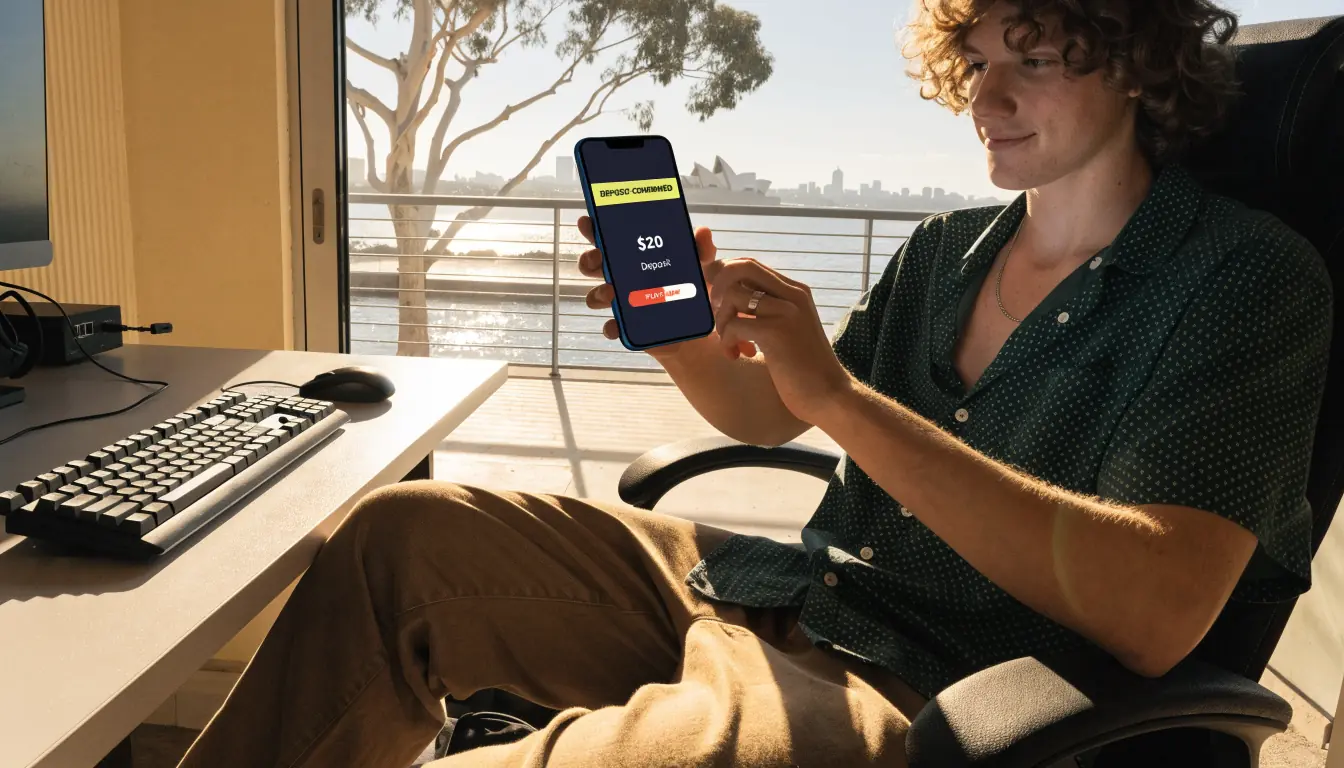
A $2 deposit sits at the very bottom of the low deposit casino range. In Australia, low deposit online casino sites allow first deposits from $1 to $10, so a $2 entry amount is not an anomaly of the market — it is one end of an established scale. What makes the $2 tier worth a separate look is not the amount itself but the mechanics around it: which payment rails can actually move two dollars without fees swallowing the transaction, and whether pokies — the game category most Australians deposit for — treat that amount differently from the rest of the casino floor.
Why pokies are the natural fit for a $2 deposit
Low-deposit pokies allow real-money play with minimal deposit amounts, and the per-spin economics work in favour of small balances. Minimum stakes on low-deposit pokies in Australia can go as low as AUD 0.01 per line, which means a $2 deposit funds a meaningful number of spins even on games with multiple active paylines. A table game minimum bet would exhaust the same deposit in a handful of rounds; pokies stretch it. That asymmetry explains why the $2 deposit tier and the pokies category grew up together.
There is also a broader pattern behind this. Low-deposit pokies have shown resilience during economic downturns, offering entertainment with minimal financial commitment. When household budgets tighten, a two-dollar outlay is a decision that requires no budget review — and the demand for that entry level keeps the tier alive even when the wider gambling market contracts.
The payment methods that carry a $2 deposit
The supported payment methods for Australian low deposit casinos include PayID, Neosurf, POLi, Visa, Mastercard, and cryptocurrency. Not all of them are equally suited to a $2 transaction, and the differences are practical rather than cosmetic.
- PayID moves money directly from an Australian bank account and is the closest thing to a purpose-built rail for small local transfers.
- Neosurf is a prepaid voucher, which removes the need to attach a bank card to a casino account at all — a relevant consideration at any deposit level.
- POLi works as an online banking gateway, where it is still offered; its availability has narrowed over time.
- Visa and Mastercard work, but card networks treat gambling transactions as a specific merchant category, which is worth knowing before relying on a card for recurring small deposits.
- Cryptocurrency rounds out the list and behaves differently from every other method on it — see below.
For a two-dollar deposit, the practical question is whether the payment method imposes its own floor. A card or bank rail that charges a fixed processing cost per transaction eats a disproportionate share of a $2 transfer, which is why voucher and instant-banking methods carry disproportionate weight at this tier.
Bitcoin and other crypto options
Cryptocurrency has a structural appeal for small deposits: transfers sit outside the card networks and the banking system’s gambling-merchant classification, and the deposit is not tied to a personal card. For players depositing two dollars at a time, that separation is the main draw — not speed or cost alone, which vary by network and operator.
Two caveats apply, and both belong in any honest description of this option.
First, the regulatory position. Australia prohibits the provision of online casino games to residents under the Interactive Gambling Act 2001; there are no domestically licensed real-money online casino operators. Sites accepting Australian players, whether for fiat or crypto deposits, operate from offshore licences. It is not illegal for an individual Australian to play at such sites — the law targets operators, not players — but no domestic regulator stands behind the transaction, whichever currency carries it. There is no local licence to verify and no public register of approved casino operators, so the standard advice to "check the licence" has no local object here; the licence that exists is foreign, issued under a foreign regime.
Cryptocurrency deposits are processed outside regulated payment rails, meaning there is no charge‑back or local dispute mechanism if something goes wrong.
Second, the payment-method restrictions that do exist in Australian gambling regulation are pointedly not crypto-friendly. The framework here prohibits accepting credit cards or digital currencies for deposits or betting on services that fall inside it. Crypto deposits at online pokies sites therefore live entirely on the offshore side of the market — legal for the player to make, but outside every consumer protection that regulated payment rails carry. A two-dollar Bitcoin deposit is cheap entertainment only until something goes wrong with it; at that point there is no chargeback, no bank dispute process and no local authority to appeal to.
What a $2 deposit actually buys
Once deposited, the balance is not fenced off from the rest of the platform. Licensed casinos serving the Australian market offer online slots, table games, live dealer games, sports betting, and lotteries — and a deposit made to play pokies is, in most setups, a general account balance. The $2 tier is defined by the deposit and the game economics, not by a separate product. The practical consequence: the choice between depositing for pokies and depositing for anything else on the same site is a budgeting decision, not a technical one.
The one dry footnote to all of this: the payment method debate at a $2 deposit level is, in monetary terms, a conversation about the price of a coffee. The reason it matters anyway is that the same rails carry the withdrawals, and the withdrawal is where a small-balance player’s actual interests sit.
$2 Casino Deposit Mechanics and Limits
A $2 casino deposit follows the same processing chain as any larger deposit: the player selects a payment method, enters the amount, and the operator credits the balance once the payment provider confirms the transaction. What distinguishes a two-dollar deposit is not the mechanics but the thresholds attached to it — the minimum the cashier accepts, the methods that still clear at that amount, and the wagering a bonus carries once the credit lands.
How the deposit is processed
Payment methods listed for Australian low deposit casinos include PayID, Neosurf, POLi, Visa, Mastercard, and cryptocurrency. Not every method clears at a $2 floor. Card processing involves fixed per-transaction fees on the acquiring side, which is why some operators set the card minimum above the headline figure and keep the lowest threshold for voucher or crypto deposits. The cashier page states the per-method minimum; the advertised casino minimum of $2 applies only to the methods that support it.
The deposit itself is near-instant once the provider confirms it. Withdrawals are a separate transaction with separate rules: identity verification with a government-issued ID precedes any withdrawal, and the verification documents, not the deposit size, determine how quickly the money moves back out.
Wagering requirements on a $2 bonus
Wagering requirements for low deposit casino bonuses in Australia range between 20x and 50x. On a two-dollar balance the arithmetic is blunt: at the bottom of that range, a $2 bonus must be turned over twenty times before anything withdrawable exists; at the top, fifty times. The requirement applies to the bonus amount, and winnings generated from it remain locked until the turnover is complete. Operators are required to display wagering requirements clearly before a bonus is offered — the terms belong on the offer itself, not in a footnote discovered after the deposit.
A $2 deposit that arrives without a bonus carries no turnover condition at all. The trade-off is straightforward: the bonus buys attempts, the condition buys the operator time.

The legal limits
The deposit limit that matters most is not on the amount but on the operator. Under the Interactive Gambling Act 2001, online casino games — slots, poker, blackjack, roulette — cannot be lawfully offered to Australian residents. No domestic licence for an online casino exists, and it is not possible to obtain one. There are no domestically licensed real-money online casino operators available to Australian players.
The law targets operators, not individual players, so the $2 deposit itself is not the player’s legal problem. It does mean, however, that every casino accepting that deposit operates under an offshore licence, outside the enforcement reach of Australian regulators. A two-dollar loss ceiling limits the financial exposure; it does not change who is holding the money.
$2 Deposit Pokies: Which Games Accept the Minimum
A $2 deposit is made to the casino account, not to a specific game — so the real question is which pokies can be played meaningfully once that $2 sits in the balance. The answer is determined by two separate minimums: the deposit threshold set by the operator, and the per-spin or per-line cost set by the game. Low-deposit pokies in Australia allow real-money play with minimal deposit amounts, and minimums can run as low as AUD 0.01 per line, which makes a $2 balance workable across a wide range of titles.
Titles that suit a $2 balance
The games below are the ones most commonly associated with low-deposit play. Verified per-game minimums or RTP figures are not published in a form that can be cited here, so the list names titles without attributes that would have to be invented:
- Big Bass Bonanza — a fishing-themed pokie frequently featured on low-deposit platforms.
- Buffalo King — a wildlife-themed title popular with budget players.
- Lightning Link — a progressive franchise with adjustable line play.
- Starburst — a low-frills title long associated with small-stakes play.
- Wolf Gold — a fixed-line pokie widely available across offshore operators.
None of these names comes with an official per-line cost attached in public sources; what is documented is that per-line minimums on low-deposit pokies can reach AUD 0.01, which is the mechanism that makes a $2 session possible at all.
One legal caveat worth repeating
None of these titles is offered by a domestically licensed Australian operator, because no such licence exists — online casino games are prohibited under the Interactive Gambling Act 2001, and the law targets operators rather than players. Any platform offering these pokies to Australians is offshore-licensed. Low-deposit pokies have shown resilience during economic downturns precisely because the financial commitment is minimal, but "minimal" is not "free": a $2 balance on a game with per-line minimums depletes at the pace the game’s paytable dictates, and that paytable is the only number that matters after the deposit clears.
Mobile $2 Deposit Casinos in Australia
A $2 deposit made from a phone works through the same cashier as a desktop deposit. What changes on mobile is the set of payment methods a player realistically reaches for, and how the game library is delivered.
Payment methods on mobile
Australian low-deposit casinos that accept small payments support PayID, Neosurf, POLi, Visa, Mastercard and cryptocurrency. On a phone, the practical differences between these methods matter more than on a desktop:
- PayID and POLi run through Australian banking rails, so a $2 transfer confirms against an existing bank app rather than a form filled in a browser.
- Neosurf is a prepaid voucher: the code is typed in manually, which is slower on mobile but requires no card or bank credentials to be entered on the casino site.
- Visa and Mastercard work through a card form or a device wallet prompt, depending on the platform.
- Cryptocurrency deposits bypass card entry entirely; the mobile wallet app handles the transaction on its own.
The method determines whether a $2 deposit is even possible. Some payment rails carry processing overhead that makes a transaction this small uneconomical for the operator, so the minimum deposit listed in the cashier can differ by method even on the same platform. The published minimum is the platform’s figure; the per-method minimum is what the player actually encounters.
Game availability
The desktop catalogue and the mobile catalogue are not identical. Games built in older formats or with heavy live-streaming components may load on desktop only. Live dealer games, table games and pokies from the current generation are the titles most commonly ported to mobile, where they run in the browser or through the operator’s app. Licensed operators offering slots, table games, live dealer games, sports betting and lotteries tend to expose most of that range on mobile, but not necessarily all of it.
For a $2 bankroll the practical consequence is simple: verify on the phone itself that the games worth playing at a two-dollar balance load and accept low per-spin stakes before counting on them. A deposit method that works in the browser and a game that does not open on the device is not a functioning combination.
Finding the Best $2 Deposit Casinos in Australia
If you’d rather test the waters than dive in headfirst, a low minimum deposit lets you explore a casino’s games and features without committing much upfront — here’s a rundown of options worth a look.
License: Curacao Gaming Control Board OGL/2023/174/0082 (Dama N.V.) · Bonus: up to A$5,000 + 300 free spins across 4 deposits Operating under a Curacao Gaming Control Board license held by Dama N.V., this casino offers a multi-deposit welcome package worth up to A$5,000 plus 300 free spins spread across four deposits.
License: Curacao Gaming Authority (Jumpman Gaming Ltd) · Bonus: up to A$6,600 + up to 250 free spins across 4 deposits Licensed via the Curacao Gaming Authority under Jumpman Gaming Ltd, it backs its offering with a sizeable welcome bonus of up to A$6,600 and up to 250 free spins across four deposits.
Bonus: 240% up to A$4,100 + 300 free spins Stands out for a generous 240% match bonus up to A$4,100 alongside 300 free spins, making its welcome offer one of the more eye-catching on this list.
License: Curacao eGaming OGL/2023/174/0082 (Dama N.V.) · Bonus: up to A$10,000 + 500 free spins across 4 deposits · Min. deposit: A$15 Licensed through Curacao eGaming under Dama N.V., it pairs a low A$15 minimum deposit with a substantial welcome package of up to A$10,000 and 500 free spins over four deposits.
License: Curacao Gaming Control Board OGL/2023/176/0095 (Hollycorn N.V.) · Bonus: up to A$5,000 + 300 free spins across 4 deposits Holding a Curacao Gaming Control Board license under Hollycorn N.V., it offers a welcome bonus of up to A$5,000 plus 300 free spins spread over four deposits.
License: Curacao Gaming Control Board OGL/2023/176/0095 (Hollycorn N.V.) · Bonus: up to A$1,500 + 200 free spins across 3 deposits Also licensed by the Curacao Gaming Control Board via Hollycorn N.V., it keeps things more modest with a bonus of up to A$1,500 and 200 free spins across three deposits.
License: Curacao eGaming OGL/2024/923/0383 (Antillephone N.V.) · Bonus: up to A$2,000 + 100 free spins across 2 deposits · Min. deposit: A$30 Licensed under Curacao eGaming through Antillephone N.V., it requires a A$30 minimum deposit and offers up to A$2,000 plus 100 free spins across two deposits.
Bonus: up to A$750 + 50 jackpot spins, 35x wagering · Payout speed: crypto ~90 minutes, fiat 1-5 days · Min. deposit: A$30 Requires a A$30 minimum deposit and offers up to A$750 plus 50 jackpot spins with 35x wagering, with payouts noted as roughly 90 minutes for crypto and one to five days for fiat.
License: Curacao · Bonus: up to A$2,000 Licensed in Curacao, this casino offers a welcome bonus of up to A$2,000 for new players.
License: Curacao Gaming Control Board (TechSolutions Group N.V.) · Bonus: 100% up to A$250 + 100 free spins (1st deposit) Licensed under the Curacao Gaming Control Board via TechSolutions Group N.V., it offers a first-deposit bonus of 100% up to A$250 plus 100 free spins.
A search for the best $2 deposit casino in Australia returns long lists of operators, but the list itself is the least useful part. What matters is the set of criteria behind it, because a $2 deposit does not change the obligations attached to real-money play — it only lowers the entry point.
Regulation comes first, and it has a twist. There are no domestically licensed real-money online casino operators in Australia: the Interactive Gambling Act 2001 prohibits offering online casino games, and no licence for such a service can be obtained domestically. Offshore sites that accept Australians operate under foreign licences. A site advertising an "Australian casino licence" for pokies is therefore stating something that does not exist. What can be checked instead is the offshore regulator named in the site’s terms and the operator’s own stated licence details — bearing in mind that offshore licensing varies widely in rigour.
Direct bank transfer using a payer identifier; ideal for small, repeat $2 deposits.
Prepaid voucher that avoids sharing card or bank details; works well for low‑value transactions.
Online banking gateway that connects directly to Australian banks; supports $2 deposits but availability is decreasing.
Standard card route; may impose higher minimums or fees that eat into a $2 deposit.
Off‑shore digital currency transfer; no local consumer protection but no card‑network restrictions.
Payment methods tell you how realistic the minimum is. Australian low deposit casinos support PayID, Neosurf, POLi, Visa, Mastercard and cryptocurrency. A genuine $2 minimum holds across at least some of these methods. Where a casino claims a $2 floor but every listed method except one carries a higher threshold, the headline minimum is a marketing figure rather than a working option.
Wagering requirements decide whether a bonus attached to $2 is worth anything. Typical requirements for low deposit bonuses in Australia run between 20x and 50x. The number itself is standard; what separates operators is whether it is displayed before the bonus is claimed or discovered afterwards. Terms published up front are a precondition, not a courtesy.
What cannot be verified should be stated as such. There is no public register of approved casino operators for this market, and no regulator publishes a ranking of low-deposit sites. Any "best" list is the opinion of whoever compiled it. The verifiable facts — payment methods, stated minimums, wagering terms, the licence the operator claims — are all a player can actually check. Everything else is advertising.
Understanding $2 Minimum Deposit Options at Australian Casinos
A $2 minimum sits at the lower end of what the Australian low deposit casino market offers. Across operators in this segment, minimum deposits run between $1 and $20, with first deposits at low deposit online casino sites starting from as little as $1 and reaching $10. A $2 floor is therefore not an outlier — it is a recognised point on a scale that spans one-dollar entries at the bottom and $20 at the top.
Where $2 sits among the thresholds
The practical difference between a $1 and a $10 entry point is narrow in absolute terms but real in structure:
- $1–$2 thresholds exist to remove friction. They target players whose goal is to test a platform’s banking and games with money they can afford to lose outright.
- Thresholds up to $10 are more common as qualifying deposits for bonuses, since promotional terms are usually written around amounts a $2 deposit cannot reach.
- Amounts up to $20 function as the standard low end of the wider casino market, where $2 options start to look like an exception rather than a category.
An operator offering a $2 minimum is making a deliberate trade: lower entry revenue against a wider base of cautious depositors.
Payment method as the deciding factor
The stated minimum is not always the effective one. A casino may advertise a $2 floor while its banking page sets different minimums per method — PayID, Neosurf, POLi, Visa, Mastercard and cryptocurrency each carry their own processing floor, and the lowest of these defines what a player can actually deposit. A $2 deposit via PayID can succeed at a platform where the same $2 by card is rejected at the cashier.
What the range does not tell you
Two operators with identical $2 minimums are not interchangeable: bonus eligibility, wagering terms and game access are set separately from the deposit floor. The minimum answers only one question — the cheapest way in — and none of the questions that follow the money.
$2 Dollar Deposit Casinos – What to Expect
A two-dollar deposit sounds like the smallest possible commitment an online casino can ask for, and in practice it is close to that floor. Low deposit casinos in Australia sit in the $1 to $20 range, and a $2 entry sits near the bottom of it. What that money buys, and what it does not, is worth setting out before anyone types a card number into a cashier page.
The legal position comes first
There are no domestically licensed real-money online casino operators available to Australian players. Offering online casino gambling in Australia is illegal, and no licence to run an online casino domestically can be obtained — the framework simply does not issue one. Any site accepting a $2 deposit from an Australian resident is operating from an offshore licence, not a local one.
This does not make the player a criminal. The Interactive Gambling Act 2001 targets operators rather than individuals, so playing at an offshore-licensed casino is not illegal for the person holding the account. But it does mean the protections a domestic licence would carry — a local regulator, a formal complaint channel, an enforceable set of operator obligations — do not exist behind that deposit. Whatever dispute procedure the site lists is the only dispute procedure there is.
What a $2 deposit realistically delivers
The deposit itself is a payment-processed transaction like any other. Where the sum starts to matter is on the bonus side: promotional offers advertised alongside a casino carry their own minimum-deposit conditions, and a figure accepted for play is not automatically a figure accepted for a bonus. Wagering requirements attached to low-deposit bonuses in Australia range between 20x and 50x, and at a $2 base that arithmetic leaves little room before the bonus is worth less than the effort of clearing it.
The absence of domestic licensing is the single fact that shapes everything else on this page. Every other expectation — payment speed, bonus terms, withdrawal rules — rests on the offshore operator’s own conditions rather than on Australian law.
$2 Deposit for New Players – Bonuses and Restrictions
A first deposit of $2 is, in accounting terms, a small entry ticket — and the bonus attached to it is correspondingly small. New-player welcome offers advertised by offshore operators serving Australians are typically built around percentages and free spins, but the fine print is where the actual deal lives: wagering requirements for low deposit casino bonuses in Australia range between 20x and 50x. At the upper end of that range, a bonus earned on a $2 deposit has to be turned over many times before any withdrawal is possible, and the playthrough clock usually expires long before a cautious player completes it.
Two restrictions matter more than the bonus headline:
- Bonus eligibility floors. Many welcome offers set their own minimum deposit above $2, which means the smallest deposits may qualify for nothing beyond the balance itself. The terms attached to each offer, not the casino’s general deposit minimum, decide what a $2 payment unlocks.
- Payment-method limits. PayID, Neosurf, POLi, Visa, Mastercard and cryptocurrency are the supported methods for Australian low deposit casinos, but deposits made with some methods are excluded from bonus eligibility — a restriction worth checking before, not after, the transaction.
One structural restriction sits above all of these: no domestically licensed real-money online casino exists for Australian players, so every bonus on offer comes from an offshore operator under an overseas licence. The regulator enforcing Australian law targets operators, not individual players — but that also means no local authority stands behind the bonus terms being advertised.
What is the minimum deposit at an Australian low-deposit casino?
Low deposit casinos in Australia accept minimums between $1 and $20, with first deposits typically starting from $1 to $10. A $2 minimum sits inside that range and is reachable by every payment method an operator supports.
What payment methods can I use at Australian low deposit casinos?
Commonly accepted options include PayID, Neosurf, POLi, Visa, Mastercard, and cryptocurrency. Some $1 minimums are restricted to a narrower set of deposit options than higher thresholds.
How can I verify if a gambling operator is legal in Australia?
Check the regulator: ACMA enforces the Interactive Gambling Act 2001 federally, while each state and territory has its own gambling regulator, and the Northern Territory Racing Commission licenses most national online bookmakers. Note that online casino games are prohibited domestically — only sports betting is licensed, and no domestic online casino licence exists.
Is it illegal for me to play at an offshore online casino in Australia?
No — the Interactive Gambling Act 2001 targets operators, not individual players, so Australians are not breaking the law by playing at offshore-licensed online casinos. Offering online casino games domestically, however, is illegal.
Can I get a casino bonus with a small deposit?
Yes, though eligibility depends on the operator’s minimum: bonuses typically start from $5 to $10 deposits, for example 7bit Casino (from $5, up to AU$200 plus 50 free spins) or Asino Casino (from $10, 100% up to A$1,100 plus 200 free spins). Wagering requirements usually range between 20x and 50x.
What games can I play with a $2 deposit?
Pokies and slots are the natural fit because per-line stakes can be as low as AUD 0.01, stretching a $2 balance across dozens or hundreds of spins. Table games typically have minimum bets that would exhaust a $2 balance within a few hands.
Created by the ”Casino Regional Guide” editorial team.