Solana Casino Comparison for Australia 2026
 Available in AU
- Top Solana Casinos for Australian Players in 2026
- Playing Solana Casinos Online: Key Features and Player Considerations
- Solana Casino Comparison for Australia 2026: Side‑by‑Side Review
- Solana NFT Casinos: How NFTs Enhance the Gaming Experience
- Crypto Casinos on Solana: Core Benefits and Common Pitfalls
- Solana‑Powered Slot Sites: What Australian Players Should Know
- No‑KYC Solana Casinos: How They Work and What Risks Exist
- Solana Casino Club: Features, Community and Gameplay
- Solana Casino Flip: Mechanics, Rewards and Player Appeal
- Solana Casino Tokens: Utility, Staking and Governance
Top Solana Casinos for Australian Players in 2026
Solana-based gambling sits in an unusual position for Australian players. The coin itself is one of the more practical options for casino banking — deposits are confirmed quickly, often within minutes, and network fees sit far below what older blockchains charge. The catch is the legal frame: no online casino can be licensed in Australia, so every Solana casino an Australian player reaches is an offshore operator, licensed in jurisdictions such as Curacao or Malta and outside the reach of Australian regulators. None of what follows changes that fact. What this section does instead is set out how the highest-rated Solana casinos earn that rating, what separates the strong operators from the rest, and how the Australian context shapes the choice.
Why Solana Casinos Rank Where They Rank
A ranking is only as good as its criteria, so it is worth stating the criteria before any names. The casinos that consistently sit at the top of Solana-focused reviews share several measurable properties:
- Banking speed. Deposits are confirmed very quickly, often within minutes. On withdrawals, the picture splits — and sources split with it. One account of the market describes withdrawals as instant or processed within hours, often clearing in minutes with low fees; another notes that withdrawals depend on casino approval and blockchain processing, which may delay them. Both can be true of different operators on the same network. The distinction to hold onto is this: Solana itself settles fast, but the casino’s own approval step sits between the withdrawal request and the blockchain, and that step is not governed by the network.
- Provably fair games. Reputable crypto casinos use provably fair algorithms that let players verify randomness through cryptographic hashes. This is the one feature that meaningfully separates crypto-native casinos from card-led sites: the player can check, after the fact, that a round was not retroactively adjusted. Not every Solana casino offers it, and its absence is a legitimate reason to rank an operator lower.
- Payment flexibility. Crypto casinos offer wider payment flexibility than traditional card-led systems, and a more direct way to move funds. Bitcoin remains the most widely accepted cryptocurrency, and many crypto casinos also support Ethereum, Litecoin, USDT, Dogecoin, Solana, Ripple and other altcoins. A top-tier Solana casino is one that supports Solana natively — on its own network, not wrapped or bridged from another chain — alongside a reasonable spread of other coins.
- Licensing. Many crypto casinos operate offshore and are licensed in jurisdictions such as Curacao or Malta. Australian players should be clear about what such a licence is and is not: it is a real regulatory instrument in its issuing jurisdiction, and it is not equivalent to an Australian licence, which for online casinos does not exist. The Interactive Gambling Act 2001 prohibits online casinos licensed in Australia from offering services to Australian residents, and it is not possible to obtain a licence to operate an online casino domestically.
With so many Solana-friendly casinos launching for Australian players, it helps to see how licensing, bonus structures, and payout terms actually compare before signing up.
License: Curacao Gaming Control Board OGL/2023/174/0082 (Dama N.V.) · Bonus: up to A$5,000 + 300 free spins across 4 deposits Licensed under Curacao’s Gaming Control Board via Dama N.V., this operator backs its offering with a multi-deposit welcome package worth up to A$5,000 plus 300 free spins spread across four deposits.
License: Curacao Gaming Authority (Jumpman Gaming Ltd) · Bonus: up to A$6,600 + up to 250 free spins across 4 deposits Operating under a Curacao Gaming Authority licence through Jumpman Gaming Ltd, it offers a sizeable welcome bundle of up to A$6,600 and up to 250 free spins across four deposits.
Bonus: 240% up to A$4,100 + 300 free spins Notable for a high-percentage 240% match bonus worth up to A$4,100 alongside 300 free spins, making its welcome offer a standout feature.
License: Curacao eGaming OGL/2023/174/0082 (Dama N.V.) · Bonus: up to A$10,000 + 500 free spins across 4 deposits · Min. deposit: A$15 Licensed by Curacao eGaming under Dama N.V., it presents one of the larger welcome packages at up to A$10,000 with 500 free spins across four deposits, and a low A$15 minimum deposit keeps entry accessible.
License: Curacao Gaming Control Board OGL/2023/176/0095 (Hollycorn N.V.) · Bonus: up to A$5,000 + 300 free spins across 4 deposits Backed by a Curacao Gaming Control Board licence via Hollycorn N.V., it offers a welcome bonus of up to A$5,000 plus 300 free spins across four deposits.
License: Curacao Gaming Control Board OGL/2023/176/0095 (Hollycorn N.V.) · Bonus: up to A$1,500 + 200 free spins across 3 deposits Also licensed through Hollycorn N.V. under the Curacao Gaming Control Board, it keeps things more modest with a bonus of up to A$1,500 and 200 free spins spread over three deposits.
License: Curacao eGaming OGL/2024/923/0383 (Antillephone N.V.) · Bonus: up to A$2,000 + 100 free spins across 2 deposits · Min. deposit: A$30 Licensed via Antillephone N.V. under Curacao eGaming, it offers a bonus of up to A$2,000 with 100 free spins across two deposits, requiring a A$30 minimum deposit.
Bonus: up to A$750 + 50 jackpot spins, 35x wagering · Payout speed: crypto ~90 minutes, fiat 1-5 days · Min. deposit: A$30 Stands out for its payout speed, with crypto withdrawals processed in around 90 minutes and fiat within one to five days, alongside a bonus of up to A$750 plus 50 jackpot spins under 35x wagering and a A$30 minimum deposit.
License: Curacao · Bonus: up to A$2,000 Holding a Curacao licence, this operator keeps its offering straightforward with a welcome bonus of up to A$2,000.
License: Curacao Gaming Control Board (TechSolutions Group N.V.) · Bonus: 100% up to A$250 + 100 free spins (1st deposit) Licensed under the Curacao Gaming Control Board through TechSolutions Group N.V., it offers a first-deposit bonus of 100% up to A$250 plus 100 free spins.
On names: one industry review lists GoldEx, King Johnnie and Stellar Spins among the top crypto casinos for Australian players. That is a single source, not a market consensus, and affiliate reviews in this space carry obvious incentives. The names are noted here for completeness, not as a verdict.
What Sets the Best Apart From the Rest
The Solana casino field is broad, and most of it looks identical at a glance: similar game lobbies, similar bonus banners, similar promises. The differences that matter are structural, not cosmetic.
Native Solana support versus token swaps. Some casinos advertise Solana but handle it through a third-party swap, converting the deposit into another asset before it lands in the player’s account. Others accept Solana directly on the network. The first adds a conversion step and its attendant costs; the second does not. The distinction is visible in the deposit flow — a native Solana deposit produces a transfer to a Solana address, and nothing else.

Provably fair coverage. An operator may offer thousands of games while making only a handful provably fair. The rating-relevant question is not how large the lobby is but whether the games the player actually plays publish their hashes for verification.
Withdrawal handling. This is where the market’s internal contradiction shows. The blockchain settles in seconds; the casino’s approval queue is a business process. The best operators keep that queue short and state their processing times plainly. Operators that bury withdrawal conditions in dense terms pages rank lower for a reason, and the reason is arithmetic: a delay that sits between the request and the network is a delay the player pays for in time, whatever the marketing says about instant payouts.
Bonus conditions stated up front. Wagering requirements that surface only after a deposit is locked in are a cost discovered too late to matter. Clear operators display them before the bonus is taken.
The Australian Legal Frame, Stated Once and Plainly
No section of this article can responsibly discuss Solana casinos for Australians without anchoring the legal position, so it is stated here once.
The Interactive Gambling Act 2001 makes it illegal for operators to offer online casino games to Australian residents. No domestic licence exists, so any offshore Solana casino operates outside Australian regulatory protection.
The Interactive Gambling Act 2001 (IGA) is the primary Commonwealth law governing online gambling in Australia, introduced with a public-protection and harm-minimisation focus and enforced by the ACMA. Online casino-style games — slots, poker, blackjack, roulette — are prohibited under the IGA. There are no domestically licensed real-money online casino operators available to Australian players, and it is not possible to obtain an Australian licence to operate one.
The law targets providers and operators, not individual players. It is not illegal for individual Australians to play at offshore-licensed online casinos, and there is no criminal penalty for players accessing offshore crypto casinos. Online sports betting is legal in Australia under state and territory licences; online casino, poker and in-play betting are prohibited federally. Live in-play betting online is unavailable at locally regulated sites, though live betting by phone is legal.
Two further points carry the "single source" flag and should be treated accordingly. According to one industry review, the 2023 amendments to the Interactive Gambling Act sought to restrict operators from accepting digital currency payments from Australians; the same review reports that in June 2024 the Act was amended to prohibit the use of cryptocurrencies and credit cards on Australian licensed gambling sites. Neither is confirmed by a second source here, and one caveat matters for the offshore case: these measures bind Australian licensed sites, of which — in the casino segment — there are none. Offshore operators sit outside their reach, which is precisely why the offshore segment exists.
Finally, the same single industry review reports AML/CTF changes in 2026 that require additional reporting for the gambling sector, mainly affecting providers. If accurate, that shifts compliance work onto operators rather than players, but it is one source’s account of a moving target, not an established norm.
How Solana Casinos Differ From What Follows in This Article
This section is the overview: the criteria, the legal frame, the shape of the market. The sections that follow each take one slice of it in more depth.
The side-by-side comparison puts the leading operators next to each other on the specific dimensions that matter to Australians — accessibility and regulatory posture — rather than reviewing them one at a time as done here. The NFT and native-token platforms cover the decentralised end of the market, where no single company controls funds or outcomes and where a few platforms run tokens with staking rewards and governance rights; that is a different animal from a conventional offshore casino that merely happens to accept Solana. The core benefits and pitfalls section takes the practical layer — speed, fees, and the recurring user mistakes: sending funds on the wrong blockchain, overlooking transaction fees, and assuming crypto removes identity checks. The slot-site section narrows to slots specifically and the provably fair algorithms behind them. The no-KYC section addresses the platforms that skip identity verification, what that actually means operationally, and the regulatory stance toward them. And the final sections cover specific platforms and game modes — the Club platform, the Flip game, and casino tokens’ utility, staking and governance — none of which are part of a general ranking.
In short: this section answers which operators rank best and why. The rest of the article answers how the underlying machinery works.
The ranking methodology relies solely on verifiable properties: provably‑fair hashes, on‑chain deposit/withdrawal timestamps, stated terms, and the meaning of offshore licences. No unverified marketing claims are used.
What "Top" Means When No Licence Exists
A note on method, because the word "best" does a lot of unearned work in this market. On a licensed market, "best" can lean on a regulator: a licence, a complaint process, an authority that answers the phone. Australia’s casino segment online has none of that. There is no public register of licensed casino operators to check, because there are no licensed casino operators to register.
That shifts the entire weight of evaluation onto factors a player can verify independently:
- The provably fair hash. Verifiable after the fact, by design. Either the casino publishes seeds and hashes or it does not.
- The deposit and withdrawal flow. Observable on the blockchain. A Solana transaction is public, timestamped and feeed — the player can see what the network charged separately from what the casino charged.
- The stated terms. Wagering requirements, withdrawal conditions, verification triggers. Read before depositing, not after.
- The licence’s actual meaning. A Curacao or Malta licence tells a player which jurisdiction’s rules the operator has accepted. It does not tell them an Australian authority will intervene in a dispute, because none will in this segment.
An honest ranking on an unlicensed market is a ranking of verifiable properties, not of reassurances. That is the standard applied throughout this article.
A Practical Reading of the 2026 Landscape
Pulling the threads together, the position for an Australian player looking at Solana casinos in 2026 looks like this.
The banking case is genuine. Crypto casinos offer faster banking and a more direct way to move funds than traditional card-led systems, and Solana’s network properties — fast confirmations, low per-transaction costs — fit that use case well. Deposits land within minutes; withdrawals are the contested variable, with sources differing on whether the market delivers instant cashouts or approval-gated processing. The gap between those two accounts is, in itself, useful information about the market: it says withdrawal experience varies by operator more than by technology, and that a player’s expectation should be set by the specific casino’s stated terms rather than by the network’s capabilities.
The fairness case is genuine where it applies. Provably fair verification via cryptographic hashes is a real, checkable property, and it is the strongest objective argument for crypto-native casinos over their card-led counterparts — for the games that carry it.
The legal case is settled and unsatisfying in equal measure. Australians can play at offshore casinos without criminal exposure; the prohibition binds operators, not players; and no Australian remedy exists when an offshore dispute goes wrong. The IGA, the ACMA’s enforcement, the 2023 and 2024 crypto-payment restrictions reported by a single industry review, and the 2026 AML/CTF reporting changes reported by the same — all of these shape what operators do, and none of them hand the player a safety net.
The rating itself, finally, is only as durable as its sources. One industry review’s list of top names, even where noted, reflects that review’s methodology and incentives. What holds up independently — the criteria, the verifiable properties, the legal frame — is what a serious comparison should be built on. The sections that follow build on exactly that foundation, one layer at a time.

Playing Solana Casinos Online: Key Features and Player Considerations
A casino on Solana is, functionally, a crypto casino that has added a fast blockchain to its banking rails. The games are the familiar set — slots, table games, dice-style titles — but the layer underneath them works differently from a card-led operator, and those differences are where the money is won or lost before a single bet is placed. This section covers the mechanics of playing at a Solana casino online: how deposits and withdrawals actually move, which coins sit alongside SOL, the mistakes that cost players their balances, and the Australian legal backdrop that shapes all of it. It is deliberately not a ranking of specific operators — that is covered separately.
How banking works on a Solana casino online
The defining feature of a Solana-powered casino is the speed of its transaction layer. Crypto casino deposits can be confirmed very quickly, often within minutes, and Solana’s own network design pushes that toward the lower end of the waiting spectrum compared with older blockchains. There is no card processor in the middle, no pending authorisation sitting with a bank, and no settlement window between the operator and a payment provider. The deposit leaves the player’s wallet, lands on the casino’s address, and the balance updates.
Withdrawals deserve a more careful read than deposits, because two separate things have to happen: the casino has to approve the payout, and the blockchain has to process it. Sources in this space disagree on what that means in practice. One account holds that withdrawals are usually instant or processed within hours, often clearing in minutes with low fees. The other holds that withdrawals depend on casino approval and blockchain processing, which may delay them. Both are describing the same pipeline; the disagreement is about where the delay actually lives — on the casino’s side of the approval step, or on the network side. The honest position is that a Solana casino can clear a payout in minutes, but nothing in the architecture guarantees it, and any operator that sits on its approval step will do so regardless of how fast the blockchain beneath it is. Checking the operator’s stated withdrawal conditions — not the blockchain’s theoretical throughput — is the only way to know which applies.
Banking flow details
Deposits: the player sends SOL (or another supported coin) from their wallet to the casino’s Solana address; the transaction is recorded on‑chain and the balance updates instantly.
Withdrawals: first the casino must approve the payout internally, then the approved amount is transferred on the Solana network. The blockchain step is fast, but the overall speed depends on the operator’s approval process.
Transaction fees also sit on the player’s side of the ledger. A common mistake is overlooking them entirely: blockchain fees are small on Solana relative to older networks, but they exist on every transfer, and moving funds repeatedly between wallet and casino compounds them. A balance that looks sufficient for a deposit can arrive short once the network fee is deducted, which on some platforms means a failed or partial transaction.
Which coins a Solana casino actually supports
SOL is the headline coin, but a casino running on Solana rarely takes Solana alone. The broader picture across crypto casinos is that Bitcoin remains the most widely accepted cryptocurrency, and many operators also support Ethereum, Litecoin, USDT, Dogecoin, Solana, Ripple and other altcoins. The practical consequence is that a player does not need to hold SOL to play at a Solana-based platform, though holding it typically gives access to the network’s speed and fee advantages for that platform’s native transactions.
This flexibility cuts both ways, and it produces the single most expensive mistake in crypto gambling: sending funds on the wrong blockchain. If a platform lists a deposit address on the Solana network and the player sends USDT over a different chain, the funds do not simply bounce back — they can become effectively unreachable. Recovery, where it is possible at all, is at the operator’s discretion and there is no chargeback mechanism comparable to a card dispute. The deposit address, not the coin’s name, determines the network; matching both before sending is a thirty-second check that protects the entire balance.
The third mistake in the same family is assuming crypto removes identity checks. It does not. A platform may not ask for documents at registration, but a payout above certain thresholds or a flagged account will typically trigger verification at the withdrawal stage — which is the worst possible moment to discover that a document is missing, because the funds are then locked until it is supplied. The terms of each individual operator govern this, and they vary; the assumption that crypto equals anonymity is a convenience at deposit time and a liability at withdrawal time.
Dice games and the rest of the catalogue
Dice titles occupy a specific niche in the Solana casino catalogue. A dice game in this context is not a craps table: it is a provably fair number draw in which the player sets a target range and the payout adjusts to the probability of hitting it. The format suits crypto casinos because rounds are fast, the maths is transparent, and the provably fair model — a cryptographic hash the player can verify after each round — matches the demographic that chose a blockchain casino in the first place. Reputable platforms in this space use provably fair algorithms precisely so that the randomness of each outcome can be checked rather than trusted.
The wider game library — slots, table games, live dealers — mirrors what any online casino offers. The blockchain layer changes the banking, not the rules of blackjack. What it does change is payout latency at the end of a session, which on a Solana platform is measured in network confirmations rather than banking days.
The Australian legal backdrop
Australian players approaching a Solana casino online are operating inside a specific legal frame, and it is worth stating precisely, because it is widely misstated in both directions.
The Interactive Gambling Act 2001 is the primary Commonwealth law governing online gambling in Australia. It prohibits online casinos licensed in Australia from offering services to Australian residents — and, more fundamentally, it is illegal to offer online casino gambling in Australia at all, and no domestic licence for it exists to obtain. Enforced by the ACMA, the Act also prohibits unlicensed offshore operators from actively offering online casino services to Australian residents. Australia has some of the strictest online gambling laws among developed countries.
Wrong blockchain
Sending funds to a Solana address on a different blockchain (e.g., USDT on Ethereum) makes the deposit unrecoverable and can result in a total loss of the transferred amount.
What the law targets is providers and operators, not individual players. There is no criminal penalty for an Australian resident accessing an offshore crypto casino, and Australian players can legally access offshore platforms. Certain forms of online gambling — online sports betting under state or territory licences, for instance — are legal domestically; casino-style games are not.
Two developments add nuance for crypto specifically, though both come from single industry accounts and are not established market norms. According to one industry review, amendments to the Interactive Gambling Act in 2023 sought to restrict operators from accepting digital currency payments from Australians. The same category of source reports that in June 2024 the Act was amended to prohibit the use of cryptocurrencies and credit cards on Australian licensed gambling sites. The consistent thread across both accounts is that the restriction binds operators on the supply side; the player-facing position under the IGA — no penalty for the individual — is the part that rests on settled, documented law rather than a single review. A separate industry overview also reports additional AML/CTF reporting requirements for the gambling sector in 2026, affecting providers rather than players. None of these items should be read as a player-side prohibition, but they signal the direction of regulatory attention.
What this means in practice
For an Australian player, the practical picture at a Solana casino online is this: deposits that confirm in minutes, a coin list that extends well past SOL, payouts whose speed depends on the operator’s approval step as much as the network, and a legal position in which the individual is not the target of the law. The failure points are equally concrete: funds sent on the wrong chain, fees ignored until a transaction falls short, and identity checks assumed away until they appear at the withdrawal gate. Every one of them is avoidable at the moment it matters, which is before the money moves.
Solana Casino Comparison for Australia 2026: Side‑by‑Side Review
Comparing Solana casinos for the Australian market is an exercise in comparing offshore operators, because that is the only category available. There are no domestically licensed real-money online casino operators in Australia, and it is not possible to obtain a licence to run one. The comparison therefore starts from a fixed point: every Solana casino accessible to an Australian resident operates from outside the country, typically under offshore licensing in jurisdictions such as Curacao or Malta.
What "accessible to Australian players" actually means
The Interactive Gambling Act 2001 (IGA) is the primary Commonwealth law governing online gambling in Australia. It prohibits online casino-style games — slots, poker, blackjack, roulette — from being offered to Australian residents. The critical distinction for a comparison is who the law targets: providers and operators, not individual players. It is not illegal for an Australian to play at an offshore-licensed online casino, and no criminal penalty applies to the player.
One point of confusion deserves a direct flag. Most sources place the prohibition of online casino games under the Interactive Gambling Act 2001. One source instead attributes it to an Interactive Gambling Act 1997. The discrepancy sits with the sources, not with the reader — the 2001 Act is the one enforcement and regulatory discussion consistently reference, and it is the ACMA that enforces the prohibition on unlicensed offshore operators actively offering services to Australians.
Australia has some of the strictest online gambling laws among developed countries, and that strictness shapes what a fair comparison can measure:
| Comparison factor | What it means for Australian players |
|---|---|
| Domestic licensing | Does not exist for online casinos; no comparison possible |
| Operator legality offshore | Legal for the player to access; the offence sits with the operator |
| Domestic crypto payments | Not available — locally regulated gambling sites cannot take digital currency |
| Enforcement body | ACMA, acting against operators offering to Australians |
A comparison that ranks Solana casinos by "regulatory standing" from an Australian perspective is therefore comparing offshore licences, not local approvals. There is no public register of domestic licensees to check a casino against, because no such licence for online casino gambling exists.
How the regulatory frame shifts the comparison
Two consequences follow, and both belong in any side-by-side assessment.
First, the 2023 amendments to the Interactive Gambling Act sought to restrict operators from accepting digital currency payments from Australians — according to a single industry review, so this is not settled market practice, and any Solana casino claiming otherwise is speaking for itself. Second, amendments reported from June 2024 prohibit the use of cryptocurrencies and credit cards on Australian licensed gambling sites — again, per one industry review, not as an established norm. A Solana casino is, by definition, not an Australian licensed gambling site, so these restrictions operate on the regulated side of the market. A comparison that treats them as rules governing offshore Solana casinos misstates their scope.
What the offshore framework does not provide is recourse. Offshore licensing in Curacao or Malta covers the operator’s obligations in that jurisdiction. It does not create an Australian complaint pathway, and the ACMA’s remit runs against operators, not on behalf of players in disputes.
The honest basis for comparison
With domestic licensing off the table, the measurable grounds for comparing Solana casinos for Australia in 2026 narrow to a few verifiable ones: whether the operator accepts Australian players at all, which cryptocurrencies it supports beyond Solana, whether its games run on provably fair algorithms verifiable through cryptographic hashes, and what its stated withdrawal processing actually is. Sources disagree on the withdrawal picture — one describes withdrawals as usually instant or cleared within hours at low cost; another notes that withdrawals depend on casino approval and blockchain processing, which may delay them. Both can be true at different operators, which is precisely why this belongs in the comparison rather than in a general description.

What a comparison cannot rank, and should not pretend to, is regulatory protection. On that dimension, every Solana casino open to Australians sits in the same position: outside the Australian framework, inside whichever offshore framework it holds.
Solana NFT Casinos: How NFTs Enhance the Gaming Experience
The basic casino list answers one question: where to deposit Solana and play. It does not answer a different one — what happens when the casino itself runs on-chain, with NFTs and native tokens built into the product rather than bolted on as a marketing gimmick. That distinction is the whole subject here.
What an NFT casino actually is
On a conventional crypto casino, the blockchain is a payment rail. Solana moves the deposit, the balance sits in the operator’s database, and the game logic lives on the operator’s servers. On a decentralised protocol, that architecture is inverted: some crypto casino platforms operate on decentralised protocols where no single company controls funds or outcomes. Deposits sit in smart contracts, bet resolution follows code rather than an operator’s discretion, and there is no cashier to petition when a withdrawal stalls.
NFTs enter this picture in two working ways. The first is access: an NFT held in a player’s wallet can function as a membership credential, unlocking games, tables or reward tiers that a wallet without the token cannot reach. The second is ownership of the asset itself. A loyalty reward issued as an NFT is transferable — it can be sold, traded or held, which a bonus locked to an internal account cannot be. The player holds the key; the platform cannot revoke the asset retroactively.
Fairness that can be checked, not just claimed
Every casino claims its games are fair. On Solana, the claim is testable. Reputable crypto casinos use provably fair algorithms that allow players to verify randomness via cryptographic hashes: the outcome of a round is committed before the bet, and the hash can be recomputed afterwards to confirm nothing was altered in between. On fully on-chain games this goes further — the bet, the result and the payout are all recorded in a form anyone can audit, because there is no private server holding the record.

This is the practical case for the NFT and token layer. It is not the artwork; it is the fact that the same public infrastructure that carries the asset also carries the proof.
Native tokens: what one industry review reports
Beyond NFTs, a number of these platforms issue their own tokens. According to one industry review, a few platforms have native tokens that offer staking rewards and governance rights. Two caveats belong next to that sentence. First, the single-source attribution matters: this is a market in flux, and the review describes specific platforms, not an established norm across all Solana casinos. Second, both features cut in different directions for the holder.
Staking rewards tie a player’s capital to a platform whose revenue depends on volume — a loyalty scheme with a market price attached. Governance rights are more consequential in a decentralised setup: if no single company controls the protocol, token-based voting is the mechanism that decides what the protocol does next. A token with genuine governance weight is closer to equity than to a bonus point.
The distinction is worth the diligence. A token with utility is a product feature; a token with no function beyond being bought is a marketing instrument. The terms published by the operator are the only place to verify which is which.
The Australian position
None of this exists in a domestic regulatory frame. Online casino games are prohibited under the Interactive Gambling Act 2001, and no Australian licence for them is available — the platforms described here operate under offshore licensing. What matters for the individual is that the law targets operators, not players: it is not illegal for Australians to play at offshore-licensed online casinos.
The decentralised model does change one practical calculation. With no single company in control, there is no operator to appeal to when something goes wrong — the code and the contract are the entire recourse. That is either the appeal or the risk, depending on how well the code was written.
Crypto Casinos on Solana: Core Benefits and Common Pitfalls
Why Solana appeals to crypto casino players
Solana-based gambling runs on a blockchain designed for high throughput, and that translates into two things a player can actually measure: transaction speed and cost. Deposits on crypto casinos can be confirmed very quickly, often within minutes, and low network fees mean the amount sent is close to the amount that arrives. Withdrawals are usually instant or processed within hours, often clearing in minutes with low fees — though sources disagree on this point. An alternative account notes that withdrawals depend on casino approval and blockchain processing, which may delay them. Both descriptions are plausible because the withdrawal itself has two stages: the operator’s internal approval, which is not governed by the blockchain, and the on-chain transfer, which is.
The comparison with card-led banking is not close. Traditional systems route deposits through intermediaries, add currency conversion, and queue withdrawals for manual review. Crypto payments on Solana move funds more directly, which is the entire basis of the model.
Where players lose money before the game starts
Three mistakes account for most self-inflicted losses, and none of them involve the casino:
- Sending funds on the wrong blockchain. A deposit routed through a network the casino does not support is not recoverable by customer support. The address looks right; the chain is not.
- Overlooking transaction fees. Low is not zero. Small withdrawals moved frequently accumulate network costs that are visible only in the aggregate.
- Assuming crypto removes identity checks. It does not. Cryptocurrency changes the payment rail, not the operator’s obligations, and a withdrawal can still be held until verification is complete.
The operator’s side of the ledger
Many crypto casinos operate offshore and are licensed in jurisdictions such as Curacao or Malta. That structure determines who a player can turn to in a dispute, and it is worth checking before depositing rather than after. According to one industry review, recent AML/CTF changes in 2026 require additional reporting for the gambling sector, mainly affecting providers rather than players — a single-source claim, so treat it as indicative rather than settled. For Australian players, the practical takeaway is simpler: the blockchain guarantees the transfer, and nothing else. Every guarantee beyond that comes from the operator’s terms.
Solana‑Powered Slot Sites: What Australian Players Should Know
Slot play is where Solana-based platforms differ most from the card-led sites Australians know from offshore casino lobbies. The differences are mechanical rather than cosmetic, and they sit in two places: the random number generator and the cashier.
Provably fair slots
Reputable crypto casinos run slot and dice outcomes through provably fair algorithms. Before a spin, the site publishes a cryptographic hash; after the result, the player can combine that hash with the revealed seed and recalculate the outcome themselves. If the two match, the round was not altered after the bet was placed. Traditional online slots offer no equivalent — the player verifies nothing and trusts the operator’s certification.
The verification step is optional. Most players never run it, but its availability is a structural check on the operator rather than a promise, and a platform that publishes hashes for every round has removed a category of dispute entirely: the "the game cheated me" conversation ends with arithmetic instead of a support ticket.
Payout mechanics
Solana’s role in slots shows up at the cashier. Crypto casinos offer faster banking and a more direct way to move funds than traditional card-led systems, and deposits confirm quickly — often within minutes. On withdrawals, the picture splits: sources describe payouts as usually instant or processed within hours, often clearing in minutes with low fees, while others note that withdrawals depend on casino approval and blockchain processing, which may delay them. Both statements describe the same pipeline at different stages: the blockchain leg is fast, the operator’s internal approval leg is not guaranteed to be. A platform that batches approval reviews will be slow regardless of which chain it runs on.
The practical reading for slot players: the network fee on a Solana transaction is a rounding error compared to card-processing costs, and the waiting time is set by the operator’s workflow, not by the blockchain.
The Australian context
Online casino games, including slots, are prohibited for domestically licensed operators under the Interactive Gambling Act 2001, and there is no domestic licensing pathway for a real-money online casino. Individual players accessing offshore platforms are not the target of the law — it addresses operators. Australian players can legally access offshore crypto casinos; the restrictions fall on whoever offers the service, not on whoever plays it.
What to check before spinning
- Whether the platform publishes provably fair hashes and lets players verify rounds independently.
- How the withdrawal approval process works, since that stage — not the Solana network — determines actual payout time.
- Whether the site states its regulatory position plainly, given that no Australian licence exists for this product category.
One caveat for anyone expecting slot titles with verified attributes: measured data on specific games — RTP or volatility figures for slots offered on Solana platforms — is not published by official sources in this market. Claims of exact payout percentages for individual titles should be treated as unverified marketing rather than audited fact.
No‑KYC Solana Casinos: How They Work and What Risks Exist
Some Solana casinos onboard players with nothing more than a wallet address: no document uploads, no selfies, no waiting on a verification queue. Deposits and withdrawals move straight between the player’s wallet and the casino’s, which is the entire operational model — the blockchain record substitutes for the identity file.
The assumption that crypto removes identity checks entirely is one of the documented mistakes players make. A platform can skip KYC at signup and still demand government‑issued ID before a withdrawal — the check arrives when money leaves, not when it enters. Sending funds on the wrong blockchain and overlooking transaction fees complete the standard list of errors.
On the regulatory side, Australia’s Interactive Gambling Act targets operators, not players: there is no criminal penalty for an individual accessing an offshore crypto casino. That protection covers the player’s legal position, not the safety of their funds. A casino with no licence record and no KYC has no verified operator behind it — which is a risk the law does not remove.
Solana Casino Club: Features, Community and Gameplay
Solana Casino Club is a community-driven platform built on the Solana blockchain, and its distinguishing feature is structural rather than promotional: some crypto casino platforms operate on decentralized protocols where no single company controls funds or outcomes. On a model like this, balances, bet results and payouts live on-chain, and the community around the platform takes on a role that a conventional casino reserves for its operator.
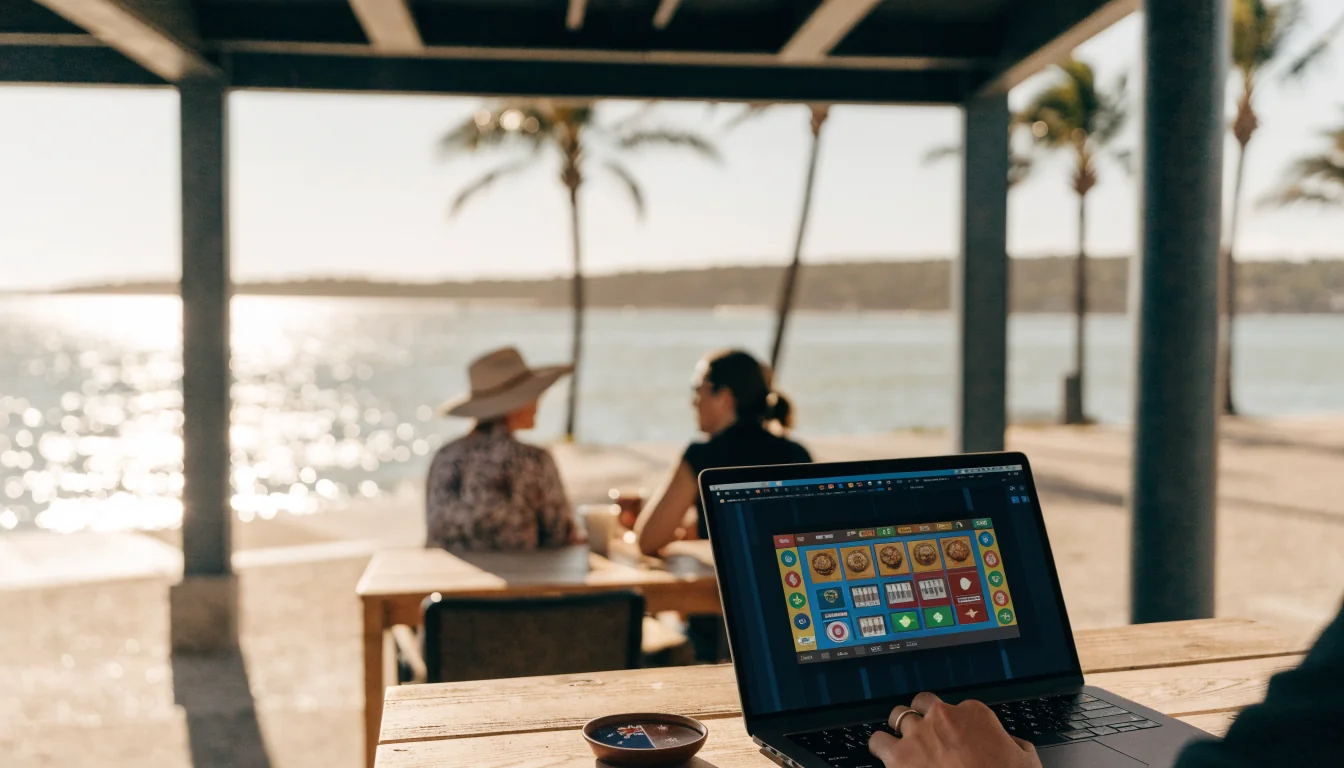
The gameplay mechanics follow the same logic. Instead of a house-controlled backend deciding outcomes, provably fair algorithms let players verify randomness via cryptographic hashes, and wins settle directly through the protocol. Community features sit alongside the games: token holders, chat channels and governance discussions shape how the platform evolves, which is covered in detail in the tokens section of this article.
For Australian players, one point matters before anything else. Online casino play is prohibited under the Interactive Gambling Act 2001 — the law targets operators, not individual players — and no domestic licence for this type of gambling exists. A decentralised protocol does not change that framework; it only changes who holds the ledger.
Solana Casino Flip: Mechanics, Rewards and Player Appeal
Flip is a coin-flip style game mode found on Solana-based casino platforms: the player picks a side, the round resolves in one outcome, and the payout either lands or it doesn’t. There is nothing in between — no reels, no multi-stage bonus rounds, no decision after the initial pick. That binary structure is the entire product.
What makes the mode attractive is the speed of the loop rather than the size of any single win. Rounds resolve as fast as the Solana blockchain confirms them, so a session is a series of rapid, self-contained bets rather than an extended build toward a feature. On a network chosen for low fees and fast confirmation, a flip game is close to the shortest possible distance between wager and result.
Rewards in Flip modes sit outside the token structures discussed elsewhere. According to one industry review, a few platforms attach native tokens with staking rewards and governance rights to their wider ecosystems, but the Flip game itself pays out in the wagered currency — a fixed outcome per round, not a yield-bearing position. Any figure beyond that — payout multiples, house edge, win rates — depends on the individual operator’s published terms, and those terms are not standardised across platforms.
One legal point belongs in the calculation rather than the fine print. One industry review reports that the 2023 amendments to the Interactive Gambling Act sought to restrict operators from accepting digital currency payments from Australians; that is a constraint on the operator side, not a penalty on the player, but it shapes which platforms remain accessible and for how long. A game that settles in seconds is only as durable as the payment channel behind it.
Solana Casino Tokens: Utility, Staking and Governance
Some crypto casinos operating on Solana issue their own native tokens. According to one industry review, a few platforms run tokens that carry staking rewards and governance rights — a feature set worth examining before treating any token as more than a betting chip.
Utility in practice splits into two functions. First, a token can serve as a house currency: deposits, wagers and payouts denominated in the token itself, moving over Solana alongside the wider coin set casinos support — Bitcoin, Ethereum, Litecoin, USDT, Dogecoin, Solana, Ripple and other altcoins. Second, it can unlock platform-level perks, from fee treatment to access decisions.
Staking shifts the economics. A staked token ties capital to the platform’s continued operation, so the reward is only as reliable as the operator behind it. Offshore licensing in jurisdictions such as Curacao or Malta — where many crypto casinos operate — means there is no domestic regulator standing behind a staking promise.
Governance adds a third layer: voting rights over platform decisions. On decentralised protocols, where no single company controls funds or outcomes, governance tokens are how that control is exercised. On conventionally run offshore sites, the same word can describe something closer to a suggestion box.
The regulatory position is separate from the token mechanics. According to one industry review, the Interactive Gambling Act was amended in June 2024 to prohibit cryptocurrencies and credit cards on Australian licensed gambling sites — which is one reason token-based play sits on offshore platforms rather than local ones.
What a token is worth remains the holder’s question to answer: staking yields, governance weight and utility are all promises priced by the operator that issued them.
Are crypto casinos legal in Australia in 2026?
No online casino can be licensed in Australia — the Interactive Gambling Act 2001 prohibits online casino-style games and it is impossible to obtain a domestic licence. However, the law targets operators, not players, so it is not illegal for individual Australians to play at offshore-licensed crypto casinos.
Is using a crypto casino legal for Australian players?
Yes, there is no criminal penalty for Australian players accessing offshore crypto casinos. The Interactive Gambling Act 2001 targets providers and operators, not individual players.
What cryptocurrencies do casinos accept?
Bitcoin is the most widely accepted, and many crypto casinos also support Ethereum, Litecoin, USDT, Dogecoin, Solana, Ripple and other altcoins. The best Solana casinos support Solana natively on its own network rather than through a wrapped or bridged token.
How fast are crypto withdrawals?
Withdrawals are usually instant or processed within hours, often clearing in minutes with low fees — but the casino’s own approval step sits between the request and the blockchain, which can delay them. Operators that state their processing times plainly keep that queue shortest.
What makes a good Bitcoin casino?
Fast banking, provably fair algorithms that let you verify game randomness via cryptographic hashes, native support for your chosen coin without token swaps, transparent bonus and wagering conditions shown up front, and an offshore licence (e.g., Curacao or Malta) that you understand is not an Australian licence.
Written by the editors at Casino Regional Guide.