
Best Low Volatility Slots in Australia for 2026
 Available in AU
- Understanding Low‑Volatility Slots and Their Appeal in Australia
- Low‑Volatility Slot Machines: Features and Player Experience
- Pragmatic Play’s Low-Volatility Slots
- Low‑Volatility Pokies in the Australian Market
- Highest RTP Low-Volatility Slots to Watch in 2026
- Top Low-Volatility Slot Games for Australian Players
- Regulatory Framework for Online Slots in Australia
Understanding Low‑Volatility Slots and Their Appeal in Australia
Volatility is the single variable that shapes a slot session more than any theme, bonus feature, or provider name. It determines how often a game pays, how large those payments tend to be, and how long a bankroll survives when the reels turn against it. For Australian players, where the legal landscape around online casino games is restrictive and every session is funded entirely out of pocket, understanding volatility is not an academic exercise. It is the difference between an evening of steady play and an empty balance in the first ten minutes.
This section sets out what volatility actually means in a slot, how low‑volatility games differ from high‑volatility ones, what the pay table reveals about a game’s behaviour before a single spin is placed, and why the low‑volatility category has particular appeal in the Australian context.
What Volatility Means in a Slot
Volatility, in the context of slot games, describes the relationship between the frequency of payouts and their size. It is not a measure of whether a game is fair, whether it is "hot" or "cold", or whether it is due to pay. It is a structural property of the game’s mathematical model — the distribution of outcomes programmed into it.
Every slot is built around a payout distribution. Some games are designed so that winning combinations land often, but those combinations return small amounts relative to the bet placed. Others are designed so that wins land rarely, but when they do land, the returns can be many multiples of the stake. The first category is low‑volatility. The second is high‑volatility. Between them sits a middle band often described as medium volatility, where both the frequency and the size of payouts fall somewhere in the middle of the two extremes.
The key point — and the one most often misunderstood — is that volatility says nothing about the total amount a game returns over time. That is the job of the return‑to‑player percentage, a separate measure. Two games can return the same proportion of wagers over the long run while delivering completely different playing experiences: one pays in small, frequent increments, the other in rare, large bursts. Volatility describes the shape of the journey; it does not change the destination.
In Australian gambling content and in the vocabulary of game providers themselves, the preferred term is "volatility". The word "variance", which appears in some statistical or older discussions of slot mathematics, refers to the same underlying concept but is not the term the Australian market uses. Providers publish volatility ratings — low, medium, high — in their game information sheets, and those ratings are the fastest way to classify a game before playing it.
How Low‑Volatility Slots Behave
Low‑volatility slots pay out more frequently, but with smaller rewards. That is the entire proposition in one sentence, and every consequence worth discussing flows from it.
In practice, this behaviour shows up as:
- Winning combinations or small feature triggers appear at short intervals, keeping the balance moving rather than sitting still spin after spin.
- Individual wins are typically modest relative to the total bet — often a fraction of it, sometimes a small multiple of it, rather than the dramatic multiples associated with high‑volatility games.
- Long dry spells, in which nothing at all is returned, are shorter and less punishing than in high‑volatility titles.
- Bonus rounds and free‑spin features, where they exist, tend to trigger more regularly rather than withholding themselves for extended stretches.
The result is a smoother experience. The balance line on a low‑volatility game declines more gradually, is punctuated by regular small recoveries, and gives the player more decision points — more moments at which to continue, adjust the bet, or stop — before the session’s funds are exhausted.
It should be stated plainly, because the marketing of low‑volatility games sometimes obscures it: smaller rewards are a feature of the category, not a defect of a particular title. Players may experience smaller jackpots and payouts compared to higher volatility games. The trade is frequency for magnitude. A game that pays constantly in small amounts cannot also pay the headline multipliers of a game that rarely pays at all, unless something else in its mathematical model gives. Nothing gives. The distribution simply moves.
How High‑Volatility Slots Differ
High‑volatility slots sit at the opposite end of the same scale. They pay out infrequently, but with larger wins. The intervals between meaningful returns stretch out; stretches of losing spins run longer; and the bankroll is consumed in a steady bleed that only a substantial hit reverses.
High‑Volatility Risk
Playing high‑volatility slots can quickly deplete a bankroll due to long dry spells and rapid loss of funds.
The appeal of high volatility is obvious and legitimate: the possibility of a return large enough to transform the session — or, in the most extreme cases, a sum that changes the session’s entire arithmetic in a single spin. Players chasing that possibility accept long stretches of nothing in exchange for it.
The costs are equally obvious:
- Bankroll burn rate. A high‑volatility game consumes funds faster during losing stretches, because those stretches are longer and no interim wins soften them.
- Session length. Unless a significant win lands early, the session is short. The bankroll either gets rescued by a hit or it does not.
- Emotional load. Extended barren runs test discipline. The temptation to increase bet size to “force” a recovery — a strategy with no mathematical basis — grows precisely when the bankroll is least able to absorb it.
- Variance of outcome. Two players on the same high‑volatility game, same stakes, same session length, can walk away with completely opposite results. That is the definition of the category.
The comparison, then, is not a question of which is better. It is a question of what each category costs and what each category offers. High volatility sells the possibility of a large win and charges for it in session length and stability. Low volatility sells the session itself — longer play, smaller recoveries, a gentler decline — and charges for it by capping the size of what can be won. A player choosing between them is choosing which price to pay, not choosing between a good and a bad option.
Reading Volatility from the Pay Table
Game providers publish volatility ratings, but a player does not have to take a provider’s word for it. Pay tables can indicate a slot’s volatility. The pay table — the screen listing every symbol combination and what it returns — contains enough information to make a reasonable classification before playing.
What to look for:
The gap between the bottom and the top of the table. In a low‑volatility game, the highest payouts are modest multiples of the line bet, and the table’s rewards cluster in a narrow band. In a high‑volatility game, the top prizes are dramatic multiples of the stake, and the gap between the most common payouts and the rarest ones is wide. A table whose biggest prize towers over its everyday ones is describing a distribution that rarely pays that prize.
The density of low-value wins. Low‑volatility games list many combinations that return small amounts — frequently less than the total spin cost, sometimes only a fraction of it. That density is the mathematical signature of frequency: the game is built to return something often, even if that something is small.
The structure of feature payouts. Where the pay table describes bonus rounds, free spins, or jackpot tiers, the spread of those payouts matters as much as their existence. A feature that reliably returns modest amounts behaves differently from one that occasionally returns an enormous amount and usually returns very little.
The presence of jackpot tiers. Games with progressive or tiered jackpots carrying large headline amounts are, by construction, weighted toward rare large events. That weighting is what high volatility is.
The pay table reveals a slot’s volatility: many low‑value wins indicate low volatility, while a wide gap between smallest and largest payouts signals high volatility.
The pay table is read before the first spin, not after. It costs nothing to open, it is a required disclosure rather than a marketing claim, and it tells the player more about the coming session than any review written about the game’s theme or graphics. A player who checks the pay table and the provider’s volatility rating has done more due diligence than one who reads three promotional descriptions of the same title.
Why Long Sessions Matter: The Case for Reduced Risk
Low‑volatility slots allow for longer playing sessions with reduced risk. Each element of that statement deserves attention, because both halves — the session length and the risk profile — carry weight for the Australian player.
Session length. The appeal of a long session is not merely entertainment value. A longer session means more spins, and more spins mean the actual experience of the game moves closer to its underlying distribution. On a high‑volatility game, a short session is dominated by randomness — one player hits early, another never hits at all. On a low‑volatility game, the experience converges on what the game actually is: frequent small returns, a gradual balance decline, occasional small recoveries. The session is more predictable, and predictability has its own value in a form of entertainment built entirely on random outcomes.
Reduced risk. Risk here has a specific meaning: the probability that the session bankroll is exhausted quickly. Low volatility reduces that probability structurally. The regular small returns act as a brake on the rate of loss. This does not make a low‑volatility game profitable — no slot is designed to be — but it changes the pace at which losses accumulate, and pace is the one variable the player genuinely experiences.

Budget control. When the decline in balance is gradual and visible, budgeting becomes practical. A player who can see the rate at which funds are being consumed can set a session limit and expect the session to last roughly as long as planned. A player on a high‑volatility game has no such expectation; the session ends when the bankroll does or when a hit arrives, and neither event can be scheduled.
Smaller bets across multiple paylines. A further practical point, and one that applies directly to low‑volatility play: it is advisable to place smaller bets on machines with multiple paylines to maximise winning chances. A low‑volatility game with many paylines rewards coverage — small stakes spread across the full set of lines give more of the game’s frequent small wins a chance to land on an active line. Concentrating the same total stake on fewer lines with higher per‑line bets raises the cost of each missed combination and works against the very frequency the game is built around. The structure of a low‑volatility, multi‑payline game and the structure of a small‑spread betting approach reinforce each other.
Why the Category Suits Australian Players
The appeal of low‑volatility slots in Australia is not only a matter of temperament. It follows from the market’s specific conditions, and those conditions are worth stating precisely.
Regulatory Context
Online casino games, including slots, are prohibited for Australian operators under the Interactive Gambling Act 2001; the law targets operators, not players.
The regulatory starting point. Online casino games — including slots, poker, blackjack, and roulette — are prohibited under the Interactive Gambling Act 2001, the primary Commonwealth law governing online gambling in Australia. The Act was introduced to protect the public, with a stated focus on harm minimisation. A note on sources: some references describe the prohibition as arising from an Interactive Gambling Act 1997. The sources disagree on the year of the instrument; what they agree on is the substance — the provision of online casino games to Australian residents is prohibited under Commonwealth law, and the 2001 Act is the instrument most consistently cited as governing the field.
What the law targets. It is not illegal for individual Australians to play at offshore‑licensed online casinos. The law targets operators, not players. This distinction shapes the entire Australian online slots landscape: there are no domestically licensed real‑money online casino operators available to Australian players, and the games Australians access online are offered by operators licensed elsewhere.
Practical Player Implications
- Session budgeting becomes essential because there is no domestic consumer‑protection framework.
- Frequent small wins provide continuous feedback, helping players manage their bankroll.
- Choosing low‑volatility games aligns with the harm‑minimisation goals of Australian gambling policy.
The consequence for the player. In this environment, every consideration a player might apply elsewhere becomes more important, not less. There is no domestic licensing regime whose standards stand behind the games an Australian player accesses, no local complaint pathway tied to a domestic licence, and no consumer‑protection framework that reaches the player automatically. The practical implications for game selection follow directly:
- Session economics matter more, not less. Without domestic consumer protections wrapping around the play session, the player’s own management of funds, pace, and session length is the primary protection available. Low‑volatility play — longer sessions, gradual balance movement, frequent small returns — aligns with that self-managed approach.
- Frequency of feedback aids control. A game that returns small amounts regularly gives the player continuous information about the session’s state. A game that returns nothing for long stretches gives the player nothing to measure against. For anyone treating a session as a budgeted activity rather than a lottery ticket, the feedback-rich option is the manageable one.
- The entertainment calculation. For players whose interest is the game itself — the mechanics, the pacing, the gradual accumulation of small wins — low volatility delivers the maximum playing time per dollar of bankroll. That calculation does not require the game to be profitable; it requires it to be slow, and slowness is what the category sells.
The harm‑minimisation alignment. The framing of Australian gambling law — protection of the public, harm minimisation — is a statement of public policy, and it is not the place of a game guide to editorialise about it. But it is fair to observe that the playing style characterised by smaller bets, longer sessions, gradual losses, and frequent low‑value returns is, at minimum, more consistent with that policy framing than the alternative of large stakes on rare‑payout games. Low volatility and low stakes are natural companions; the small‑bets-across-multiple‑paylines approach described above belongs to the same family.
Low Volatility and Return to Player: Two Different Questions
Because this page also deals with high RTP games, a boundary needs to be drawn here between volatility and return to player, because the two are constantly confused and the confusion leads to bad choices.
Return to player is a long‑run measure: the proportion of total wagers a game is designed to return over an extended period of play. Volatility is a distribution measure: the pattern — frequent and small, or rare and large — in which those returns arrive. The distinction matters for three reasons:
- A high RTP does not make a game gentle. A game can return a high proportion of wagers over time and still deliver it in rare, devastating swings. The RTP figure says nothing about the ride.
- A low‑volatility game is not automatically generous. Frequency of payout is not generosity. A game that returns small amounts constantly can still return less over the long run than a volatile one.
- The player choosing a game needs both figures, for different purposes. RTP answers the question of what the game costs over time. Volatility answers the question of what the session will feel like. Selecting on RTP alone and ignoring volatility is choosing a destination without asking about the road.
Players searching for the intersection — games that combine high RTP with low volatility — are searching for the category this page is built around, and the specific titles are dealt with in later sections. What belongs here is the principle: the two measures are independent, both are published, and a sensible selection process checks both before the first spin.
Practical Selection Checklist
Before committing a bankroll to any game, the low‑volatility selection process reduces to a short sequence of checks, none of which requires spending anything:
- Open the pay table. Look at the spread between the lowest and highest payouts, and at how many small-value combinations the table lists.
- Check the provider’s stated volatility rating in the game information.
- Confirm the number of paylines, and plan bet sizes that cover them at the smallest viable per‑line stake rather than concentrating stake on a few lines.
- Set the session budget before the first spin, and treat the low‑volatility profile as a pacing tool — the gradual balance decline is the mechanism by which the budget translates into session time.
- Treat any win, however small, as part of the session’s arithmetic rather than as a signal to increase stakes. The category’s value lies in accumulation and pacing, not escalation.
None of this turns a slot into an investment. The house edge — whatever the RTP figure of a given title — exists regardless of volatility. What the process does is align the game’s structural behaviour with the player’s actual goal: a measured session, a visible rate of loss, and a game whose character was known before the money was committed.
The Category’s Honest Limits
A section that explains the appeal of low‑volatility slots owes the reader the limits of that appeal, stated without hedging:
- The wins are small. That is the design, not a run of bad luck.
- The jackpots and headline payouts of the high‑volatility category are not on offer here. Players may experience smaller jackpots and payouts compared to higher volatility games — this is the price of the frequency, and no title in the category escapes it.
- Longer sessions mean longer exposure, and longer exposure means more wagers placed in total. A slow bleed is still a bleed; the low‑volatility player loses at a gentler pace over a longer time, which is pacing, not profit.
- Reduced risk of rapid loss is not the absence of risk. The category softens the shape of the session; it does not change its direction.
Within those limits, the proposition is coherent and worth stating once more without decoration: low‑volatility slots exchange the size of the largest possible win for the frequency and steadiness of everything else. For the Australian player — playing in a market where domestic licensing of online casino games does not exist, where the law targets operators rather than players, and where the session’s protections are therefore largely the player’s own discipline — a game category built on slower losses, visible pacing, and frequent small feedback is not merely a stylistic preference. It is the option whose behaviour can actually be managed.
Low‑Volatility Slot Machines: Features and Player Experience
A slot machine’s volatility is not written on the cabinet or the loading screen, but it announces itself quickly enough once the reels start turning. Low‑volatility slot machines pay out more frequently than their high‑volatility counterparts, and they pay smaller amounts each time. That single trade‑off — frequency in exchange for size — shapes everything else about the machine: its pay table, its pace, its bonus round behaviour, and the kind of session it produces.
What low volatility means on a slot machine
Volatility describes the pattern of payouts over time, not the size of the jackpot on paper and not the theoretical return to the player. Two machines can return the same proportion of wagers over the long run while producing completely different experiences along the way. The low‑volatility machine drips: regular small wins, frequent returns of part or all of a stake, dry spells that stay short. The high‑volatility machine holds its money back and releases it in occasional larger amounts, leaving long stretches of nothing in between.
The practical consequence for the player is the shape of the bankroll curve. On a low‑volatility machine, the balance declines slowly and unevenly rather than in steep steps. Wins arrive often enough that the session extends itself without additional deposits. Players accept smaller jackpots and smaller top payouts as the price of that steadiness. Anyone chasing a life‑changing single win has chosen the wrong machine class; anyone who wants the entertainment to last has chosen the right one.
Reading the pay table
Pay tables can indicate a slot machine’s volatility before a single spin is placed. The signal is in the distribution of the prizes, not the headline figure. A pay table that lists many modest payouts spread across frequent symbol combinations points toward low volatility. The gap between the smallest and largest prizes is narrow: the top award is a multiple of the stake rather than a different order of magnitude, and mid‑tier combinations pay amounts that meaningfully soften the cost of a losing run.
A pay table weighted toward one large top prize, with little in between, tells the opposite story. When almost the entire return sits at the top of the table, the machine has to withhold payment for long periods to fund it — that is the mechanics of high volatility. Comparing two pay tables side by side, the pattern is hard to miss: the low‑volatility machine spreads its money thin and wide; the high‑volatility machine stacks it.
Bonus features follow the same logic. On low‑volatility machines, free spin rounds and pick‑style bonuses tend to trigger regularly, with payouts that are pleasant rather than spectacular. The feature is part of the rhythm of play rather than a rare event the whole session is built around waiting for.

The player experience: longer sessions, reduced risk
Low‑volatility slots allow for longer playing sessions with reduced risk. That statement deserves precision, because it is often repeated loosely. The reduced risk is not the absence of loss — over enough spins, the machine’s long‑run behaviour holds regardless of volatility. The reduction is in the pace at which the balance can fall. A losing streak on a low‑volatility machine costs less per unit of time than the same streak on a high‑volatility one, because intervening wins keep refunding part of the outlay.
For the player, this produces a specific experience: the session is measured in time, not in outcomes. There is no single moment that redeems the evening, and no need for one. The appeal is continuity — the reels keep responding, the balance keeps breathing, and the decision to stop belongs to the player rather than to the machine’s appetite. The corresponding cost is worth stating plainly: the ceiling is lower. Smaller jackpots and payouts are the accepted consequence of smoother ground.

Betting structure and paylines
Machines with multiple paylines reward a particular approach: it is advisable to place smaller bets across those lines rather than larger bets on fewer of them. The reasoning is mechanical. Each active payline is a separate chance at a winning combination, and low‑volatility machines are built to land those combinations regularly. Spreading the stake widens the net without increasing the total wager, which aligns with the machine’s own payout pattern instead of fighting it.
The calculation is not glamorous, which is precisely why it suits this class of machine. A low‑volatility slot with a wide payline structure is a volume game: many small events, each individually trivial, collectively determining how long the bankroll survives. Larger per‑line bets raise the cost of each event without changing how often it occurs, and the bankroll curve steepens accordingly.
Machines in the physical and virtual sense
The features above apply to both cabinets on a gaming floor and their digital equivalents. Physical machines and online slots implement the same volatility mechanics through the same instrument — the pay table and the underlying payout distribution. The differences are packaging: a cabinet carries its pay table on the glass or an on‑screen menu, while an online slot exposes it behind an information button a click away. The information is equally available in both settings, and equally worth consulting before play. Titles such as Starburst have become reference points for this class precisely because their pay structure follows the low‑volatility pattern described here: frequent, modest, evenly distributed returns.

The Australian context
One legal point frames any discussion of slot machines played online from Australia, and the sources do not fully agree on its history. The Interactive Gambling Act 2001 (IGA) is the primary Commonwealth law governing online gambling, introduced with a public‑protection and harm‑minimisation focus; one source instead references an Interactive Gambling Act 1997 as prohibiting the provision of online casino games to Australian residents. The 2001 date is the one carried by the weight of the material, but the discrepancy exists and is noted here rather than smoothed over. Under the IGA, online casino‑style games — slots included — are prohibited offerings. The prohibition targets operators, not individual players, and there is no domestic licence under which an online casino can lawfully offer these games to Australians. The machines themselves, and the mathematics that makes a low‑volatility slot behave the way it does, remain what they have always been: a pay table, a payout distribution, and a trade between frequency and size that the player can read in advance — and should.
Free support is available at Gambling Help Online for anyone whose play has stopped feeling like a priced entertainment choice.
Pragmatic Play’s Low-Volatility Slots
Pragmatic Play is one of the most prolific providers in the online slot market, and its catalogue demonstrates how the volatility principles discussed earlier translate into actual game design. The provider tags its releases with a volatility rating, which makes the sorting task straightforward: the low end of that scale marks games built to pay out more frequently, but with smaller rewards on each win.
In practice, this shows up in the pay structure. Low-volatility titles in the provider’s portfolio distribute value across frequent small combinations rather than concentrating it in rare high-paying events. A session on such a game produces a steady rhythm of modest returns, which suits a longer playing session with reduced risk — the same trade-off that defines the category as a whole. The cost is equally explicit: jackpots and top payouts are smaller than what higher-volatility games can deliver.
One design habit matters for anyone playing these games. Pragmatic Play releases typically run on multiple paylines, and on machines with multiple paylines it is advisable to place smaller bets to maximise winning chances. The reasoning is mechanical rather than superstitious: more active lines mean more combinations evaluated per spin, and a smaller stake per line keeps the total outlay within a planned budget while the hit frequency stays high.
For Australian players assessing this provider, the practical takeaway is limited by what is publicly disclosed. Pragmatic Play does not publish a documented breakdown of per-title payout behaviour beyond its own volatility ratings, so the rating itself — combined with the pay table, which can indicate a slot’s volatility — remains the available evidence. Games by other providers, including NetEnt’s Starburst and PlayNGo titles, appear in the sections that follow.
Low‑Volatility Pokies in the Australian Market
"Pokies" is the local word, and in Australia it carries a specific meaning: poker machines, whether standing on a club floor in Sydney or running in a browser. International reviews tend to call everything slots; Australian players search, compare and argue about pokies. The mechanics underneath are the same — reels, paylines, a pay table — but the vocabulary and the expectations around it are local.
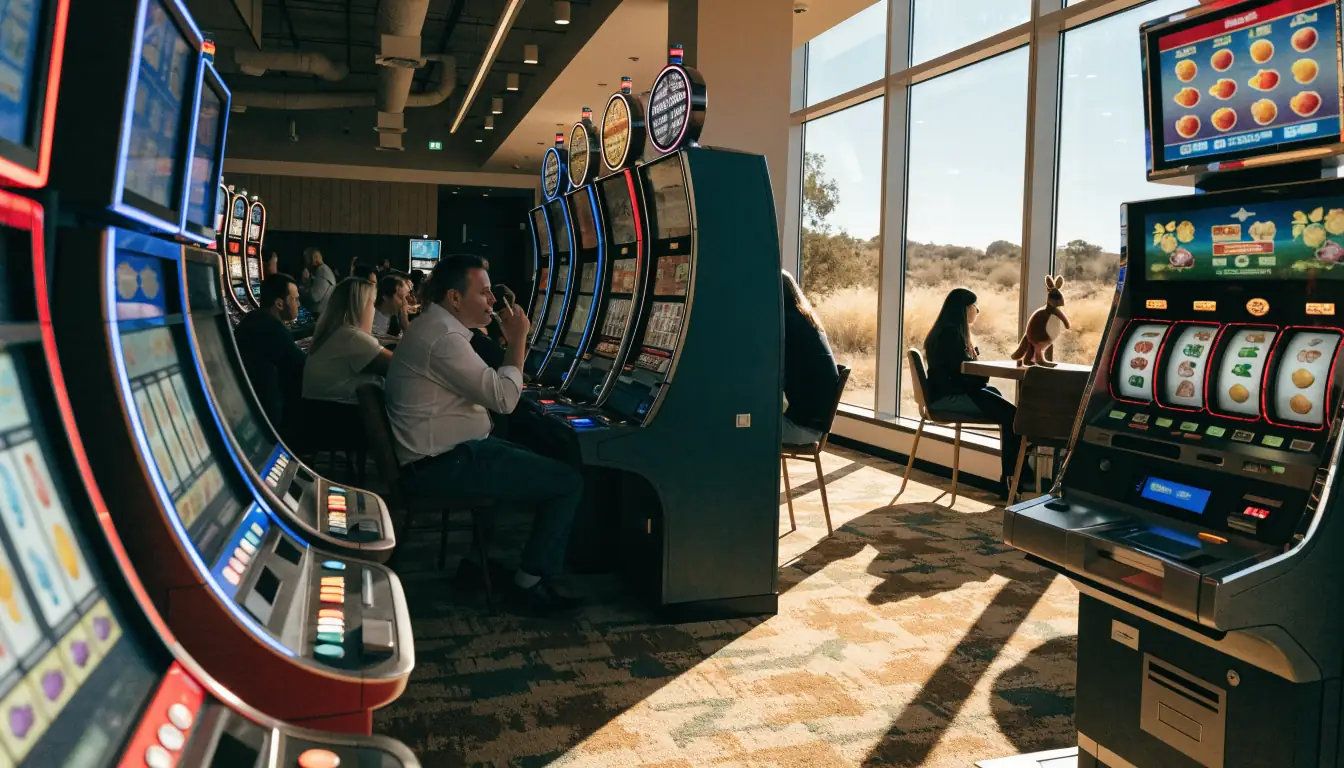
What Australian players look for in low-volatility pokies matches the general pattern: frequent payouts, longer sessions with reduced risk, and the trade-off of smaller jackpots compared with higher-volatility games. The pay table is the practical test before any money is committed — a spread of modest line payouts signals low volatility, while a top-heavy table with a large maximum prize points the other way.
Titles that circulate widely in the Australian market include familiar names such as Starburst, Thunderstruck II, Gonzo’s Quest, Gemix and Dead or Alive. Starburst is the standard example of a low-volatility pokie: frequent small line wins, no punishing dry spells, and a session budget that stretches accordingly. Thunderstruck II and Gonzo’s Quest sit differently — both are better classified as medium volatility, so they appear in local comparisons as the counterweight rather than the recommendation. That comparison is precisely what distinguishes the Australian discussion of pokies from generic slot content: local players weigh titles against each other on session length and payout frequency, not on marketing language.
One legal point shapes the whole market. Real-money online casino games, including pokies, cannot lawfully be offered to Australian residents, and no domestic licence for such a service exists. Playing at an offshore site is not an offence for the individual — the Interactive Gambling Act 2001 targets operators. Any list of pokies for Australian players sits inside that reality, not outside it.
Highest RTP Low-Volatility Slots to Watch in 2026
Return-to-player figures for specific titles are not published in a single verified source, so no percentages are listed here — an invented RTP figure would be worse than a blank space, because a session budget depends on it. What can be stated with confidence is the structural point: low-volatility slots pay out more frequently but with smaller rewards, and a pay table can indicate a slot’s volatility before a single spin is placed.
With that filter applied, the titles worth examining in 2026 are:
- Starburst — NetEnt; frequent small line wins, the reference point for low-volatility design.
- Gemix — Play’n GO; cascading wins that pay steadily across levels.
- Wild Wild Chest — Red Tiger; short pay intervals typical of low-volatility builds.
- Thunderstruck II — Microgaming; steadier payout curve than most Norse-themed titles.
Providers disclose the exact RTP per game; where a figure matters, it should be read at the source rather than quoted from memory.
Top Low-Volatility Slot Games for Australian Players
If you’re after low volatility slots that pay out smaller wins more frequently, the casino behind the games matters just as much as the titles themselves — licensing, bonus structure and deposit terms all shape how comfortably you can play the long game.
License: Curacao Gaming Control Board OGL/2023/174/0082 (Dama N.V.) · Bonus: up to A$5,000 + 300 free spins across 4 deposits Licensed under the Curacao Gaming Control Board through Dama N.V., this operator backs its offering with a multi-deposit bonus package worth up to A$5,000 plus 300 free spins spread across four deposits.
License: Curacao Gaming Authority (Jumpman Gaming Ltd) · Bonus: up to A$6,600 + up to 250 free spins across 4 deposits Operating under a Curacao Gaming Authority license via Jumpman Gaming Ltd, it offers a sizeable welcome package of up to A$6,600 and up to 250 free spins across four deposits.
Bonus: 240% up to A$4,100 + 300 free spins Stands out for a generous 240% match bonus up to A$4,100 combined with 300 free spins, giving new players a substantial bankroll boost.
License: Curacao eGaming OGL/2023/174/0082 (Dama N.V.) · Bonus: up to A$10,000 + 500 free spins across 4 deposits · Min. deposit: A$15 Licensed under Curacao eGaming through Dama N.V., it provides one of the larger bonus packages on offer — up to A$10,000 plus 500 free spins across four deposits — with an accessible A$15 minimum deposit.
License: Curacao Gaming Control Board OGL/2023/176/0095 (Hollycorn N.V.) · Bonus: up to A$5,000 + 300 free spins across 4 deposits Holding a Curacao Gaming Control Board license via Hollycorn N.V., it offers a welcome package of up to A$5,000 and 300 free spins spread over four deposits.
License: Curacao Gaming Control Board OGL/2023/176/0095 (Hollycorn N.V.) · Bonus: up to A$1,500 + 200 free spins across 3 deposits Licensed by the Curacao Gaming Control Board under Hollycorn N.V., it keeps things more modest with a bonus up to A$1,500 plus 200 free spins across three deposits.
License: Curacao eGaming OGL/2024/923/0383 (Antillephone N.V.) · Bonus: up to A$2,000 + 100 free spins across 2 deposits · Min. deposit: A$30 Operating under a Curacao eGaming license via Antillephone N.V., it offers up to A$2,000 plus 100 free spins across two deposits, with a A$30 minimum deposit requirement.
Bonus: up to A$750 + 50 jackpot spins, 35x wagering · Payout speed: crypto ~90 minutes, fiat 1-5 days · Min. deposit: A$30 Offers a bonus up to A$750 with 50 jackpot spins under 35x wagering, and is notable for fast crypto payouts of around 90 minutes alongside a A$30 minimum deposit.
License: Curacao · Bonus: up to A$2,000 A Curacao-licensed operator offering a straightforward welcome bonus of up to A$2,000.
License: Curacao Gaming Control Board (TechSolutions Group N.V.) · Bonus: 100% up to A$250 + 100 free spins (1st deposit) Licensed by the Curacao Gaming Control Board through TechSolutions Group N.V., it offers a first-deposit bonus of 100% up to A$250 plus 100 free spins.
A short list works better than a long one here, because the titles that actually deliver the low-volatility profile are a known quantity. These are the games worth naming:
- Starburst (NetEnt) — the reference point for frequent, smaller payouts; wins land often, jackpots stay modest.
- Gemix (Play’n Go) — cascade-based gameplay with steady returns across its grid format.
- Wild Wild Chest (Red Tiger) — compact feature set built around regular small wins.
- Thunderstruck II (Microgaming) — a middle-ground option that leans calmer than most jackpot chasers.
- Dead or Alive (NetEnt) — included with a caveat: this title behaves closer to the high-volatility end, paying out infrequently but with larger wins when it does.
- Gonzo’s Quest (NetEnt) — avalanche mechanics that suit extended sessions with reduced risk.
The trade-off is consistent across all of them: smaller jackpots and payouts compared to higher volatility games, in exchange for a bankroll that lasts. For Australian players budgeting a fixed session amount, that exchange is the entire decision.
Regulatory Framework for Online Slots in Australia
Australian gambling regulation has no single statute and no single authority. It operates at two levels: state and territory regulators oversee gambling within their own jurisdictions, while federal law addresses online gambling specifically.
The Interactive Gambling Act 2001 (IGA) is the primary Commonwealth law governing online gambling. Under it, online casino games — including slots, poker, blackjack and roulette — cannot lawfully be offered to Australian residents, and no domestic licence exists for operating an online casino. The law targets operators, not players: it is not illegal for an individual to play at an offshore-licensed online casino.
The Australian Communications and Media Authority (ACMA) is the federal regulator that enforces the IGA. Since November 2019, ACMA has had the power to order internet service providers to block illegal offshore gambling sites, and it has used this power extensively — published figures on the number of blocked sites differ between sources, so treat any single count with caution. ACMA enforcement has also prompted illegal services to exit the Australian market; the scale of those exits is likewise reported differently across sources.
Land-based casinos, by contrast, sit outside ACMA’s remit: they are regulated by state government regulators and law enforcement agencies. State and territory bodies, such as the Victorian Gambling and Casino Control Commission and Liquor & Gaming NSW, hold limited power over offshore online casinos — the enforcement gap between the two levels of regulation is where the offshore market continues to operate.
For players considering low-volatility slots online, the practical consequence is straightforward: there is no domestic licensing framework to verify an operator against, because Australian law makes no provision for one.
Published by the Casino Regional Guide team.