Best Casino in Melbourne: Hotels, Gaming and Dining Guide
 Available in AU
- Casino‑Integrated Hotels in Melbourne
- Poker Rooms and Gaming Facilities
- Parking and On‑Site Access
- Nearby Accommodation Options
- Contact Information and Customer Support
- Buffet, Breakfast and Employment Opportunities
- Opening Hours and Operational Policies
- Restaurant Choices Within the Casino Complex
- Spa and Wellness Services
- Food Courts and Outdoor Pools
Casino‑Integrated Hotels in Melbourne
Melbourne’s casino precinct is unusual among Australian cities in that the main gaming complex sits on a single riverside site with hotel accommodation built directly into it, rather than scattered across separate venues. The distinction matters for anyone planning a stay around a casino visit: a hotel attached to the gaming floor operates on a different logic from a generic city hotel three tram stops away, and the differences are worth spelling out before a booking is made.
What "casino-integrated" actually means
An integrated casino hotel shares infrastructure with the gaming complex. The lobby, the lifts, the restaurants and the room towers belong to the same operational footprint as the casino floor. The practical consequences are straightforward:
- No transfer between accommodation and gaming. Guests move between their room and the casino without leaving the building or re-crossing a street. In a city where evening temperatures drop sharply, this is less a luxury than a scheduling decision.
- Extended service hours. Casino-linked hotels run front-desk and concierge services around the clock, because the casino itself operates continuously. A standard CBD hotel does not — its desk closes, its room service ends, and late arrivals are managed by a night porter.
- Facility access tied to the complex. Pools, spas, gyms and dining venues inside the hotel are often the same ones marketed to casino visitors, which changes both availability and pricing. Spa and wellness services, food courts and pool areas are covered in their own sections of this article; the point here is only that they belong to the same building as the accommodation.
- Security and entry screening. A casino-integrated property applies the casino’s entry standards — photo identification, minimum age of 18 — at points a normal hotel never would. A guest who books a room without realising this can find the check-in process slower than expected, since identification is checked rather than glanced at.
Since online casinos can’t legally operate from within Australia, players in Melbourne looking for a real-money experience typically turn to offshore-licensed platforms — making it worth checking each site’s licensing, bonus terms, and payout practices before signing up.
License: Curacao Gaming Control Board OGL/2023/174/0082 (Dama N.V.) · Bonus: up to A$5,000 + 300 free spins across 4 deposits Licensed under the Curacao Gaming Control Board, this operator offers a multi-deposit welcome package worth up to A$5,000 plus 300 free spins spread across four deposits.
License: Curacao Gaming Authority (Jumpman Gaming Ltd) · Bonus: up to A$6,600 + up to 250 free spins across 4 deposits Operating under a Curacao Gaming Authority license, it stands out with a sizeable welcome offer of up to A$6,600 and up to 250 free spins across four deposits.
Bonus: 240% up to A$4,100 + 300 free spins This operator features a high-percentage 240% match bonus worth up to A$4,100 alongside 300 free spins, aimed at players chasing a bigger initial boost.
License: Curacao eGaming OGL/2023/174/0082 (Dama N.V.) · Bonus: up to A$10,000 + 500 free spins across 4 deposits · Min. deposit: A$15 Licensed under Curacao eGaming, it offers one of the larger welcome packages on this list, up to A$10,000 plus 500 free spins across four deposits, with a low A$15 minimum deposit.
License: Curacao Gaming Control Board OGL/2023/176/0095 (Hollycorn N.V.) · Bonus: up to A$5,000 + 300 free spins across 4 deposits Holding a Curacao Gaming Control Board license, it provides a welcome bonus of up to A$5,000 with 300 free spins spread over four deposits.
License: Curacao Gaming Control Board OGL/2023/176/0095 (Hollycorn N.V.) · Bonus: up to A$1,500 + 200 free spins across 3 deposits Licensed by the Curacao Gaming Control Board, this operator keeps its welcome offer more modest, up to A$1,500 plus 200 free spins across three deposits.
License: Curacao eGaming OGL/2024/923/0383 (Antillephone N.V.) · Bonus: up to A$2,000 + 100 free spins across 2 deposits · Min. deposit: A$30 Under a Curacao eGaming license, it offers a welcome bonus of up to A$2,000 with 100 free spins over two deposits, requiring a A$30 minimum deposit.
Bonus: up to A$750 + 50 jackpot spins, 35x wagering · Payout speed: crypto ~90 minutes, fiat 1-5 days · Min. deposit: A$30 This operator combines a bonus of up to A$750 plus 50 jackpot spins with fast crypto payouts of around 90 minutes, alongside standard fiat withdrawal times and a A$30 minimum deposit.
License: Curacao · Bonus: up to A$2,000 Operating under a Curacao license, it offers a straightforward welcome bonus of up to A$2,000.
License: Curacao Gaming Control Board (TechSolutions Group N.V.) · Bonus: 100% up to A$250 + 100 free spins (1st deposit) Licensed under the Curacao Gaming Control Board, it provides a first-deposit bonus matching 100% up to A$250 along with 100 free spins.
This last point follows from Australian law rather than hotel policy. The minimum legal gambling age in Australia is 18, and a property whose lifts open onto a gaming floor enforces that boundary structurally, not just with signage.
How these hotels differ from generic city hotels
The differences are practical, and most of them show up in the price and the fine print rather than the photographs.
Rate structure. Generic CBD hotels price rooms against the corporate and events calendar. Casino-integrated rooms are priced against the gaming calendar: weekends, public holidays and major events at nearby venues push rates up in patterns that don’t track the rest of the hotel market. A room that looks overpriced on a Tuesday can look like the cheapest option in the precinct on a Saturday night, and the reverse.
Room categories. Integrated properties tend to run a wider spread of tiers than standalone hotels, from standard rooms through suites positioned for guests who stay and play over multiple nights. The higher tiers exist because the property’s revenue model treats accommodation partly as a retention tool for casino visitors, not purely as a room-selling business.
Noise and orientation. Rooms in a casino hotel are not equal. Towers and floors closer to the entertainment precinct pick up function noise and late-night venue traffic. When a booking is made, the room orientation matters more than in a quiet business hotel, and requesting a river-facing or high-floor room at the time of booking costs nothing.
Cancellation terms. Casino hotels in Melbourne hold large event blocks, and cancellation policies on those dates are tighter than the hotel’s standard terms. Checking the cancellation window against the events calendar is a two-minute task that occasionally saves a full night’s rate.
The market context behind the precinct
The scale of the precinct is not an accident. Australians placed bets totalling $244.3 billion in 2022–23, with gambling losses of $31.5 billion over the same period. 72.8% of Australian adults gambled in the previous 12 months as of 2022, and 38% gambled at least once per week. A hotel attached to a gaming floor is built for that level of demand: the accommodation exists to keep visitors on site through the hours the casino runs, not to compete for the ordinary city-break traveller.
Per-capita figures make the economics explicit. In FY 2020–2021, per-capita gambling bets in Australia were AUD 9,885, with a per-capita loss of AUD 1,200. A hotel that captures even part of that spend on site has a revenue base a comparable non-casino hotel does not, and that shapes everything from room rates to the quality of the lower-tier rooms.
On hotel "deals"
The search interest in casino hotel deals in Melbourne is persistent, and the honest answer is that a deal attached to a casino property is best judged like any other rate: what the room costs, what the cancellation terms are, and what is actually included. Package rates that bundle dining credits or venue access are common at integrated properties and are only worth their headline if the included components would have been purchased anyway. A dining credit inside a complex where every restaurant belongs to the same operator is not a discount; it is a spend commitment with a different label.
Gambling Risk
Playing at a casino can lead to significant financial loss, especially for the 0.5‑1 % of Australian adults who experience problem gambling. Always set a budget and stick to it.
What is verifiable: rates at casino-integrated hotels move with the events calendar, and comparison against non-integrated hotels in the same precinct — covered separately in the section on nearby accommodation options — is the only reliable way to see whether the integration premium is worth paying on a given night.
Who the integrated option suits
For a visitor whose primary purpose is the casino, the case is simple: the room, the gaming floor, the restaurants and the late-night food options are in one footprint, and the property never closes around the guest. For a visitor whose primary purpose is Melbourne itself — the galleries, the laneways, the MCG — a generic city hotel does the same job at a rate that isn’t carrying any precinct premium, and the casino becomes a destination visited once rather than a lobby walked through twice a day.
One caveat belongs here rather than anywhere else. Around 80,000–160,000 Australian adults — 0.5–1.0% of the adult population — experience significant gambling problems. A hotel whose lifts open onto a gaming floor is, for that share of guests, not a neutral accommodation choice. It is a factor worth naming plainly, because the rest of the marketing material will not.
Poker Rooms and Gaming Facilities
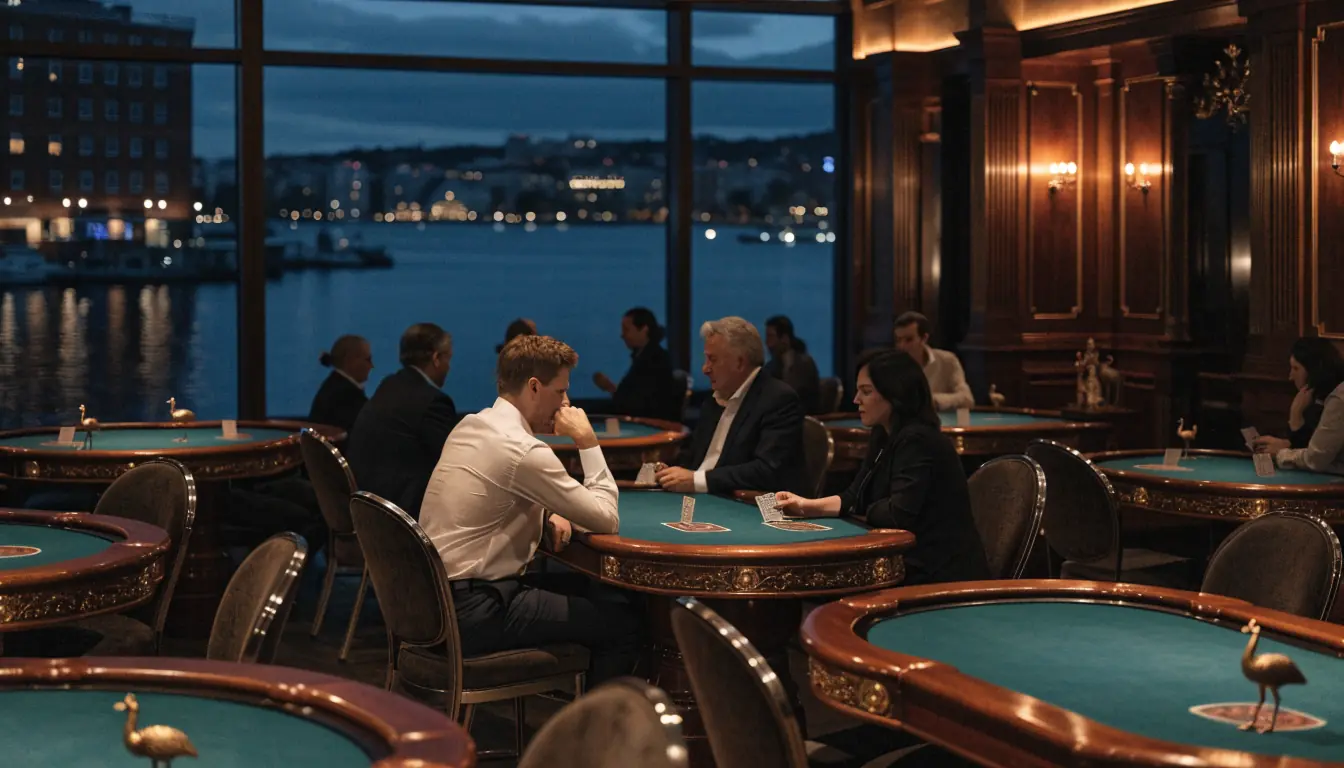
A dedicated poker room is a different proposition from the main casino floor, and the distinction matters for anyone planning a visit. The general floor is built around pokies and table games run continuously, with no structure beyond the table minimums. A poker room, by contrast, operates on scheduled play: cash games that fill seats in a set order, tournaments with a fixed start time, and a registration process that closes before the first hand is dealt. Walk in expecting the floor’s format and the room will not accommodate it.
What separates the poker room from the floor
The differences are practical, not cosmetic:
- Opponents, not the house. Table games on the main floor are played against the house. Poker is played against other patrons, with the venue taking a rake from each pot rather than a statistical edge on the game itself.
- Seating discipline. Cash games are filled from a waiting list managed by the room. During peak periods the wait is longer than the walk from the entrance; whether the room is busy at a given hour is something the venue’s own operational channels confirm, and this page’s section on opening hours covers the schedule side of that question.
- Tournaments run to a clock. Blind levels rise on a published structure, and late registration — where offered — closes at a defined point. Turning up after that point means a cash game or nothing.
- Age is checked, not assumed. The minimum age for casino play in Australia is 18, and a poker room enforces it at the door with identification, not at the table.
Tournament spaces
Tournament play at a Melbourne casino venue happens in spaces set aside from both the cash-game tables and the general floor — either a sectioned area of the poker room or a dedicated events space used for larger series. What those events are, when they run, and what entry costs is information the venue publishes through its own channels and updates as schedules change; any third-party summary of a specific tournament calendar goes stale quickly, so the fixture list belongs to the venue, not to a summary like this one. What holds regardless of the calendar: tournament entry is a fixed buy-in for a fixed starting stack, which makes the cost of the evening known in advance — a calculation poker shares with nothing else on the floor.
Sports bar and hybrid gaming areas
A sports bar inside a casino complex occupies the middle ground between the poker room and the floor. It carries the broadcast element of a dedicated venue — screens, race and sports results, the atmosphere of a packed room during a major fixture — while sitting within the complex’s broader gaming offering. For a poker player it functions as the waiting room between sessions; for a race bettor it is the point of the visit. Online sports betting is legal in Australia under state and territory licences, which is why race and sports wagering outlets operate openly alongside the casino floor — a legal status that poker played online does not share. Under the Interactive Gambling Act 2001, online poker is prohibited federally, which is precisely why a physical poker room carries weight here: it is the only locally sanctioned way to play the game against live opponents for money.
Legal Discrepancy
Sources differ on whether the Interactive Gambling Act was introduced in 1997 or 2001; both references are cited in the article, so the exact year is left unresolved.
Worth noting, since sources on this point conflict: some references cite an Interactive Gambling Act 1997 as the instrument prohibiting online casino games for Australian residents, while others name the Interactive Gambling Act 2001. The discrepancy exists in the source material and is stated here as such rather than resolved silently.
How Casino Regional Guide handles rankings
Casino rankings on Casino Regional Guide are recalculated every week using a weighted formula: bonus generosity at 30%, payout reliability at 25%, game library breadth at 20%, customer support responsiveness at 15%, and user-submitted feedback at 10%. Each listing is scored on bonus transparency, cashout speed, customer care, and licensing integrity. Reviewers deposit at least A$300 at each casino and test withdrawals before a verdict is recorded. Access to casino offers is restricted to those aged 18 and over — a threshold enforced as policy, not left to the reader’s discretion.
Responsible play
Poker rooms concentrate long sessions and repeat buy-ins more than any other part of a casino. Anyone whose play has stopped being a calculated expense can contact GamblingHelpOnline.org.au or call 1800 858 858. Both services are free, and neither requires a commitment before the first conversation.
Parking and On‑Site Access
Getting to a Melbourne casino is a logistics question before it is an entertainment one. The main casino precinct sits on the southern bank of the Yarra River, which means access routes, parking entry points and drop-off zones are all shaped by the river, the exhibition centre next door and the CBD grid immediately across the water. This section covers only the physical side of arrival: where to bring a car, what valet and self-parking arrangements exist, and how the on-site access routes work. Hotels and dining inside the complex are covered separately.
Arriving by car
The precinct is reachable from the west via the link from the M1/West Gate Freeway corridor, and from the east through the CBD street grid via Flinders Street and its continuation over the river. Drivers coming from the south-eastern suburbs typically approach along St Kilda Road and cross at one of the upstream bridges. On event nights — a stadium match or a large exhibition — the roads closest to the river bank slow down considerably, and the practical move is to enter the precinct from the western side rather than fighting the CBD edge.
Parking arrangements
Self-parking at the complex runs through a multi-level car park connected directly to the venue, so the walk from bay to gaming floor is indoors and under cover — relevant in Melbourne, where rain arrives without an appointment. The car park has multiple entry points, and the western entrance is generally the one to use when the riverside access is congested.
What the venue does not publish, in any verifiable form, is a reliable breakdown of parking pricing by duration, time of day or day of week. Rates for casino parking in Melbourne are quoted inconsistently across third-party sites, and none of those figures can be treated as confirmed. The honest position: check the current rates on the venue’s own channels before planning a visit around them, because this article will not reproduce numbers that the operator itself does not clearly stand behind.
Free parking
This is where the picture gets blunt. The phrase "free parking at Melbourne casino" circulates widely in search queries, but there is no verifiable, standing arrangement for free parking at the casino complex available to all visitors. Where free or discounted parking occasionally appears, it has historically been tied to specific conditions — membership tiers, dining spend at venues inside the complex, or particular promotional windows. Those conditions change without notice, and none of them is currently confirmable as a permanent offer. Budgeting on the assumption of free parking is a planning error; assume paid parking and treat any discount as a bonus if it materialises at the boom gate.
Parking Rates Unverified
The casino does not publish a reliable breakdown of parking fees by time or day, so visitors should check the venue’s own website for the latest pricing before arriving.
Valet parking
Valet service operates at the main hotel and casino entrance on the riverside. It is the practical choice when the self-parking levels are filling up on peak nights, and it drops passengers at the door rather than a five-minute walk through the car park. As with self-parking rates, the current valet fee is not something the operator publishes in a form that can be quoted here with confidence. What can be said: it exists, it runs during venue operating hours, and it is worth the cost mainly when convenience or time matters more than the fare — on a rainy Friday evening, that calculation often answers itself.
Public transport and walking access
For many visitors, the car is the wrong instrument entirely. Two tram corridors run past the precinct, and the tram stop outside the main entrance is among the most serviced in the city. The northern edge of the complex sits a short walk from a major railway station via the river crossings, which puts the venue within a ten-minute walk of the western end of the CBD grid. Compared with negotiating event-night traffic and paid parking, public transport frequently wins on both cost and total travel time — a calculation worth doing before the car keys leave the pocket.
Access within the precinct
Once inside, the complex is built as a single interconnected environment: casino floor, hotel, dining and event spaces link through internal walkways and lifts, so a visitor parks once, or steps off a tram once, and moves between everything on foot without re-entering the street. Lift access and step-free routes run from the car park and the main entrances through to the gaming and entertainment levels.
One access condition is fixed rather than negotiable: the minimum age for entry to the gaming floor is 18, and identification can be requested at the door. Arriving by car or tram does not change that threshold.
A note on the online alternative
Searches for Melbourne casinos increasingly pull in online gambling queries alongside parking questions, so the distinction deserves one clear statement. Domestic online casino play — pokies, table games, live dealer formats — is prohibited in Australia under the Interactive Gambling Act 2001, and no local licence for such services exists. Online sports betting, by contrast, operates legally under state and territory licences. The physical casino in Melbourne remains the only venue of its kind in the city where the full range of casino games can be played lawfully on site, which is precisely why the parking and access details above are worth planning around.
Parking, in the end, is a cost line in the evening’s budget like any other: a confirmed tram fare on one side, an unconfirmed parking rate on the other. The side that publishes its price is usually the side that ends up cheaper.
Nearby Accommodation Options
Not every visitor to Melbourne’s casino precinct wants to sleep inside it. The surrounding blocks hold a dense secondary market of hotels, apartments and short-term rentals that operate with no affiliation to the casino itself — different owners, different booking systems, different cancellation terms. The practical difference between the two categories is not comfort but what the room rate does and does not include.
What "near" actually costs in trade-offs
An independent hotel within walking distance of the casino precinct competes on price against the integrated properties covered earlier in this guide. The discount, where it exists, is paid for in distance, in the absence of a lift directly from the lobby to the gaming floor, and in the fact that none of the loyalty or membership benefits attached to the casino complex carry over. A room across the river or a few blocks up Swanston Street is a separate commercial relationship from the moment of booking.
Short-term rentals add another layer. A self-contained apartment near the precinct suits longer stays and travellers who want a kitchen, but the pricing structure differs from hotel inventory in ways that matter to a budget: cleaning fees, minimum-stay requirements and host cancellation policies vary unit by unit, and none of it is visible in a headline nightly rate. Comparison requires reading the terms, not the first number on the screen.
Rooms are priced according to the gaming calendar, offer 24‑hour front‑desk service, and share facilities such as pools and gyms with the casino.
Rates follow the broader hotel market, provide separate amenities, and do not require age verification for entry.
Offers self‑catering and flexible stay lengths, but includes additional fees (cleaning, security deposit) that are not reflected in the headline nightly rate.
Accommodation deals and how to read them
Package offers combining a room with casino entry or dining credit appear periodically through third-party booking channels. Two things are worth checking before treating any such deal as a bargain. First, whether the hotel in the package is genuinely independent or an official partner — the distinction determines whether the "deal" is a discount or a marketing arrangement. Second, whether the bundled credits carry conditions: expiry windows on the credit, restrictions on when it can be redeemed, and requirements to spend a set amount to unlock any of it. A credit that must be spent in one sitting and cannot be used on the same visit as check-in day is worth less than its face value.
No verified data exists on which nearby properties consistently offer the best rates relative to the casino precinct — that market shifts with event calendars and occupancy, and no operator publishes comparative pricing. Anyone claiming a fixed ranking of nearby hotel prices is estimating.
Location and the walk-back calculation
The casino’s position on the Yarra’s south bank puts a large share of the CBD’s hotel stock within a walkable radius, which is the main reason nearby accommodation is a viable category at all. The calculation for a late-night visitor is simple: distance measured not in metres but in minutes at the hour the night actually ends. A property that is pleasant at check-in and a long cold walk at closing time is a different product than it appears on a map.
This is also where the parking question connects — covered separately in this guide — because a nearby hotel without its own parking shifts that cost back onto the guest, and street or commercial parking around the precinct is priced accordingly.
Worth knowing before booking anything
Two facts from the Australian market frame the money side of any casino trip, wherever the room is booked.
Gambling winnings are not taxed in Australia. A successful night at the tables does not create a tax liability, and accommodation budgeting does not need to account for one.
The gaming available inside the venue is land-based. Online casino games — pokies, poker and similar — cannot lawfully be offered to Australian residents under the Interactive Gambling Act 2001, and no domestic licence for real-money online casinos exists. A hotel room near the precinct is a base for the physical venue only; any "casino promotions" advertised online that promise in-room play on pokies or table games are not operating under an Australian licence, because there is no such licence to hold.
Practical summary
Independent hotels and rentals near the precinct trade convenience for price and flexibility. The terms that determine value are the cancellation policy, the true all-in cost of a rental including fees, and the realistic walk time at the end of the night. Everything bundled as a "deal" deserves the same scrutiny the gaming floor gets: read the conditions before accepting the headline number.
Contact Information and Customer Support
A casino the size of Melbourne’s flagship complex runs on a simple principle: every question has a channel, and every channel has a boundary. Knowing which one handles what saves time on the night.
Complaint Pathway
Complaints about land‑based casino issues must be directed to the Victorian regulator, while online gambling complaints go to the ACMA or NTRC. Sending a complaint to the wrong body results in it being closed.
Reaching the Complex
The main contact number published by the casino handles general enquiries: table game availability, restaurant bookings at venues inside the complex, upcoming concerts and shows, and questions about the bars on site. Individual restaurants, bars and the theatre spaces inside the complex frequently run their own booking lines, so a general enquiry about a specific venue is often redirected — worth knowing before dialling.
For visitors planning a visit around specific games — baccarat, craps, poker — the general line can confirm which tables are running, but it will not quote table minimums over the phone. That information changes with demand and time of day, and the venue treats it as a floor-level detail rather than a phone enquiry.
A venue map is available from the same contact points, and it is the practical answer to most navigation questions: where the gaming floor sits relative to the bars, restaurants, theatre entrances and the car park. Asking for a map before arrival replaces a series of one-by-one directions questions.
What Customer Support Actually Covers
On-site customer service at the complex deals with:
- membership and loyalty programme enquiries
- lost property
- venue accessibility questions
- complaints about in-house service
- general information about shows and dining
What it does not deal with is disputes about online play. This distinction matters more than most visitors expect.
Where Casino Complaints Actually Go
There is no single gambling authority in Australia. Regulation splits between the federal government and the states and territories, and contact information reflects that split.
- The Australian Communications and Media Authority (ACMA) is the federal regulator that enforces the Interactive Gambling Act 2001. Complaints about prohibited online casino services — sites offering pokies, blackjack, roulette or poker to Australian residents — go to ACMA, not to any casino front desk.
- The Northern Territory Racing Commission (NTRC) functions as the country’s de-facto online gambling regulator, licensing most national online bookmakers. Complaints about licensed wagering operators typically route through the NTRC.
- Land-based casino matters in Victoria fall under the state-level regulator, separate from both of the above.
The practical consequence: a complaint lodged with the wrong body is not forwarded — it is closed. The front desk of any Melbourne casino can help with an in-house issue; it cannot act on anything that happened online.
A Legal Boundary Worth Stating
It is illegal to offer online casino gambling in Australia, and no domestic licence for it exists. Any website presenting itself as an Australian-licensed online casino is misrepresenting itself, and no contact number it publishes is a regulated channel. For comparison, live in-play betting online is prohibited while live betting by phone is legal — the boundary is technical, and operators exploit the confusion.
Where Casino Regional Guide fits in: rankings here are recalculated weekly using a weighted formula — bonus generosity at 30%, payout reliability at 25%, game library breadth at 20%, customer support responsiveness at 15% and user-submitted feedback at 10%. Reviewers deposit at least A$300 at each casino tested and verify withdrawals before any listing is scored. Enquiries about the rankings themselves go to [email protected].
Support Hours and Standards
The physical complex operates around the clock for gaming, but its concierge, membership and enquiry desks do not — phone and email support run on shorter schedules than the floor. For anything time-sensitive on the night, the on-floor staff are the working channel; phone lines exist for planning, not for urgent in-venue problems.
One number belongs in every visitor’s phone before any other: 1800 858 858, the free, confidential gambling support line. It is staffed by people whose job is the caller, not the venue.
Buffet, Breakfast and Employment Opportunities
A casino resort in Melbourne runs on two clocks. One belongs to guests who want a buffet breakfast before the gaming floor has fully filled. The other belongs to the several thousand staff who make that breakfast happen. Both operate inside the same complex, and both are worth examining separately from the à la carte dining covered elsewhere.
Buffet and Breakfast Service
The buffet at Melbourne’s casino complex is positioned as a volume operation: fixed price, broad selection, fast turnover. That model suits the resort format, where a large share of guests are staying in the integrated hotel, want to eat without leaving the building, and want to do so on a predictable schedule before meetings, shopping or the gaming floor.
Buffet Pricing
Buffet prices vary by time of day and day of week; the most accurate rates are listed on the casino’s own website, not on third‑party sites.
A few practical points about how this works:
- Buffet breakfast is the anchor service. It is aimed primarily at hotel guests and early risers, and operates in the morning window before the lunch service takes over the same space. Where the complex runs a restaurant rewards or loyalty scheme, buffet spend can qualify — the terms attached to the specific program determine whether points accrue and at what rate.
- The buffet format trades variety for speed. A plated restaurant breakfast gives more control over the outcome; a buffet gives immediacy and the ability to eat in minutes rather than waiting on a kitchen queue. For guests with a fixed morning schedule, that calculation usually decides the matter.
- Pricing tiers generally reflect time of day and day of week. Weekend and holiday sessions are priced differently from weekday mornings. The venue publishes current pricing on its own channels; third-party listings are often out of date, so the operator’s site is the source that actually carries consequences.
What no listing can supply is a comparison table of buffet quality against other Melbourne casino-area venues. The operator does not publish measurable standards for its food service, and any ranking of buffets would rest on taste rather than verifiable data. The honest position is that the buffet is adequate, broad, and priced for convenience — and that is the entire claim it needs to support.
Employment at the Complex
The casino complex is one of the larger hospitality employers in central Melbourne, and the work falls into distinct categories:
- Gaming operations — dealers, table game supervisors, gaming machine attendants. These roles require certification under Victorian gaming regulation and carry a minimum age requirement of 18 years, consistent with the legal gambling age across Australia.
- Food and beverage — kitchen staff, buffet and restaurant service, bar staff. These roles follow standard hospitality licensing, including responsible service of alcohol certification.
- Hotel, security and administration — front-of-house, housekeeping, surveillance, finance, HR and event coordination.
Applications run through the operator’s own careers portal. Positions are advertised as they open; the complex does not publish a standing headcount or a hiring schedule, so any figure on "jobs available this month" found on an aggregator site should be treated as unverified.
One consideration that rarely appears in job listings: the industry employs a young workforce, and the data on early gambling exposure in Australia is unambiguous in its direction. Nearly 46% of 18–19-year-olds gamble, and about 30% of those aged 12–17 report gambling activity of some kind. Staff on a gaming floor are working inside that environment daily, and Victorian requirements place responsible-gaming obligations on the operator’s employees, not just its systems. Anyone weighing a role in gaming operations should factor in that compliance dimension, which is a condition of the job rather than an optional extra.
For those who prefer their employment risk profile more conventional, the hospitality side of the complex — buffet, breakfast service, events — offers the same location without the regulatory load attached to gaming roles.
Opening Hours and Operational Policies
The best casino in Melbourne in 2026 is not a fixed verdict. Rankings are recalculated every week using a weighted formula: bonus generosity carries a weight of 30%, payout reliability 25%, game library breadth 20%, customer support responsiveness 15%, and user‑submitted feedback 10%. Each listing is scored on bonus transparency, cashout speed, customer care, and licensing integrity. A venue that leads the table this week can lose that position the next, which is why any review claiming a permanent winner is describing a snapshot, not a standing.
Hours of Operation
Precise opening hours are not something third‑party sources publish reliably, and an unverifiable schedule repeated across review sites is worse than none. The casino’s own channels — its website, its phone line and its on‑site signage — remain the only authoritative record of trading times, including any changes around public holidays, major events in the precinct, or scheduled maintenance of specific gaming areas. Anyone planning a visit around a particular room, restaurant or entertainment act should confirm the times for that specific facility rather than assuming the complex operates as a single block: gaming floors, dining venues and event spaces frequently run to different schedules, and seasonal programming shifts both opening and last‑entry times.
Reopening and Development Status
Search interest in whether the Melbourne casino has reopened reflects a real pattern: large casino precincts undergo staged development, and sections close and reopen as work progresses. What matters for a visitor is that "open" is not a binary state for a complex of this scale. A venue can be open at the main entrance while a tower, a gaming level or an entertainment wing remains behind hoarding. The practical check is facility‑specific: confirm that the particular room or attraction is trading, not that the building has doors unlocked. Development announcements also affect the calendar — events and entertainment schedules get revised around construction milestones, and a ticket bought months ahead can land in a precinct rearranged since purchase.
Development Status
The complex can be open to the public while individual towers, gaming floors or entertainment venues remain closed for construction. Verify the specific area you plan to visit.
Operational Rules
Several policies are stable and worth knowing before arrival:
- Age requirement. The minimum age to access casino offers is 18 years, and this applies to the gaming floor itself, not only to wagering. Photo identification is standard practice at entry points.
- Identification for withdrawals. Identity verification with government‑issued ID is required before any withdrawal is processed, regardless of the amount. Arriving without ID delays cashouts, not the obligation.
- Responsible gambling tools. Self‑exclusion through BetStop and support via GamblingHelpOnline.org.au or the helpline 1800 858 858 operate independently of venue hours — a exclusion or support request does not wait for the casino to open.
- Legal boundaries. Land‑based casino gaming operates under state regulation. Online casino games — pokies, poker, blackjack and roulette included — are prohibited under the Interactive Gambling Act 2001, and no domestic licence for real‑money online casino play exists. A venue’s online presence, where one exists, covers licensed sports betting only, not casino games.
What a Review Can and Cannot Tell You
A weekly recalculated ranking answers the question of how a venue scores on transparency, cashout speed, customer care and licensing integrity at a point in time. It does not answer whether a specific poker room is open on a Sunday night or when a particular restaurant seats its last guests. Those details belong to the operator’s own schedule, and the operator is the only party that can be held to them. Treat any review site — including listings here — as a filter on quality, not a substitute for the venue’s posted hours.
Restaurant Choices Within the Casino Complex
A casino complex of Melbourne’s scale doesn’t run on pokies alone. The dining precinct is a core part of the business model: it keeps visitors on-site between sessions, draws in locals who never touch a table, and gives the venue a revenue stream that doesn’t depend on the floor. For a visitor, that means the restaurant selection inside the complex functions as a genuine dining destination in its own right — not an afterthought tucked behind the gaming floor.
What the dining mix looks like
The restaurant concepts inside a major casino complex typically sort into a few clear tiers, and Melbourne follows the pattern:
- Fine dining rooms — chef-driven establishments with set menus and premium produce, aimed at occasions and corporate entertaining. These are the bookings that fill first on weekends and event nights.
- Casual full-service restaurants — mid-priced concepts covering a spread of cuisines, where a table can usually be secured the same day.
- Bars with serious kitchens — cocktail and wine-led venues whose food holds up on its own, sitting between a restaurant and a drinking destination.
The buffet and the food court sit outside this discussion — they’re covered separately — but the distinction matters for planning. The full-service restaurants take bookings, run to their own hours and price themselves as restaurants, not as floor-adjacent refuelling.
How to think about the choice
The practical calculus is straightforward. Fine dining at a casino complex carries the same cost as fine dining anywhere in Melbourne’s dining scene; what it adds is proximity — dinner is a lift-ride from the tables rather than a taxi across the CBD. Casual concepts trade ambition for accessibility: later seating, walk-in tolerance, menus built to satisfy a group that can’t agree on one cuisine.
Event nights change the equation. When the complex hosts a major function or a peak-season crowd, the casual restaurants absorb the overflow and waiting times stretch accordingly. A booking at the fine-dining end costs the same on those nights and buys certainty instead of a queue.
Chef‑driven menu, premium pricing, dress code enforced, ideal for special occasions.
Mid‑range pricing, flexible seating, suitable for quick meals between gaming sessions.
Focused on drinks with a solid food offering, operates longer hours and often serves as a waiting area for poker players.
Why the food matters to the venue
The numbers explain why a casino operator invests in kitchens rather than treating dining as a concession. 72.8% of Australian adults gambled in the previous 12 months as of 2022, and 38% gambled at least weekly. That level of habitual participation means the casino isn’t competing only for the tourist dollar — it’s competing for the regular local’s night out. A weak dining precinct sends that customer elsewhere for dinner, and they may not come back afterwards.
The venue also has a regulatory interest in keeping visitors fed on-site. Victorian rules around venue operations encourage patrons to take breaks from play, and a restaurant reservation is the most effective break there is — it pulls someone off the floor for a defined stretch without them leaving the building.
Planning notes
- Book ahead for the fine-dining rooms, particularly around weekends and major events at the adjacent venues.
- Dress codes at the premium end are enforced, not suggested — check before arriving straight from the floor.
- Several concepts close between lunch and dinner service; the gap matters when planning a mid-afternoon meal.
- Signature dishes and chef line-ups change with seasons and partnerships, so current menus are worth checking directly rather than relying on older reviews.
The dining precinct is, in short, the part of the complex that works whether or not the tables do — and for many Melbourne visitors, it’s the reason they walked in.
Spa and Wellness Services
Melbourne’s main casino complex treats its spa as part of the product rather than an afterthought. The logic is straightforward: a venue that keeps guests on the premises for hours benefits from giving them somewhere to recover between sessions on the floor. A massage booking fills the gap the same way a restaurant reservation does — it keeps the guest in the building.
What the Spa Covers
The on-site spa follows the standard model for large casino resorts in Australia:
- Massage treatments — the core offering, booked by appointment, with walk-in availability dependent on how busy the complex is.
- Facial and body treatments — positioned at visitors who arrive for a weekend rather than a single evening.
- Sauna and relaxation areas — shared facilities available to treatment guests, not a general entry perk.
- Beauty services — manicures, grooming and similar appointments aimed at guests attending events elsewhere in the complex.
Treatment menus change, and the venue does not publish fixed service lists in advance the way it publishes gaming information. Specific treatments and their availability are confirmed at the time of booking — worth checking before planning an itinerary around them.
How It Complements the Gaming Floor
The commercial arrangement is not subtle. Guests who use the spa stay longer, eat on-site, and return to the floor instead of leaving for a hotel spa elsewhere. For the visitor, the practical benefit is logistics: no travel between a treatment and a table game, no re-parking, no scheduling around a second venue’s closing time.
The spa also serves a function that the floor itself cannot. Gaming sessions run long, and the venue’s own harm-minimisation environment — part of the regulatory framework governing Australian gambling — encourages breaks. A scheduled treatment is one of the few breaks a casino is happy to sell you.
Practical Notes
- Dress code applies across the complex’s premium areas, including restaurants and some bars adjacent to the spa; the spa itself requires standard treatment attire, which is provided.
- Bookings are handled through the complex’s main concierge and reception channels rather than a separate reservations line.
- Access is for guests aged 18 and over, consistent with the venue’s entry rules.
One Framing Point
Wellness spending sits outside the gambling ledger, and that separation matters in Australia. Winnings from gambling are not taxed, so the accounting question is confined to what was staked and lost. The spa bill, by contrast, is an ordinary consumer expense — paid, GST-inclusive, and gone. Whether it complements the gaming experience or merely extends the cost of the visit depends on which side of that distinction the visit falls.
Food Courts and Outdoor Pools
Quick, casual eating and a swim belong to a different budget line than the restaurant row inside Melbourne’s casino complex. A food court is priced for speed: grab a meal between sessions without a booking, a set menu or a waiter’s time added to the bill. Full-service restaurants and buffets are covered elsewhere on this page; here the subject is the cheap end of the food spectrum and the water.
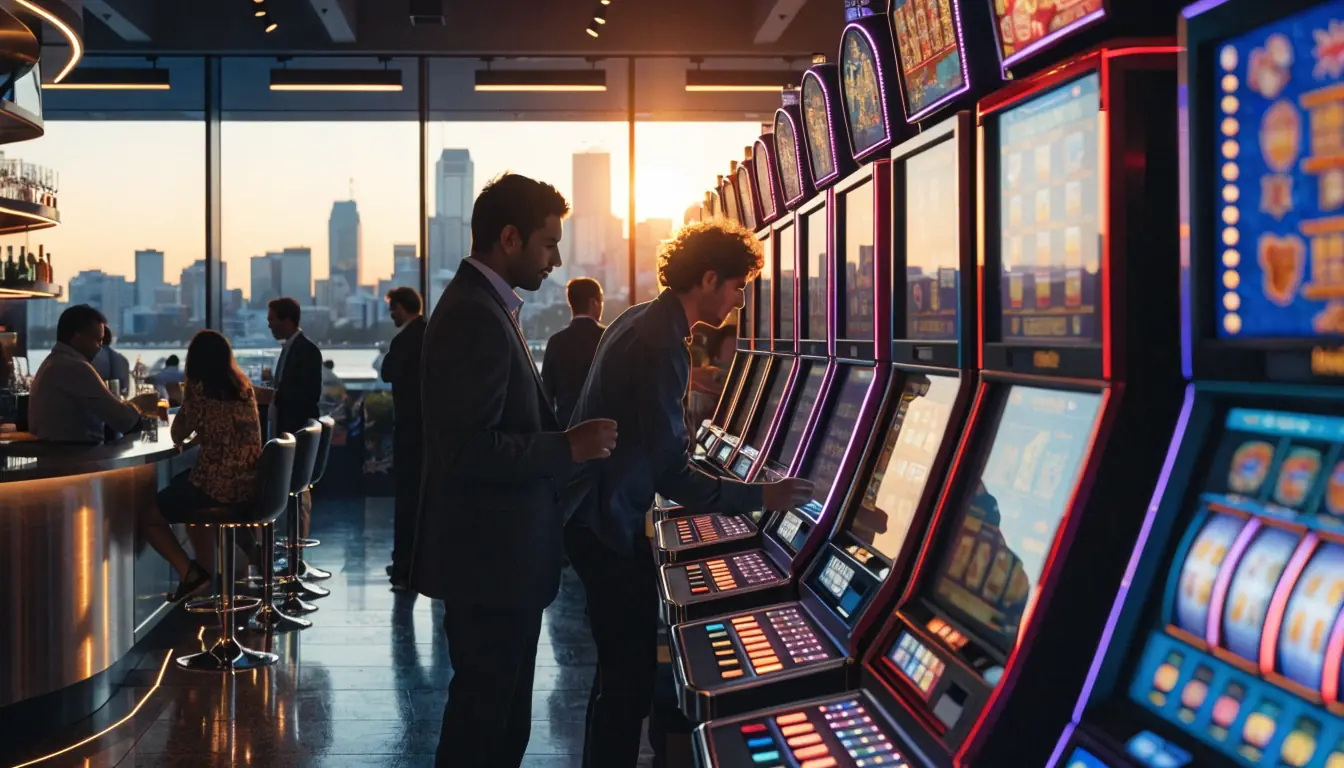
A food court inside a casino precinct works the same way it does anywhere in the city — counter service, shared seating, no reservation. The difference is location: the walk back to the tables is short, and the kitchen keeps pace with the venue rather than the street. Whether a specific outlet is open on any given day is operational detail the casino does not publish in advance; checking the venue’s own channels on the day is the reliable method.
Outdoor pools are the non-gaming reason to book into the precinct. A pool area turns a gambling trip into a full day out — swim, eat at the food court, then decide whether the evening goes back to the floor. Worth stating plainly: the money spent at the pool is gone, while the money spent gambling has a statistical expectation attached. Per-capita figures for Australia put average annual losses around AUD 1,200, and adults experiencing significant gambling problems number between 80,000 and 160,000. The pool is the part of the visit with a known, fixed cost.
What is the minimum legal gambling age in Australia?
18 years. This is set by Australian law, and Melbourne’s casino-integrated hotels enforce it with photo identification at entry points — so even hotel guests can expect ID checks.
Is online gambling legal in Australia?
Only in part. Online sports betting is legal under state/territory licences, but online casino games, poker and in-play betting are prohibited federally under the Interactive Gambling Act 2001, and no domestic online casino licence exists. However, it is not illegal for individual Australians to play at offshore-licensed online casinos — the law targets operators, not players.
Are crypto casinos legal in Australia in 2026?
No online casino gambling — crypto or otherwise — can be legally offered to Australian residents under the Interactive Gambling Act 2001, and no domestic licence can be obtained. Playing at an offshore-licensed casino as an individual is not itself illegal, since the law targets operators rather than players.
Prepared by the Casino Regional Guide editorial staff.