Best Online Pokies for Real Money in Australia
 Available in AU
Understanding Australian Online Pokies: Legal Landscape, Licences and Game Features
Real-money pokies sit at an odd intersection in Australia. The games themselves are a national pastime, the software behind them is built by some of the country’s most successful exporters, and yet the online version of the product exists in a legal grey corridor that every player walks through, whether they realise it or not. This section maps that corridor: what the law actually says, who issues the licences that offshore operators carry, and what separates an Australian-friendly pokie — technically and in gameplay terms — from the same title served to players in London or Toronto.
The Interactive Gambling Act: What It Prohibits and What It Doesn’t
The Interactive Gambling Act 2001 (IGA) is the Commonwealth statute that governs online gambling in Australia. Its central prohibition is straightforward: it is illegal for companies to offer online casino services — pokies, poker, blackjack, roulette — to Australian residents. The law targets the supply side, not the demand side. An individual Australian player who accesses an offshore online casino site is not criminalised. That asymmetry is deliberate. The IGA was introduced as a public protection measure with a stated focus on harm minimisation, and its drafters chose to go after operators rather than punish the people the legislation was written to protect.
With so many pokies sites competing for Australian players in 2026, it helps to see at a glance how each casino is licensed and what its welcome offer actually involves before you sign up.
License: Curacao Gaming Control Board OGL/2023/174/0082 (Dama N.V.) · Bonus: up to A$5,000 + 300 free spins across 4 deposits Licensed under the Curacao Gaming Control Board via Dama N.V., this operator backs its offering with a multi-deposit welcome package worth up to A$5,000 plus 300 free spins spread across four deposits.
License: Curacao Gaming Authority (Jumpman Gaming Ltd) · Bonus: up to A$6,600 + up to 250 free spins across 4 deposits Operating under a Curacao Gaming Authority license held by Jumpman Gaming Ltd, it offers a sizeable welcome bundle of up to A$6,600 and up to 250 free spins across four deposits.
Bonus: 240% up to A$4,100 + 300 free spins Stands out for a straightforward first-deposit boost of 240% up to A$4,100 alongside 300 free spins.
License: Curacao eGaming OGL/2023/174/0082 (Dama N.V.) · Bonus: up to A$10,000 + 500 free spins across 4 deposits · Min. deposit: A$15 Licensed through Curacao eGaming under Dama N.V., this casino offers one of the larger packages on the list, up to A$10,000 plus 500 free spins over four deposits, with a low A$15 minimum deposit.
License: Curacao Gaming Control Board OGL/2023/176/0095 (Hollycorn N.V.) · Bonus: up to A$5,000 + 300 free spins across 4 deposits Holding a Curacao Gaming Control Board license via Hollycorn N.V., it provides a welcome bonus of up to A$5,000 plus 300 free spins across four deposits.
License: Curacao Gaming Control Board OGL/2023/176/0095 (Hollycorn N.V.) · Bonus: up to A$1,500 + 200 free spins across 3 deposits Licensed by the Curacao Gaming Control Board under Hollycorn N.V., it offers a welcome package of up to A$1,500 plus 200 free spins over three deposits.
License: Curacao eGaming OGL/2024/923/0383 (Antillephone N.V.) · Bonus: up to A$2,000 + 100 free spins across 2 deposits · Min. deposit: A$30 Licensed via Curacao eGaming under Antillephone N.V., this casino offers up to A$2,000 plus 100 free spins across two deposits, with a A$30 minimum deposit requirement.
Bonus: up to A$750 + 50 jackpot spins, 35x wagering · Payout speed: crypto ~90 minutes, fiat 1-5 days · Min. deposit: A$30 Notable for its jackpot-focused welcome offer of up to A$750 plus 50 jackpot spins under 35x wagering, and for fast crypto payouts of around 90 minutes alongside a A$30 minimum deposit.
License: Curacao · Bonus: up to A$2,000 Operating under a Curacao license, this casino keeps things simple with a welcome bonus of up to A$2,000.
License: Curacao Gaming Control Board (TechSolutions Group N.V.) · Bonus: 100% up to A$250 + 100 free spins (1st deposit) Licensed by the Curacao Gaming Control Board through TechSolutions Group N.V., it offers a first-deposit match of 100% up to A$250 plus 100 free spins.
There is no domestic pathway around this. An online casino licence for the Australian market does not exist — it cannot be applied for, purchased, or renewed. Sports betting and lotteries are licensed domestically through state and territory regulators, but casino-style online games sit entirely outside that system. What is licensed in Melbourne’s Crown complex has no online equivalent carrying an Australian seal of approval. Every real-money pokie site an Australian player reaches is, by definition, operating from somewhere else.
That fact has a practical consequence that shapes everything else in this article: there is no Australian register of approved online casino operators to check a site against. Advice that works in regulated markets — "verify the operator’s licence number with the local regulator" — simply has no Australian version, because the local regulator for online pokies does not exist. What an Australian player can check is foreign: the licence of the offshore jurisdiction, the operator’s terms, and whether the site appears on a very different Australian list, discussed below.
The 2017 Amendments and ACMA’s Blocking Powers
The IGA was amended in 2017, and the amendments changed the enforcement landscape considerably. The Australian Communications and Media Authority (ACMA) was given the power to require internet service providers to block access to non-compliant offshore gambling sites. This is not a theoretical power. ACMA maintains a public Gambling Prohibition Register listing websites directed for blocking, and since 2017 more than 200 offshore gambling sites have been blocked under this mechanism.

Two things are worth registering about that number. First, blocking operates at the ISP level: a site on the register becomes difficult to reach through ordinary Australian internet connections, though the register itself is public and a determined user can see exactly which domains have been listed. Second, the register is a list of prohibited operators — it is the inverse of an approval list. A site’s absence from the register means only that ACMA has not blocked it; it is not a form of endorsement, and nothing in the Australian system can function as one.
For a player choosing where to play, the register is still a usable filter, just not in the way offshore marketing often implies. A site on ACMA’s register has been formally assessed as non-compliant with Australian law and actively blocked. A site absent from it carries no Australian judgement at all — good or bad. The absence of a domestic licence means the burden of judging an operator falls on the licence the operator holds elsewhere, and on the verifiable details of its own published terms.
The ACMA Gambling Prohibition Register is a blacklist, not an approval list. A site’s absence from the register does not mean it is safe or endorsed; it simply means it has not been blocked yet.
The Offshore Licence Landscape: Curaçao, Malta, Gibraltar, the Isle of Man
Since no Australian licence exists, the offshore casinos that serve Australian players operate under licences from other jurisdictions. The typical set is Curaçao, Malta, Gibraltar, and the Isle of Man, with a handful of recognisable issuing bodies behind them:
- Malta Gaming Authority (MGA) — the most established of the European regulators serving this space; an MGA licence is the most common marker of a serious operation among casinos that accept Australians.
- UK Gambling Commission (UKGC) — a rigorous regulator, though UKGC-licensed operators generally do not serve the Australian market; the licence matters here mainly as a benchmark for what strict regulation looks like.
- Curaçao eGaming — the most frequently seen licence among Australian-facing casinos; cheaper and faster to obtain than European equivalents, which means it spans a wide range of operator quality.
- Gibraltar Regulatory Authority — a well-regarded jurisdiction historically tied to major bookmaking and gaming brands.
- Isle of Man Gambling Supervision Commission — a smaller but credible licensing body, notable for being an early adopter of framework rules around cryptocurrency gambling.
The spread matters more than the names. A Curaçao licence and a Gibraltar licence both make a site "licensed," but they impose very different obligations on the operator, different dispute-resolution paths for the player, and different levels of financial scrutiny. Where a licence number is displayed — prominently in the site footer, verifiable against the regulator’s own records — the claim can be checked. Where it is buried in dense terms-and-conditions text or absent entirely, the claim cannot be checked, and an unverifiable licence claim is functionally the same as having none.
A structural point follows from the licence list: the jurisdictions above are the ones Australian-friendly operators actually hold. An offshore casino serving Australians under none of these licences, or under a licence from a body that cannot be located in any regulator’s public records, falls outside even the loose framework the offshore market has built for itself. The market’s own floor, low as it is, still exists — and a site below that floor is where the actual risk sits, far more than in the legal status of the player.
The Player-Side Position: Legal to Play, Illegal to Serve
Returning to the player, because the asymmetry bears repeating in operational terms. The IGA makes the provision of online casino services to Australians illegal. It does not make the consumption of those services a crime. An Australian playing real-money pokies at an offshore site commits no offence under the Commonwealth statute. The law’s machinery — the 2017 blocking powers, the prohibition register, the enforcement actions against operators — is pointed entirely at the supply chain.
Illegal Supply
Providing real‑money online pokies to Australian residents is illegal for operators. Players are not criminalised, but using a non‑compliant operator can expose them to loss without any Australian consumer protection.
This position is stable across both major amendments of the framework and has not shifted toward player criminalisation. It does, however, come with consequences that flow from the market’s structure rather than from any courtroom. Because the operators serving Australians are offshore and unregulated in Australia:
- Disputes have no Australian venue. A complaint about a withheld withdrawal goes to the offshore regulator named on the licence, if it goes anywhere at all. ACMA accepts complaints about prohibited gambling services, but its remedy is blocking and enforcement against the operator — not recovering a player’s funds.
- Australian consumer law protections are attenuated. The statutory guarantees that apply to domestic transactions do not travel cleanly to a contract with a Curaçao-licensed entity. The operator’s own terms are, in practice, the contract that governs.
- The operator’s published conditions are the primary consumer protection. Which is why the details that matter — wagering requirements shown clearly up front, RTP-verified games, stated withdrawal times — are worth reading before depositing rather than after something goes wrong.
None of this is an argument against playing. It is an inventory of what a player is actually agreeing to: a transaction governed by foreign licence terms, with no domestic backstop, priced against the convenience of access. Anyone depositing real money should make that trade with open eyes and a clear view of the terms.
What "Australian-Friendly" Actually Means: The Market’s Practical Definition
Beyond the legal architecture, the offshore market has developed a working definition of an Australian-friendly casino, and it is expressed in operational details rather than marketing copy. The markers are concrete:
Australian dollar accounts. Deposits and play denominated in AUD, without conversion margins shaving value on every transaction. The minimum deposit at most Australian-friendly casinos falls in the $10–$30 AUD range — low enough to test an operator with real money before committing more.
Australian payment rails. POLi, bank transfer, cryptocurrency, e-wallets, and Visa/Mastercard are the common methods. The composition of this list reflects the local reality: card transactions to offshore gambling sites can be declined by Australian banks, so the market has built around them. POLi and, more recently, PayID are the local-answer methods; the next section of this article deals with PayID in detail.

Withdrawal times measured in hours, not weeks — at least at the top of the market. Bank transfer withdrawals typically take 2–5 business days, which is the baseline the banking system imposes. Faster options compress that dramatically. According to one industry review, withdrawals at some Australian-facing casinos can be processed in under 4 hours. The same review credited one well-known operator with average withdrawal processing under 12 hours, per its own published performance figures. Cryptocurrency withdrawals sit at the far end of the speed curve: one industry review reports they can be processed within minutes. These are single-source claims about specific operators, not market-wide guarantees — but they establish that the fast end of the market is measured in hours and minutes, and an operator whose stated timelines stretch well beyond that is below the standard the better casinos have already demonstrated.
English-language support in Australian time zones. Australian-friendly casinos provide 24/7 live chat in English. This sounds like table stakes until a withdrawal is stuck at 2am AEST; round-the-clock English-language support is one of the few service commitments that can be tested directly, before any money is at stake.
Identity verification before withdrawal. First-time withdrawals commonly require identity verification — a government-issued ID check. This is a feature, not an obstacle: it is the mechanism that stands between a player’s account balance and whoever else might obtain the password. Operators that skip verification entirely are skipping a control, not removing a friction.
The pattern across all five markers is the same: each one is verifiable before a large deposit is made. The AUD minimums are listed, the payment methods are shown in the cashier, withdrawal timelines are in the terms, live chat can be tested with a question, and the verification requirement is stated in advance. An operator that obscures any of these is telling the player something before the player has paid for the lesson.
Deposits and play are denominated in AUD, with minimum deposits typically $10–$30, allowing a low‑cost trial.
Supported methods include POLi, bank transfer, PayID, and popular e‑wallets, avoiding card declines common with offshore sites.
Top operators process withdrawals in hours (sometimes minutes for crypto), whereas the baseline bank transfer takes 2–5 business days.
Live‑chat support in English is available around the clock, ensuring help is reachable even during off‑hours.
HTML5 and the Death of the Download
The technical substrate of online pokies is settled, and it has been for years: HTML5. Every contemporary pokie — new releases included — is built on HTML5 technology, which allows seamless play on smartphones and tablets directly through the browser. No download, no dedicated casino app required, no separate "mobile version" of the game with a stripped feature set.
The significance of this is easy to understate, so it is worth spelling out what changed. The pre-HTML5 era split the market. Casino software came as downloadable clients, which meant the full game library ran on desktop machines, while mobile players received a reduced selection of converted titles. An Australian playing on a phone was playing a second-class catalogue. HTML5 collapsed that division: the game that loads in Safari on an iPhone is the same build, with the same reels, paylines, bonus rounds, and RTP, as the one that loads in Chrome on a desktop in Sydney.

The practical consequences for mobile play are specific:
- One account, every device. Registration, deposits, play, and withdrawal requests all function through the same browser-based interface. A session started on a desktop can be resumed on a phone mid-commute without any reconfiguration.
- No storage or update overhead. The game code loads from the operator’s servers each time. There is nothing to install, nothing to update, and nothing occupying device storage — a real consideration on phones where a download client and a handful of game packages were once a multi-gigabyte commitment.
- Platform parity in game features. Bonus rounds, free spin mechanics, Megaways-style dynamic reels, and progressive jackpot pools behave identically across devices, because they are the same code executing in different browsers.
- Australian network conditions are sufficient. HTML5 pokies are lightweight by design — continuous streaming video is not involved outside the live-casino vertical — so play over mobile data is stable on ordinary Australian connections.
"Mobile pokies real money" is, at this point, not a separate product category. It is simply pokies. The distinction survives only in search behaviour and in the marketing of operators still advertising apps that are, functionally, wrappers around the same HTML5 games the browser serves anyway. Where a genuine native app exists, its value is in notification handling and session convenience — not in game quality, which is now identical across platforms.
RTP: The One Number That Travels Across Every Reel
Return to Player is the single most important technical figure in a pokie, and it deserves a precise definition, because it is routinely misread. RTP represents the theoretical percentage of wagered money that a pokie will pay back over time. A pokie with a 96% RTP returns $96 for every $100 wagered — on average, across the full lifespan of play on that machine.
Every clause in that definition is load-bearing:
"Theoretical." RTP is computed over an enormous number of spins — the kind of sample only the game’s aggregate player base generates. It is not a promise about any single session. A player can sit at a 96% RTP pokie and lose $100 of a $100 deposit in twenty minutes; RTP says nothing that contradicts this, because variance — volatility, in the game’s mechanics — governs short-run outcomes while RTP governs the long-run average.
RTP
Return to Player (RTP) is the theoretical percentage of total wagered money that a pokie will pay back over a very large number of spins. A 96% RTP means the game returns $96 for every $100 wagered on average.
"Of wagered money." The percentage applies to the total amount wagered, not deposited. A player who deposits $50 and cycles it through a pokie repeatedly, wagering $500 in total on a 96% RTP game, is averaging a $20 theoretical loss against that $500 of turnover — not a $2 loss against the $50 deposit. The house edge compounds on turnover, which is why slow, low-stakes play and rapid, high-stakes play can produce identical percentages with wildly different dollar outcomes.
"Over time." The figure is a long-run statistical property, verified in testing. Reputable operators run RTP-verified or provably fair games — titles whose payout behaviour has been audited by independent industry bodies such as eCOGRA, GLI, and iTech Labs, or, in the crypto segment, whose outcomes can be verified cryptographically by the player. An operator publishing audited RTP figures is making a checkable claim; one publishing none is leaving the most basic economic property of its games opaque.
RTP comparisons across games are legitimate and meaningful — all else equal, a higher RTP is simply a lower price for the same entertainment. But the comparison only holds when the figure is verified. Unverified RTP is a marketing number, and treating it as a purchasing criterion — which it should be — requires treating the verification, not the number itself, as the thing to check.
Game Features That Define the Contemporary Australian Pokie
The mechanics of modern pokies have moved well past the three-reel format that populated the first online casinos. For Australian players choosing among real-money titles, the features below are what distinguish one game’s behaviour from another’s — and each has direct consequences for how a bankroll experiences a session.

Megaways mechanics. Pioneered by the Australian studio Big Time Gaming, Megaways replaces fixed paylines with a dynamic reel system: each reel can display a varying number of symbols on every spin, producing thousands of potential ways to win and a payout structure that changes spin to spin. It is the most consequential mechanical innovation in the pokie format this century, and its Australian origin is a point of local pride that is also commercially visible — the mechanic is licensed across the industry.
Bonus buy features. Many contemporary pokies allow players to purchase direct entry into the bonus round rather than waiting for the trigger combination to land naturally. The price is a fixed multiple of the base bet; the purchase converts the game’s variance into an immediate, high-stakes event. It is the most aggressive bankroll feature in modern pokie design and deserves the same deliberation as any other bet of its size.
Free spins and retrigger mechanics. The staple bonus structure: a symbol combination awards a round of spins at no additional cost, frequently with enhanced features — multipliers, expanding symbols, sticky wilds — that do not apply in base play. Retriggers extend the round mid-feature. Because free spins play at the triggering bet level, their value scales with the stake that unlocked them.
Cascading and tumbling reels. On winning combinations, the winning symbols are removed and new symbols fall into their places, allowing consecutive wins from a single paid spin. Consecutive cascades frequently carry escalating multipliers. The mechanic converts one wager into a chain of outcomes — higher engagement per spin, and correspondingly variable results.
RTP loss calculation
The article states a typical RTP of 96%.
A player wagers $500 in total on the game.
$500 × (1 – 0.96) = $500 × 0.04 = $20 theoretical loss.
Over the long run the player can expect to lose about $20 on $500 of turnover, regardless of the initial deposit size.
Progressive jackpots. A small fraction of every wager across the network of machines playing a linked title feeds a pooled jackpot that pays at random or on a specific outcome. Mega Moolah is the canonical example — a networked progressive whose pooled prizes have set records in the online segment. The arithmetic trade-off is structural: progressive titles typically fund the jackpot pool through the base RTP, meaning the regular game pays back slightly less to fund the tail-risk prize.
Hold-and-win and collect mechanics. Bonus rounds built around collecting special symbols that land and lock in place, building toward tiered prizes. The format has become a dominant template in new releases because it produces a visible, escalating structure during the feature itself.
The studios behind these mechanics are worth naming, because provider identity is one of the few reliable quality signals in an unlicensed-by-Australia market. Aristocrat — the Australian company whose physical pokie cabinets fill the country’s pubs and clubs — supplies the domestic land-based market and remains the reference point for what the word "pokies" means to Australian players. In the online space, Microgaming and NetEnt are the long-established majors; Big Time Gaming is the Australian innovator behind Megaways; Pragmatic Play is the most prolific current release engine; Blueprint Gaming carries a deep catalogue built heavily on licensed Megaways titles; and BGaming serves the crypto-first segment of the Australian-facing market with provably fair implementations. Games from these studios appear across the better offshore operators, and their titles — Bonanza Megaways, Extra Chilli Megaways, Gates of Olympus, Gonzo’s Quest, Mega Moolah, Starburst — form the core catalogue an Australian player will encounter on essentially every Australian-friendly site.
How Game Selection Actually Works in the Offshore Context
Choosing among real-money pokies at an offshore casino combines everything above — the licence, the verification, the RTP, the mechanics — into a sequence that a careful player runs roughly in order.
First, the operator check: the licence in the footer, its issuing body among the recognisable regulators, the absence of the site from ACMA’s prohibition register. This establishes the floor — who, if anyone, stands behind the operator’s conduct.
Second, the game-level check: whether the catalogue contains titles from the major studios, and whether the operator presents RTP-verified games with their figures displayed. A casino running audited titles from known providers has outsourced its game integrity to those providers and their auditors; a casino running unidentifiable proprietary games has outsourced it to no one.
Third, the economic check: the minimum deposit against the intended session budget, the payment methods actually available in AUD, the stated withdrawal timeline, and the wagering conditions attached to any bonus — which the operator is obliged to display clearly up front. Wagering requirements with a defined expiry date, fulfilable within that period, are the difference between a bonus and a marketing trap; the arithmetic of a 30x-to-60x style playthrough on bonus funds is covered in detail in the bonus section of this article.
Fourth, the test run: a small deposit within the stated AUD minimum range, a low-stakes session on a verified game, a live chat question, and — if the account is to be kept — a small first withdrawal, which triggers the identity verification process and measures the operator’s actual payout speed against its published timeline. Every one of these steps costs little and reveals much. The total cost of the full sequence is a modest deposit and some patience; the cost of skipping it is discovering the answers with a larger balance at stake.
PayID enables instant AUD deposits to offshore casino balances, crediting the player’s account within seconds and eliminating the waiting time of traditional card or bank transfers.
Where the 2026 Market Stands
Two currents shape the Australian-facing market as it heads into 2026. The first is enforcement: ACMA’s blocking powers have been applied to more than 200 sites since 2017, and the register continues to grow. Blocking reshuffles traffic toward operators not yet listed, but it does not change the underlying structure — the supply of real-money pokies to Australians remains legally prohibited for operators and legally tolerated for players, and every "best online pokies real money Australia" recommendation operates inside that fixed frame, not around it.
The second is the payment and technology layer. HTML5 made every pokie a mobile pokie; instant AUD rails such as PayID, covered next, have compressed deposit times to seconds; and the fast end of the withdrawal market — hours and minutes at the top operators, per the single-source figures above — has made payout speed a competitive differentiator rather than a lottery. The games themselves continue to iterate on mechanics rather than platform, which means the practical differences between casinos in 2026 sit less in what they offer to play and more in how honestly they run the surrounding machinery: verification, withdrawal speed, RTP transparency, and terms displayed before the deposit rather than discovered after it.

That is the honest summary of the landscape. The law draws a clear line against operators and leaves players alone; the licence that matters is foreign and checkable; the games are audited, mobile-native, and mechanically richer than ever; and the difference between a good offshore casino and a bad one is a set of verifiable operational facts, all of which can be tested for the price of a minimum deposit. The rest of this article takes those tests one layer deeper — starting with the payment method that has changed the deposit experience most for Australian players.
Instant PayID Deposits: Funding Your Pokie Sessions in Seconds
PayID moves money between an Australian bank account and an offshore casino balance without the wait attached to older methods. A deposit is sent in AUD, credited to the pokie account instantly, and playable in real money mode within seconds of confirmation. No separate wallet registration is involved: the payment runs through the existing bank account using a PayID identifier rather than card details.
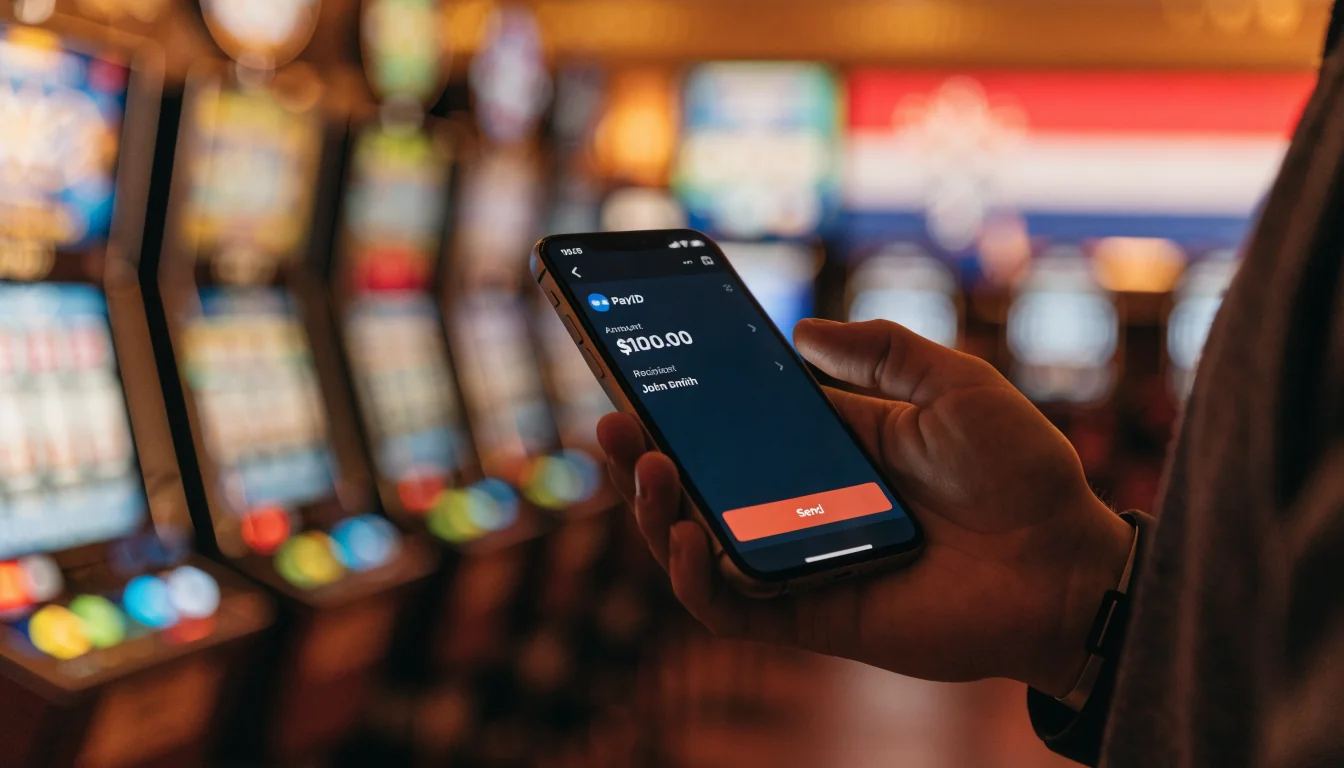
The entry threshold is low. Minimum deposits at most Australian-friendly casinos sit between $10 and $30 AUD, which covers a first session without committing a large balance. POLi and bank transfer remain alternatives for players who prefer them, but bank transfer withdrawals take 2–5 business days — a different proposition entirely from a payment identifier designed for immediate settlement. First-time withdrawals still pass identity verification before funds are released, regardless of how quickly the deposit arrived.
No‑Deposit Bonuses for Australian Pokies: Offers, Limits and Wagering
A no deposit bonus is the only way to test real money mode on Australian pokies without funding an account first. The offer itself is small. According to one industry review, no‑deposit bonuses for online pokies in Australia range from $10 to $50 in free credits, or from 10 to 50 free spins, depending on the operator’s terms.
The cost sits in the wagering requirements. The same review puts them at 30x to 60x the bonus amount before any winnings can be withdrawn. On a $20 credit with a 60x multiplier, that is $1,200 in wagers — and pokies with a 96% RTP return $96 per $100 wagered, so the arithmetic rarely favours the player.
The remaining condition is the cash‑out cap. Some operators attach a maximum withdrawal limit to no‑deposit winnings; the exact figure appears in the bonus terms, which reputable sites display clearly upfront. Read the three numbers — bonus size, multiplier, cap — before claiming, not after.
Are online pokies legal in Australia?
Offering online casino services to Australian residents is illegal under the Interactive Gambling Act 2001, but individual players are not criminalised for accessing offshore sites. There is no Australian online casino licence — every real-money pokie site serving Australians operates from offshore.
How can a player verify that an online casino holds a valid licence in Australia?
There is no Australian licence to verify, since a domestic online casino licence does not exist. Check the operator’s offshore licence (Malta, Curaçao, Gibraltar or Isle of Man) in the site footer against the regulator’s own records, and confirm the site is not on ACMA’s public Gambling Prohibition Register.
What is a licensed online pokies site?
A casino operating under a licence from an offshore regulator such as the Malta Gaming Authority, Curaçao eGaming, the Gibraltar Regulatory Authority or the Isle of Man Gambling Supervision Commission. The licence number should be displayed prominently and be verifiable against the regulator’s records.
Can I play online pokies for free?
Yes — many no-deposit bonuses give $10–$50 in free credits or 10–50 free spins, letting you play without funding an account. Note that winnings usually carry wagering requirements of 30x–60x and some bonuses have maximum cashout limits.
Where can I complain about an online casino in Australia?
ACMA does not resolve individual complaints, but it maintains the Gambling Prohibition Register and can act against non-compliant offshore sites. Your practical recourse runs through the dispute-resolution path of the operator’s offshore licence — which varies by jurisdiction (Curaçao, Malta, Gibraltar or Isle of Man).
How does ACMA protect Australian online gamblers?
Since the 2017 amendments, ACMA can require internet service providers to block non-compliant offshore gambling sites, and it maintains a public Gambling Prohibition Register — over 200 sites have been blocked since 2017. It is a prohibition list, not an approval list: a site’s absence from it means no Australian judgement either way.
How fast are withdrawals at Australian online casinos?
Cryptocurrency withdrawals can be processed within minutes, PayID deposits are instant, and some withdrawals are completed in under 4 hours (PlayAmo averages under 12 hours). Bank transfers are the slowest option at 2–5 business days, and first-time withdrawals may require identity verification.
Prepared by the Casino Regional Guide editorial staff.