
Online Pokies with PayID in Australia: Full Guide
 Available in AU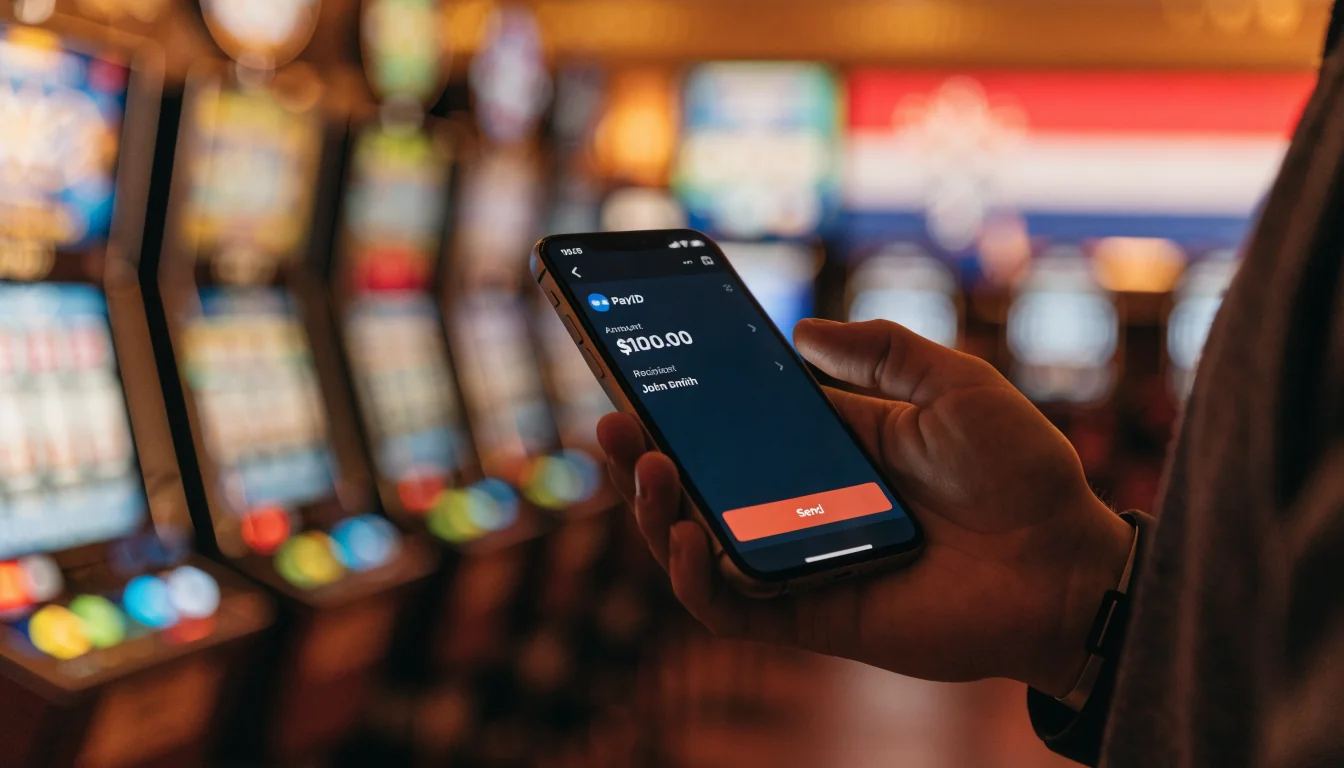
- What Are Online Pokies and Why PayID Is Growing in Australia
- Real‑Money Play: How Much Can You Win with PayID Pokies?
- PayID Pokies for Real Money: Risks and Expected Losses
- PayID Payment Methods and Instant Payouts for Pokies
- Sign‑Up Bonuses and Promotions for PayID Pokies
- Which Australian Pokies Sites Accept PayID?
- Free Credit Pokies via PayID on Facebook – What’s Allowed?
- Can You Play Online Pokies Using PayID? Technical and Legal Overview
What Are Online Pokies and Why PayID Is Growing in Australia
Pokies is the Australian word for poker machines — slot machines by any other name. The formal term is electronic gaming machines, or EGMs, and it is the term that appears in legislation, regulatory guidance and anti-money-laundering literature. In everyday use, "pokies" covers the machines found in Australian pubs, clubs and casinos, and, by extension, the digital versions of the same games played over the internet. This section sets out what those games actually are, how large the Australian market for them is, and why PayID — a payment identifier built on top of the domestic banking system — has attached itself to the phrase "online pokies" so firmly that the two now travel together in search bars and casino marketing alike.
What a pokie actually is
An electronic gaming machine is a gambling device with a screen, a random number generator and a payment mechanism. The player stakes money, presses a button, and the machine returns a result determined by the random number generator. Over time, the machine’s return-to-player setting guarantees that the operator keeps a fixed share of everything staked. That is the entire product. Everything else — themes, bonus rounds, free spins, jackpots — is presentation layered on top of that arithmetic.
Choosing where to play pokies with PayID comes down to trust and terms, so it’s worth checking each operator’s licensing and welcome offer before signing up.
License: Curacao Gaming Control Board OGL/2023/174/0082 (Dama N.V.) · Bonus: up to A$5,000 + 300 free spins across 4 deposits Licensed under Curacao Gaming Control Board via Dama N.V., with a welcome package worth up to A$5,000 plus 300 free spins spread across four deposits.
License: Curacao Gaming Authority (Jumpman Gaming Ltd) · Bonus: up to A$6,600 + up to 250 free spins across 4 deposits Operated by Jumpman Gaming Ltd under a Curacao Gaming Authority license, offering a sizeable welcome bonus of up to A$6,600 with 250 free spins across four deposits.
Bonus: 240% up to A$4,100 + 300 free spins Stands out for a high-percentage 240% match bonus up to A$4,100 plus 300 free spins.
License: Curacao eGaming OGL/2023/174/0082 (Dama N.V.) · Bonus: up to A$10,000 + 500 free spins across 4 deposits · Min. deposit: A$15 Licensed by Curacao eGaming through Dama N.V., with a substantial bonus of up to A$10,000 and 500 free spins over four deposits, requiring a low A$15 minimum deposit.
License: Curacao Gaming Control Board OGL/2023/176/0095 (Hollycorn N.V.) · Bonus: up to A$5,000 + 300 free spins across 4 deposits Holds a Curacao Gaming Control Board license via Hollycorn N.V., pairing it with a welcome offer of up to A$5,000 and 300 free spins across four deposits.
License: Curacao Gaming Control Board OGL/2023/176/0095 (Hollycorn N.V.) · Bonus: up to A$1,500 + 200 free spins across 3 deposits Licensed under the Curacao Gaming Control Board through Hollycorn N.V., with a more modest but accessible bonus of up to A$1,500 and 200 free spins across three deposits.
License: Curacao eGaming OGL/2024/923/0383 (Antillephone N.V.) · Bonus: up to A$2,000 + 100 free spins across 2 deposits · Min. deposit: A$30 Licensed by Curacao eGaming via Antillephone N.V., offering up to A$2,000 plus 100 free spins across two deposits, with a A$30 minimum deposit.
Bonus: up to A$750 + 50 jackpot spins, 35x wagering · Payout speed: crypto ~90 minutes, fiat 1-5 days · Min. deposit: A$30 Offers a bonus of up to A$750 plus 50 jackpot spins under 35x wagering, backed by fast crypto payouts of around 90 minutes and fiat withdrawals within 1-5 days, with a A$30 minimum deposit.
License: Curacao · Bonus: up to A$2,000 Operates under a Curacao license and provides a welcome bonus of up to A$2,000.
License: Curacao Gaming Control Board (TechSolutions Group N.V.) · Bonus: 100% up to A$250 + 100 free spins (1st deposit) Licensed by the Curacao Gaming Control Board through TechSolutions Group N.V., with a first-deposit bonus of 100% up to A$250 plus 100 free spins.
The distinction between a land-based pokie and an online pokie is smaller than it looks. The same game logic runs on both. What changes is the delivery channel and the money handling. A pub pokie accepts cash, prints a ticket, and pays out at a cashier or redemption terminal. An online pokie sits behind a website or app, and every deposit and withdrawal moves through a payment system. The game itself is portable between the two; the payment layer is not.
This is where PayID enters. PayID is not a casino product, a wallet or a gambling brand. It is a payment addressing standard created for the Australian New Payments Platform — the real-time banking infrastructure that connects Australian bank accounts. A PayID links an easy-to-remember identifier, such as a phone number or an email address, to a bank account, so that a transfer can be sent to that identifier instead of to a BSB and account number. Transfers made this way clear in near-real time, typically within minutes, and the recipient’s name is displayed to the sender before the money leaves, which makes misdirected payments rare.

The scale of the Australian pokies market
The numbers that describe Australian gambling are not subtle. In the 2020–21 financial year, Australians bet almost AUD$150 billion on electronic gaming machines, and players lost AUD$12 billion of that. The word "loss" is doing precise work here: it is the amount staked minus the amount won back, which is to say the revenue the machines extracted from the people playing them. The turnover figure is much larger because the same money is recycled through the machines repeatedly — a player who loses $608 in a year may have pushed several times that amount through the reels.
The per-capita figure for that same financial year is AUD$608 per adult lost to electronic gaming machines. That is an average across the entire adult population, including the substantial majority who never play. The loss carried by actual players is correspondingly higher than the average.
Australia’s share of the world’s machines is disproportionate to its population. The country is home to 3% of the world’s pub and club poker machines while holding only 0.3% of the global population — a tenfold over-representation. One further estimate, reported by complyadvantage.com, puts Australia’s share of the world’s poker machines at about 18%; that figure has not been corroborated by other sources and should be read as a single outlet’s claim rather than an established market statistic. The 3% figure, by contrast, refers specifically to pub and club machines and is the more commonly cited measure.
Cash handling in land‑based pokies is a major anti‑money‑laundering risk, with large cash insertions and minimal play often used to disguise illicit funds.
New South Wales is the centre of gravity. The state contains approximately 95,800 pokies. NSW clubs alone recorded $1.945 billion in net profit from pokies over the period from December 2017 to May 2018 — roughly eighteen months of operations at licensed clubs in a single state. That profit is the player loss, recorded as venue revenue.
On turnover, complyadvantage.com reports that pokies generated $191.2 billion in Australian gambling turnover in 2023. As with the 18% machine-share figure, this is one source’s number and is presented here as that source’s claim rather than as a settled market figure. It is, however, directionally consistent with the official FY 2020–21 turnover of almost AUD$150 billion: turnover of this magnitude is the ordinary condition of the Australian machine-gambling market, not an anomaly.
From pubs to browsers: what "online pokies" means in Australia
The legal landscape shapes the online market more than any marketing claim does. Under the Interactive Gambling Act 2001, it is illegal to offer online casino-style games — slots, poker, blackjack, roulette — to Australian residents, and it is not possible to obtain a domestic licence to operate an online casino in Australia. There are no domestically licensed real-money online casino operators serving Australian players. The law targets operators, not individuals: it is not illegal for an individual Australian to play at an offshore-licensed online casino. This produces a peculiar market structure in which the domestic provision of online pokies is prohibited, the demand is legal to satisfy, and the supply is met almost entirely by operators licensed offshore.
This structure explains much of the language that surrounds the subject. Sites promoting "online pokies PayID Australia" are, in nearly all cases, describing offshore-licensed casinos that accept Australian players and that list PayID — or a related bank-transfer method built on the New Payments Platform — among their deposit options. There is no Australian regulatory register in which such an operator’s casino licence can be verified, because no such licence exists. Sports betting is different: online sports betting is legal in Australia under state and territory licences, and licensed wagering operators are a visible, regulated part of the market. The pokies side of the online market operates entirely outside that framework.
The practical consequence is that any discussion of "the best" online pokies sites for Australian players is a discussion of offshore operators, and offshore operators answer to regulators in their licensing jurisdictions — commonly places such as Malta or the United Kingdom — rather than to any Australian authority. A site advertising PayID deposits to Australian players is making a payment claim, not a licensing claim. The two should not be confused: accepting an Australian payment method says nothing about an operator’s standing under Australian law, and under Australian law no online casino has standing.
Legal risk
Offering or promoting online pokies to Australian residents breaches the Interactive Gambling Act 2001 and can result in significant penalties.
Why cash is a problem, and why that matters for payments
The land-based pokies market runs on cash, and cash creates problems that regulators have documented in detail. A high volume of cash transactions with limited traceability makes pokies attractive for money laundering. Public inquiries and sector guidance identify pokies as a major anti-money-laundering risk area, and the NSW Crime Commission has been among the bodies drawing attention to the scale of the issue.
The mechanics are not sophisticated. The documented typologies include:
- Cash placement with minimal play. A person inserts a large amount of cash into a machine and withdraws it after little or no gameplay. The machine has functioned as a laundry: cash went in, a ticket or account credit came out, and the proceeds now carry the appearance of gambling winnings.
- Purchasing winning tickets. Criminals buy winning tickets from genuine players, paying them the face value plus a margin, and redeem the tickets themselves. The redemption record shows a legitimate win.
- Structuring across venues. Cash is broken into smaller amounts and moved through multiple venues to stay beneath thresholds and avoid triggering reporting.
- Collusion and weak oversight. Multiple parties working together, combined with venues that do not scrutinise unusual behaviour, allow illicit cash to move through machines with little friction.
Regulators and compliance guidance list specific red flags that venue staff are trained to watch for: large cash insertions followed by minimal play and immediate cash-out; frequent small redemptions across venues; multiple patrons appearing to work together to move cash; customers refusing identification or using multiple player cards; redemption patterns that diverge from venue averages; access to more cash than the customer’s profile would suggest; and deposits of higher values and larger amounts of cash than expected.
Against these typologies, the countermeasures are customer verification and patron profiling — knowing who the player is and whether their activity fits what is known about them. And this is the point at which the payment method stops being a convenience question and becomes a policy question: cashless, account-based pokies improve traceability. Every transaction tied to a verified account leaves a record. Every cash insertion into an anonymous machine does not.
Why PayID is growing: the banking side
PayID’s rise as a payment option for online gambling in Australia rests on properties of the New Payments Platform rather than on anything specific to gambling.
Speed. Traditional bank transfers between institutions could take a business day or more. New Payments Platform transfers settle in near-real time. For online gambling — an activity where the interval between deciding to play and actually playing has real behavioural significance — speed is the headline feature. A deposit that clears in minutes removes the waiting period during which a player might reconsider, which is precisely why operators like it and why harm-minimisation researchers view it with less enthusiasm.
Verified recipient names. When a PayID transfer is initiated, the system displays the name registered against the PayID before the transfer is confirmed. In a market full of offshore operators with shifting banking arrangements, this check gives the depositor at least one verifiable piece of information: the transfer is going to an account registered under a particular name. It is not due diligence and it is not a licence check — but it does prevent the most mundane failure mode, which is money sent to the wrong account.
PayID transfers settle in near‑real time, allowing deposits to appear within minutes and withdrawals to be processed equally quickly.
Familiarity. PayID is not a gambling product. It is an ordinary banking feature used by ordinary Australians for splitting bills and paying tradespeople. No separate account, no new app, no prepaid voucher. A payment method that already lives in the player’s banking app requires no behavioural change beyond entering an identifier instead of card details.
No card involvement. Australian gambling regulation prohibits licensed operators from accepting credit cards for deposits and betting. A bank-account-based transfer method sidesteps the card rails entirely. For offshore operators, PayID-style transfers additionally avoid card-scheme scrutiny of gambling transactions. The deposit leaves a bank account, arrives in minutes, and never touches a card network.
Why PayID is growing: the traceability side
There is a second, less commercially driven reason account-based payments are gaining ground in the pokies world, and it runs in the opposite direction from the convenience argument.
Cash is the preferred medium of gambling-related money laundering precisely because it is anonymous. The move toward cashless and account-based gambling — in land-based venues as much as online — is, in regulatory terms, a harm-minimisation and AML measure. When play is tied to an account and an identity, the red-flag behaviours listed above become visible: the player who deposits more cash than their profile supports, the patron who redeems in small amounts across venues, the group of customers whose cash movements coordinate with each other. None of these patterns is detectable in an all-cash venue with no player records.

The policy conversation in Australia has therefore been pulling in the same direction as the payments technology. Cashless gaming trials, account-based play, mandatory card-based play in some jurisdictions — each of these measures converts anonymous cash into traceable account transactions. PayID is the retail-banking expression of the same shift. The same property that makes account-based payments useful to AML investigators — every transaction leaves a record — makes them structurally different from cash handling, whatever the gambling context.
It is worth stating plainly that this traceability is a feature of the payment system, not a protection for the player. Moving money into an offshore casino by PayID produces a bank record of the transfer; it produces no protection of the funds once they arrive. A record that a deposit was sent is not a record that a deposit was credited, and it is not a mechanism for retrieving money from an operator over whom no Australian regulator has jurisdiction.
The 2026 context
Search interest in "online pokies PayID Australia" heading into 2026 reflects a convergence of trends that have been building for several years: the migration of gambling from venues to browsers and apps, the near-universal adoption of real-time payments in Australian banking, the regulatory pressure on cash gambling, and the prohibition-driven structure of the online casino market itself.
PayID doesn’t change odds
PayID makes money move faster and more traceably, but it does not affect the expected loss from playing pokies.
Each trend feeds the others. Real-time banking made offshore deposits frictionless enough to compete with the cash experience of a local venue. AML pressure is pushing land-based venues toward account-based play, narrowing the anonymity gap between the pub machine and the website. And the domestic prohibition on online casinos means the online market has no licensed domestic participants — so the payment experience, not the licence, becomes the thing offshore operators compete on and the thing players evaluate them by. In a market where every operator is equally unlicensed from the Australian point of view, "accepts PayID" does measurable commercial work: it signals that deposits will move through familiar banking rails at familiar speed.
Responsible-gambling infrastructure has been building in parallel. BetStop, the national self-exclusion registry, launched in August 2023 and registered 18,000 users in its first six months — a measure of both the demand for exclusion tools and the scale of the harm they address. Poker machines are identified as the most harmful form of gambling in NSW, which is the state with the densest concentration of machines. Gambling revenue accounted for 7.7% of state and territory taxation revenue in 2015–16, which explains why the fiscal stakes of any reform — cashless gaming included — are considerable. These are the forces that will continue to shape both the availability of online pokies and the payment methods attached to them.
What PayID does not tell a player
A payment method is an answer to the question "how does money move". It is not an answer to any of the other questions a player might reasonably ask.
PayID does not indicate that an operator is licensed in Australia, because no online casino operator is licensed in Australia. It does not indicate that games are fair, that withdrawals will be honoured, that deposits will be credited, or that a dispute has any avenue of resolution. The verified name on the PayID tells the depositor who owns the receiving account and nothing more. The speed of the transfer tells the depositor how fast the money left and nothing more.

The sections that follow examine the financial reality of the market from both directions — the headline turnover and the per-capita loss — before turning to the mechanics of PayID deposits and withdrawals, the bonus structures attached to them, the question of which operators accept the method, and the technical and legal picture of playing online pokies from Australia. The one number worth carrying forward into all of it is the AUD$12 billion: the amount Australians lost to electronic gaming machines in a single financial year. Every payment innovation in this market, PayID included, ultimately serves the movement of that money. The speed of the rails changes how fast it moves; it does not change where it ends up.
Real‑Money Play: How Much Can You Win with PayID Pokies?
The honest answer to "how much can you win" starts with what actually changes hands. In FY 2020‑2021 Australians bet almost AUD$150 billion on electronic gaming machines, and players lost AUD$12 billion of that. Those two figures sit in the same paragraph deliberately: the money flowing through pokies is enormous, and the money staying with players is the smaller share of it.

Where the money goes
Turnover is not winnings. When a machine takes a bet and pays out a win, both halves count as turnover — the same dollars can cycle through dozens of times in a single session. A headline number for 2023, reported by complyadvantage.com, puts Australian gambling turnover from pokies at $191.2 billion; that figure measures activity, not profit in anyone’s pocket.
The profit side is easier to see at the venue level. NSW clubs alone recorded $1.945 billion in net profit from pokies between December 2017 and May 2018 — and that is one state, one segment, and a period shorter than a year and a half. pubs and clubs hold the machines; the house margin does the rest.
What that means for a PayID player
PayID changes how money moves — instant, account‑based, traceable — not what the machine returns. Real-money play with PayID deposits carries the same mathematical structure as any other payment method:
- Turnover is not return. High betting volume describes how much was wagered, not how much was won.
- Operator profit is the aggregate of player outcomes. The AUD$12 billion lost in FY 2020‑2021 is the sum of every session that ended below its starting balance.
- Tax-free at the player’s end. Gambling winnings are not taxed in Australia, so a genuine win is kept in full — one of the few clean advantages in the equation.
The other side of the ledger
Gambling is not a rounding error in public finances either. In 2015‑16, gambling revenue accounted for 7.7% of state and territory taxation revenue. Governments have a direct, quantified stake in the volume of play — which is why the numbers above are published and audited in the first place.
The practical takeaway: real-money PayID pokies offer the fastest deposit path available to Australian players, winnings that arrive untaxed, and a game whose economics are documented down to the dollar. Whether any individual session ends on the winning side of the AUD$12 billion is a separate question — one the next section answers with per‑capita loss figures rather than aggregate ones.
PayID Pokies for Real Money: Risks and Expected Losses
The previous section looked at the money flowing through pokies. This one looks at where it comes from: the player. The same turnover figures that read as operator revenue read, from the other side of the machine, as loss.
The headline number
In FY 2020–2021, per-capita loss from electronic gaming machines in Australia was AUD$608. That is not a figure for problem gamblers — it is the average across the adult population, most of whom never touch a pokie. The loss is not evenly distributed; a small share of players accounts for the bulk of it. For anyone funding an account with PayID and playing for real money, the arithmetic is straightforward: the machines are built to return less than they take in over time, and AUD$608 per head per year is what that looks like at a national scale.
Concentration of harm in NSW
Poker machines are the most harmful form of gambling in NSW — that is not an advocacy position but the finding of public inquiries into the sector. The state carries a disproportionate share of the national machine base, and the harm that follows it: financial loss concentrated among players who cannot afford it, and the laundering risk that comes with heavy cash volume. PayID, by making transactions traceable and account-based, is part of the policy response to both problems. That does not soften the loss side of the ledger for the player; it only makes the ledger visible to someone else.

What PayID changes — and what it doesn’t
Instant transfers and account-based play change the mechanics of payment. They do not change the expected outcome of the game. A deposit that arrives in seconds and a withdrawal that clears quickly remove friction in both directions — friction that, for some players, functioned as a brake. Fast money in and fast money out means a losing session can compound faster than it would with slower methods.
Australia holds 3% of the world’s pub and club poker machines with 0.3% of the global population — a concentration that regulators treat as a structural risk rather than a point of pride.
Practical markers of trouble
Losses that scale with access to fast payments rather than with a set budget are the clearest warning sign. A prepaid limit set before a session, and PayID used to move only that amount, keeps the transfer mechanism from becoming the loss mechanism. The BetStop self-exclusion registry, launched in August 2023, is free to use and blocks access across licensed operators; Gambling Help Online operates the same way. Neither reverses a loss already incurred — by the time AUD$608-per-head averages are in the data, individual losses are already booked.
PayID Payment Methods and Instant Payouts for Pokies
PayID works through Australia’s New Payments Platform, which links an identifier — a phone number, email address or ABN — to a bank account. For deposits at pokies sites that accept it, the transfer moves directly between the player’s bank and the operator’s account, without card details changing hands.
The practical advantage is speed. A PayID transfer settles near-instantly, which means deposits appear without the delay typical of older bank payment rails, and withdrawals processed via the same rail can reach the player’s account the same way.
The same shift is visible in venues. Cashless, account-based pokies improve traceability compared with machines fed by banknotes, and customer verification paired with patron profiling is part of the AML controls operators are expected to run. In that respect, PayID is not a detour around the rules — it is a payment rail the rules can follow.
Sign‑Up Bonuses and Promotions for PayID Pokies
Promotional offers attached to PayID deposits follow one rule worth stating first: Australian law requires wagering requirements to be displayed clearly before any bonus is offered. A promotion without its terms shown up front is not a bargain with small print — it is a compliance failure, and a reason to walk away.
What operators can and do offer varies, and no official source publishes a standard bonus structure for PayID users. Any "ultimate list" of PayID pokies promotions would have to invent the numbers, so none appears here. What is verifiable is the tax position: winnings are not taxed in Australia. Whatever a withdrawal returns, the amount is the amount.
One caution sits at the intersection of bonuses and banking: access to more cash than expected for the customer profile is a recognised red-flag indicator under AML guidance. Chasing promotional credit by depositing beyond one’s usual pattern is exactly the behaviour transaction monitoring is designed to catch.
Which Australian Pokies Sites Accept PayID?
No Australian site holds a domestic licence to offer online pokies. The Interactive Gambling Act, passed on 28 June 2001, prohibits online casino games to Australian residents, and no licence for that activity can be obtained here. Any site advertising otherwise is operating outside the local framework.
What does exist under Australian licences are wagering operators — sports and race betting licensed by state and territory regulators. Whether an operator accepts PayID depends on its own banking arrangements; no official list of PayID-compatible gambling sites is published, and none can be verified against a public register, because no such register of online casino licensees exists.
On the AML side, public inquiries and sector guidance identify pokies as a major money laundering risk area, which pushes licensed operators toward account-based, traceable payment channels — a category PayID fits. Unlicensed offshore sites accepting PayID fall outside that oversight entirely, which is a fact worth weighing before any deposit.
Free Credit Pokies via PayID on Facebook – What’s Allowed?
Facebook promotions offering "free credit" for PayID pokies sit squarely outside what Australian rules permit. Advertising online casino services on social media platforms is prohibited, so any page or group pushing pokies credit through Facebook is already operating outside the rules — there is no compliant version of that ad to look for.
Some of these promotions also double as laundering channels. AML guidance lists customers refusing identification or using multiple player cards as red flags, along with deposits of higher values and larger amounts of cash than the customer’s profile suggests. A "free credit" offer that later asks for unusually large PayID transfers fits that pattern.
The practical test: a legitimate gambling service requires government-issued ID before withdrawals and does not recruit players through social media. An offer that fails both checks has nothing to recommend it, regardless of the payment method attached.
Can You Play Online Pokies Using PayID? Technical and Legal Overview
Playing online pokies with PayID is technically straightforward: a deposit requires an account with a participating Australian bank, a PayID identifier (phone number, email or ABN), and a transfer initiated from the player’s own bank account. Withdrawals follow the same rails, with identity verification via government-issued ID required before funds are released.
The legal picture is narrower. Under the Interactive Gambling Act 2001, online casino games cannot lawfully be offered to Australian residents, and no domestic licence exists for operators to hold. The prohibition targets providers, not players, so the practical answer is a combination of accessible payments and a market that operates offshore, outside Australian regulatory protection.
Two AML typologies frame the risk context: purchasing winning tickets and structuring cash across venues. Neither requires a player’s intent — both describe how pokies are misused — but they explain why cashless, traceable payment records matter to regulators.
What payment methods are available for Australian players at online casinos?
The key option tied to Australian players is PayID — a payment identifier (such as a phone number or email) linked to your bank account through the New Payments Platform, which allows near-real-time transfers with the recipient’s name shown before the money is sent. Offshore casinos serving Australians typically list PayID or related NPP-based bank transfer methods among their deposit options.
What are pokies in Australia?
Pokies is the everyday Australian word for poker machines — slot machines, formally called electronic gaming machines (EGMs) in legislation and regulation. The same games exist in pub, club and casino venues and, in digital form, at online casinos; in both cases a random number generator determines each result and a fixed return-to-player setting guarantees the operator keeps a set share of everything staked.
Are online pokies legal in Australia?
The Interactive Gambling Act 2001 makes it illegal to offer online casino-style games to Australian residents, and no domestic licence for an online casino exists. However, the law targets operators, not players — it is not illegal for an individual Australian to play at an offshore-licensed online casino.
Written by the editors at Casino Regional Guide.