Pokies Open Near Me in Australia: Current Availability
 Available in AU
Current Availability of Pokies Across Australia in 2026
Electronic gaming machines operate in every Australian state, in the Australian Capital Territory and in the Northern Territory. There is no jurisdiction on the mainland where the machines have been withdrawn from circulation. Whatever the local differences in density, licensing and venue type, the underlying position in 2026 is uniform: pokies are present and legally operable across the entire country, in pubs, in clubs and in casinos.
That availability has a measurable weight. In the financial year 2020-2021, Australians placed bets worth almost AUD 150 billion on electronic gaming machines. The total player loss for the same period was about AUD 12 billion. Per-capita losses from electronic gaming machines in that year worked out to AUD 608 — a figure that averages across the entire adult population, not across players alone, which makes it a conservative measure of exposure.
A later figure circulates alongside these numbers: pokies generated AUD 191.2 billion in gambling turnover in 2023. That number comes from a single source — complyadvantage.com — and it should be read as one outlet’s reporting, not as an established market statistic. The 2020-2021 figures above are the ones supported by the official record; the 2023 turnover figure is cited here for completeness, with its provenance attached.
Before picking where to play online pokies, it helps to know how each site is licensed and what its welcome offer actually involves, so you can compare options with real information rather than guesswork.
License: Curacao Gaming Control Board OGL/2023/174/0082 (Dama N.V.) · Bonus: up to A$5,000 + 300 free spins across 4 deposits Holds a Curacao Gaming Control Board licence under Dama N.V., and backs its offering with a multi-deposit welcome bonus of up to A$5,000 plus 300 free spins.
License: Curacao Gaming Authority (Jumpman Gaming Ltd) · Bonus: up to A$6,600 + up to 250 free spins across 4 deposits Licensed by the Curacao Gaming Authority through Jumpman Gaming Ltd, with a sizeable four-deposit bonus package reaching up to A$6,600 plus free spins.
Bonus: 240% up to A$4,100 + 300 free spins Stands out for a straightforward percentage-based bonus, offering 240% up to A$4,100 along with 300 free spins.
License: Curacao eGaming OGL/2023/174/0082 (Dama N.V.) · Bonus: up to A$10,000 + 500 free spins across 4 deposits · Min. deposit: A$15 Operates under a Curacao eGaming licence via Dama N.V. and offers one of the larger bonus packages here, up to A$10,000 with 500 free spins across four deposits, with an accessible minimum deposit.
License: Curacao Gaming Control Board OGL/2023/176/0095 (Hollycorn N.V.) · Bonus: up to A$5,000 + 300 free spins across 4 deposits Licensed by the Curacao Gaming Control Board under Hollycorn N.V., pairing this with a four-deposit bonus of up to A$5,000 plus 300 free spins.
License: Curacao Gaming Control Board OGL/2023/176/0095 (Hollycorn N.V.) · Bonus: up to A$1,500 + 200 free spins across 3 deposits Also licensed via the Curacao Gaming Control Board under Hollycorn N.V., offering a more modest three-deposit bonus of up to A$1,500 with 200 free spins.
License: Curacao eGaming OGL/2024/923/0383 (Antillephone N.V.) · Bonus: up to A$2,000 + 100 free spins across 2 deposits · Min. deposit: A$30 Holds a Curacao eGaming licence through Antillephone N.V., with a two-deposit bonus of up to A$2,000 plus 100 free spins and a defined minimum deposit requirement.
Bonus: up to A$750 + 50 jackpot spins, 35x wagering · Payout speed: crypto ~90 minutes, fiat 1-5 days · Min. deposit: A$30 Notable for its clearly stated payout speeds, with crypto withdrawals processed in roughly 90 minutes and fiat within a few days, alongside a jackpot spins bonus with disclosed wagering terms.
License: Curacao · Bonus: up to A$2,000 Operates under a Curacao licence and offers a straightforward welcome bonus of up to A$2,000.
License: Curacao Gaming Control Board (TechSolutions Group N.V.) · Bonus: 100% up to A$250 + 100 free spins (1st deposit) Licensed by the Curacao Gaming Control Board through TechSolutions Group N.V., with a first-deposit bonus combining a percentage match up to A$250 and 100 free spins.
Where the Machines Actually Are
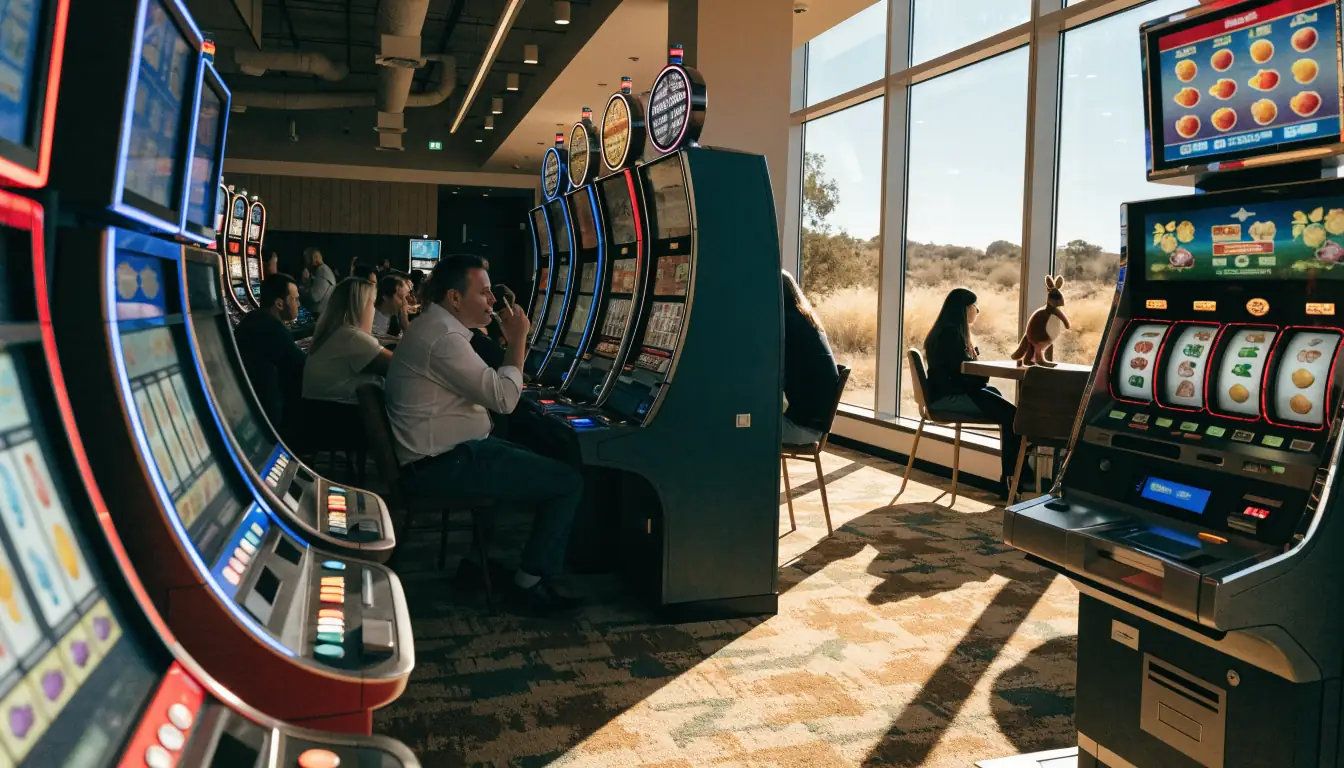
Pokies are widely used in Australian pubs, clubs and casinos. Those are the three venue categories that matter, and every jurisdiction that permits the machines permits them through some combination of the three.
Pubs and clubs carry the bulk of the national machine base. This is the distinguishing feature of the Australian model compared with markets where gaming machines are confined to licensed casinos. A suburban hotel with a gaming room, a leagues club, a registered club of any kind — these venues, not the casinos, are where most machine play occurs. Casinos hold a smaller share of the machine market and a different regulatory relationship with the state, but they complete the picture: in each state and territory, at least one licensed casino operates machines alongside table games.
The scale of the national machine base relative to the rest of the world is a matter on which sources disagree, and the disagreement is not marginal. One version holds that Australia accounts for 3% of the world’s pub and club poker machines. Another puts Australia at about 18% of the world’s poker machines. The two figures measure related but not identical things — one is scoped to pub and club machines, the other to poker machines generally — and neither source reconciles with the other. Both are reported here without a preference, because the data does not exist to arbitrate between them. What is not in dispute is the direction of the finding: Australia holds a share of the world’s machines far out of proportion to its population.
What "Open Near Me" Means in Practice
The search for a venue with machines running is, in most of urban Australia, a short search. Pokies operate in every jurisdiction, in the three venue categories above, and the question of whether a machine is available nearby resolves into a question of which venue type and what hours — not of whether machines exist in the area at all.
Cash is the central vulnerability of the pokies market; large cash insertions followed by minimal play can trigger AML reporting and expose operators to serious penalties.
The mechanics of that search differ by venue type, and the details of which venues run machines around the clock are covered separately below. What belongs in this section is the structural fact that makes such a search productive: the machine base is distributed through ordinary hospitality venues. A pub that serves lunch is, in most jurisdictions, a pub that may also hold a gaming machine licence. The machines are not quarantined in dedicated gambling halls; they sit inside the venues people already visit for other reasons. That arrangement is the product of decades of state licensing policy and is the reason machine availability tracks population density so closely.
The corollary is also structural. Because machines are licensed at the venue level by state and territory authorities, availability is not a national variable that switches on or off. It is a patchwork of thousands of individual licences, each attached to a specific pub, club or casino, each with operating hours set by the venue and bounded by state gaming law. Any answer to "is a venue open now" is therefore local by necessity — which is the subject of the sections that follow.
The Money: Turnover, Loss and Tax
The financial year 2020-2021 provides the most recent fully documented picture of the machine market’s size:
| Measure | FY 2020-2021 |
|---|---|
| Bets placed on EGMs | almost AUD 150 billion |
| Total player loss | about AUD 12 billion |
| Per-capita loss | AUD 608 |
The relationship between turnover and loss is the first number worth understanding. Almost AUD 150 billion in bets produced about AUD 12 billion in losses. The turnover figure counts every dollar fed through a machine, including winnings re-wagered; the loss figure is what players actually surrendered over the year. The gap between the two is the return-to-player component cycling back through the machines — money that is bet, won, and bet again, often many times over, before it becomes a loss.
Winnings in Australia are not taxed. A player who wins keeps the full amount; there is no gambling winnings tax applied to the individual. The taxation burden falls on the operators instead, and it varies by state and by type of gambling service. Each state and territory sets its own taxation regime for machine revenue, and the rates differ both across jurisdictions and across the gambling services a venue may offer. A club’s machine revenue, a casino’s machine revenue and a wagering product are each taxed under their own schedules.
This structure has a practical consequence for anyone reading machine-market figures. The AUD 12 billion in annual player losses is the pool from which state gaming taxes, venue revenue and provider margins are all drawn. The states have a direct fiscal interest in the machines’ continued operation, which is a standing feature of every policy debate about the sector and is not a hidden one — it appears in every state budget paper that itemises gaming revenue.
The Regulatory Framework
Two layers of law govern the machines, and they operate on different objects.
The Commonwealth layer is the Interactive Gambling Act 2001. Its target is online gambling: it makes it an offence for online operators to offer real-money gambling to Australian residents. Online casino games — slots, poker, blackjack, roulette — are prohibited under the Act. The offence belongs to the operator, not to the player; it is not illegal for an individual Australian to play at an offshore-licensed online casino, but no domestic licence for such a service exists and no lawful domestic offer can be made. This is the reason the machine market described in this section is a physical, venue-based market: the legal product is the machine in the pub, the club and the casino.
Regulatory Framework
Two layers of law govern Australian pokies. The Commonwealth Interactive Gambling Act 2001 targets online gambling, while each state and territory regulates physical venues, licences, entitlements and harm‑minimisation requirements through its own regulator.
The state and territory layer governs those physical venues. Licensing, machine entitlements, venue operating conditions and harm-minimisation requirements are set jurisdiction by jurisdiction. The result is a national market built from eight separate regulatory systems, each with its own regulator, its own licence conditions and its own enforcement practice. The Office of Liquor and Gaming Regulation, the ACT Gambling and Racing Commission and their state counterparts administer the regimes within their borders; there is no single national authority for land-based machine gambling.
The absence of a domestic online casino licence is worth stating plainly, because the phrase "licensed online pokies" has no referent in this market. Sports betting and lotteries are licensed in Australia under state and territory authority. Online casino gaming is not licensed anywhere in the country and cannot be. A site offering online pokies to Australian residents is operating outside the Australian licensing system by definition — there is no licence it could hold. There is also no public register of licensees for such a service to appear on, so advice to "check the licence" of an online casino is not caution here; it is a check with nothing to check.
Anti-Money-Laundering: The Cash Problem
The machine market’s defining vulnerability is cash. The high volume of cash transactions and the limited traceability of pokies make them attractive for money laundering, and the regulatory response to that attraction has become one of the defining compliance stories of the sector.
The laundering techniques are not exotic. Criminals insert large sums of cash into EGMs, perform minimal gambling activity, and cash out — creating a record that reads as winnings. Offenders purchase winning tickets from other players, converting dirty money into clean, traceable funds through a genuine payout made to a willing seller. Structuring across venues spreads smaller cash deposits over different locations to stay below AML reporting thresholds. According to complyadvantage.com, money mules are also recruited specifically to launder money through pokies — one source’s account of the practice, but consistent with the mechanics the other techniques share: cash goes in, a paper trail of legitimate-looking gambling comes out.
Cash Risk
Large cash insertions with minimal play are a prime money‑laundering technique and can result in heavy fines or enforcement action.
The NSW Crime Commission’s exposure of criminal exploitation of the state’s machines fed directly into the reform agenda. The 2022 NSW Islington Report — again, as reported by complyadvantage.com — recommended making all NSW pokies cashless by the end of 2028. Whether that deadline holds is an open question; the recommendation exists, the deadline is attached to it, and the politics of implementing it are unresolved. What is settled is the direction: cash is the problem, and every serious reform proposal addresses it by removing or constraining cash at the machine.
AUSTRAC and the 2024 Guide
AUSTRAC issued a guide in 2024 to help firms recognise money-laundering red flags. The guide matters to venue operators because it converts the abstract risk into a checklist of observable behaviour. The red-flag indicators include unusually high cash access, large deposits, cash transfers, casino disbursement checks and certain occupations.
The behavioural red flags are the ones venue staff can actually see:
- Large or repeated cash insertions followed by minimal play and immediate cash-out — the core laundering pattern, visible in the machine’s own session record.
- Frequent small redemptions across different venues within a short period — the fingerprint of structuring, visible only when venues or regulators compare records.
- Customers refusing identification or using multiple player cards — the attempt to keep the money unattributable, visible at the point of service.
None of these indicators is proof of anything on its own. That is the point of the guide: it tells operators what to notice, document and report, not what to conclude.
The Two Compliance Tiers
AUSTRAC’s requirements for machine venues split at a specific line: fifteen machines.
Operators with up to 15 pokies must register with AUSTRAC, keep identification records, and submit suspicious matter reports. This is the baseline tier — registration, record-keeping and a reporting obligation that activates on suspicion rather than on any transaction threshold.
Operators with more than 15 pokies carry the full AML/CFT program. They must appoint a compliance officer, conduct risk assessments, implement AML/CFT programs, perform customer due diligence, and report cash transactions over AUD 10,000. The difference between the tiers is the difference between filing what you notice and running a system designed to notice things: a named officer accountable for the program, documented risk assessments, due diligence performed on customers rather than merely recorded, and threshold-based reporting that does not depend on staff judgment to trigger.
The tiering reflects an assumption about risk that the laundering techniques bear out. Structuring across venues works precisely because small operations fly below the threshold reporting line; the larger the venue, the more machines, the more cash throughput, and the more attractive the venue is as a laundering channel. The fifteen-machine line puts the heavier program where the heavier exposure sits.
Non-compliance carries consequences at both tiers. Operators who fail to meet their obligations may receive remedial directions, infringement notices and civil fines, and suffer reputational damage. The escalation is not theoretical at the top of the market: an amendment to the Casino Control Act 1992 allows NSW casino operators to be fined up to AUD 100 million for compliance failures. That ceiling converts casino compliance from a cost of doing business into an existential exposure, and it was legislated as exactly that.
The Cashless Direction
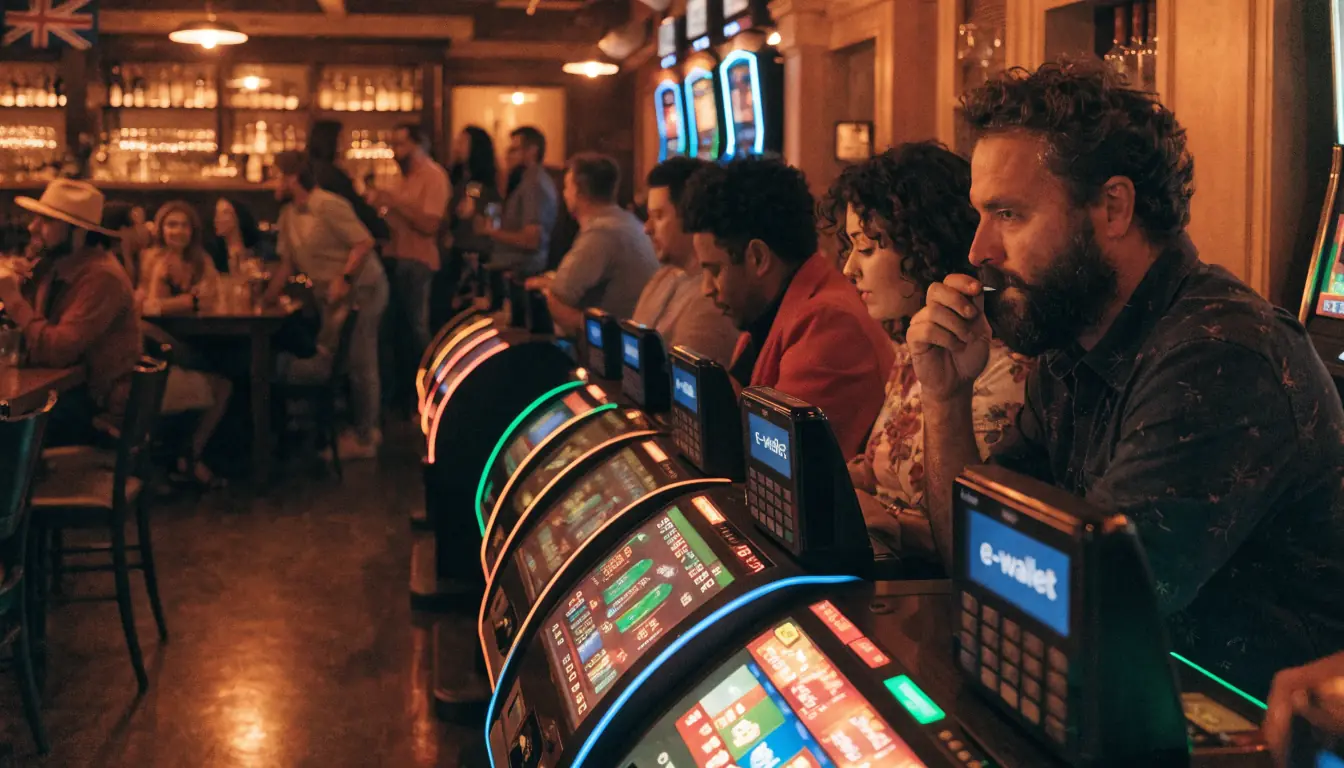
The reform trajectory points away from cash. Regulators recommend tighter customer due diligence, transaction monitoring and the adoption of cashless gaming systems. Transparent, account-based pokies provide full traceability of deposits, gameplay and withdrawals — every dollar in and every dollar out attached to an account and a record.
According to facctum.com, the adoption of cashless, account-based pokies improves traceability and reduces anonymity. That is one source’s assessment, but it follows directly from what the machines do: an account-based system replaces the anonymous cash insertion with a logged transaction. The laundering techniques described above — the minimal-play cash-out, the ticket purchase, the structuring across venues — all depend on cash entering the machine without attribution. An account-based machine records who deposited, when, where and how much, and the structuring pattern becomes visible as a pattern rather than disappearing into separate venue records.
The industry is moving towards account‑based, cashless pokies to improve traceability and reduce laundering opportunities.
The resistance to this direction is not technical. Account-based systems exist and operate. The resistance is structural: the machine market’s cash-intensive design serves players who value anonymity, venues that value throughput, and a laundering economy that values both. The AUD 12 billion annual player loss is the stake in the argument, and the state taxes collected from it give every jurisdiction a reason to move slowly.
Harm Minimisation and the Wider Context
The Interactive Gambling Act’s stated purpose — protecting the public with a focus on harm minimisation — is the policy frame the entire machine market sits inside. The Act addresses the online environment; the state regimes address the physical one; the harm-minimisation objective runs through both.
Part of that context is demographic. Almost one in three 12-17-year-olds in Australia gamble — 30% of an age group below the legal gambling age. Among 18-year-olds, 46% gamble. The minimum legal gambling age in Australia is 18, which makes the adolescent figures a measure of underage exposure rather than of lawful participation. These numbers sit outside the machine-market turnover statistics, but they describe the population the harm-minimisation framework is built for, and they are the reason the framework keeps tightening rather than loosening.
For adults who need support, the services exist: Gambling Help Online and BetStop — the national self-exclusion register — are the standing resources. A self-exclusion register is, functionally, the individual-level version of the account-based machine: a record that follows the person rather than the cash. The machinery of traceability serves both the AML regime and the harm-minimisation regime, which is one reason regulators from both directions converge on the same recommendation.
What 2026 Looks Like
The position in 2026 is a market unchanged in its fundamentals and under pressure at its edges. Machines operate in every jurisdiction, in pubs, clubs and casinos, on terms set state by state. The turnover remains in the hundreds of billions of dollars annually, the losses in the low tens of billions, the state revenues dependent on both. Winnings remain untaxed for players; operators remain taxed at state-set rates that vary by jurisdiction and service type.
The pressures are cash and compliance. AUSTRAC’s 2024 guide, the two-tier AML/CFT regime, the AUD 100 million casino fine ceiling in NSW and the cashless recommendation of the Islington Report together describe a regulator closing in on the machine market’s cash foundation. The online alternative remains closed by law — prohibited for operators, licence-less domestically, with the Interactive Gambling Act 2001 holding that line.
For anyone looking for machines running nearby, the practical answer is unchanged: every state and territory has them, the venue categories are the same everywhere, and the search resolves locally — into which pub, which club, which casino, and what hours. Those specifics are what the following sections cover: which venues keep machines running around the clock, how public holidays change the operating picture, and where the cash-only machines and cheque payouts still operate.
Main Insight
Pokies are available nationwide across pubs, clubs and casinos, but cash remains the biggest compliance risk.
The context above is the frame for all of it: a national market of almost AUD 150 billion in annual bets and about AUD 12 billion in annual losses, distributed through ordinary venues, regulated in eight parts, and being pushed — incrementally, unevenly, and against considerable fiscal inertia — out of cash and into the light.
24‑Hour Venues and Pubs Offering Pokies Right Now
The short answer to the question of which pokies venues stay open around the clock: in Australia, it is almost never the pub down the road. Continuous trading is concentrated in casinos, while pub and club gaming rooms operate on licensed hours set by each state and territory. Understanding which category a venue falls into is the fastest way to work out whether the machines will be running at 3 am.
Three Categories of Venue, Three Opening Patterns
Electronic gaming machines in Australia sit inside three distinct venue types, and their hours follow different logic.
Casinos. Licensed casinos in Sydney, Melbourne, Brisbane, Perth, Adelaide, Darwin, Canberra and Hobart are the venues most likely to run gaming floors across the full 24-hour cycle. A casino licence carries its own conditions, and gaming at these properties is not tied to the trading-hour rules that bind pubs and clubs. For anyone searching for pokies genuinely open at any hour, a casino is the default answer.

Clubs. Registered clubs — leagues clubs, RSL clubs, workers’ clubs — are the traditional home of pokies outside casinos. Their gaming rooms typically run longer than the rest of the building: the bistro may close at 9 pm while the machine room keeps going into the early hours. But "longer" is not "unlimited." Club gaming hours are set by state licensing authorities, and a club that trades its machines past its licensed window risks enforcement action. Some clubs hold extended or near-continuous gaming licences; most do not.
Pubs. Hotels and pubs hold the gaming licences most tightly bound to ordinary trading hours. A pub’s pokies room generally opens with the venue and closes with it, subject to state caps on how late machines may operate at all. In several jurisdictions there is a mandated late-night shutdown window for gaming machines — the room locks, the machines go dark, and it reopens in the morning. No amount of local searching changes that: if the state requires a shutdown, no pub in that state is an exception.
Operate 24‑hour gaming floors, not bound by standard venue trading hours.
Often run extended gaming hours beyond the bar’s closing time, but licences vary by state.
Gaming rooms follow ordinary venue trading hours and are subject to state‑mandated late‑night shutdowns.
Why Hours Differ From One Suburb to the Next
Two identical-looking pubs a kilometre apart can have gaming rooms closing hours apart. The reason is that opening hours are a licensing matter, and licensing is administered state by state, territory by territory, venue by venue. Each venue’s approval specifies its own trading conditions, and gaming hours are part of those conditions.
The practical consequences:
- Opening hours are not standardised nationally. There is no single Australian closing time for pokies; every state and territory sets its own framework.
- Extended hours are individually granted. A venue trading its gaming room late does so because its licence permits it, not because late trading is the norm.
- The gaming room and the bar keep separate clocks. Machines can be required to stop while the venue itself stays open for drinks, and vice versa.
- Hours can change. Licensing conditions are reviewed, and a venue that traded until early morning last year may hold different conditions now.
None of this is published centrally in a form that answers "what is open near me at this exact minute." The reliable check is the venue itself — a phone call or the venue’s own posted hours. Any list claiming otherwise is guessing on someone else’s behalf.
Standard Hours Versus 24-Hour Trading Versus Holidays
These are three different regimes, and confusing them wastes a trip.
Standard trading. The ordinary pattern for pubs and clubs: gaming rooms open with the venue in the morning or early afternoon and close at night under state-mandated limits. Anyone looking for machines on a weekday evening is well served by the nearest licensed pub or club — the overwhelming majority of Australia’s machines sit in exactly these venues.
Continuous trading. The 24-hour case is essentially the casino case. Casinos run their floors continuously or close to it because their licences are built for it. A pub or club advertising itself as a round-the-clock pokies venue is rare enough that its hours should be verified before travelling.

Holiday trading. Public holidays are a separate rulebook again, and a venue’s ordinary hours tell you nothing about Anzac Day, Good Friday or Christmas Day. Several holidays carry their own statutory restrictions on gaming — closed mornings, full-day shutdowns, or complete prohibitions on machine play. A pub open 24 hours on a normal Saturday can be legally required to keep its pokies dark on Good Friday. This is covered in detail in the section on public holidays; the point here is that "always open" and "open on holidays" are different questions with different answers, and a Christmas Day search that returns a venue’s regular hours has not answered the actual question.
What "Open Now" Means for Online Play
A word on the online alternative, because it follows a different rulebook. The Interactive Gambling Act 2001 makes it an offence for online operators to offer real-money casino games — including online pokies — to Australian residents. There is no domestic licence for that product. Domestic online gambling licences exist for sports betting and lotteries, not for slots. So an online search for pokies "open now" does not lead to a legally licensed Australian online casino, because one does not exist. The machines available lawfully at any hour are the physical ones, and the venue type determines the hour.
Money Matters at the Machine
Two practical points for anyone planning a session.
Late‑Night Play Checklist
- Confirm the venue type (casino, club or pub).
- Check whether today is a public holiday and review any special restrictions.
- Verify the gaming room hours directly with the venue.
- Ensure cash availability or account‑based access if the venue is cashless.
Winnings are not taxed. Australian gamblers keep what the machine pays out — there is no income tax on gambling winnings. Taxation falls on operators instead, and it varies by state and by the type of gambling service offered. A payout at 2 am is worth the same figure as the same payout at 2 pm.
Cash handling is central to how these venues work. Pokie play remains a predominantly cash activity, which is part of why casinos — the 24-hour venues — maintain cashier facilities on site at all hours. The cash-intensive nature of the machines and the compliance obligations that come with it, including the reporting requirements AUSTRAC places on venues, are set out in the section on cash-only pokies and cheque redemption.
A Practical Checklist for Late-Night Play
Before travelling to a venue on the strength of its advertised hours:
- Confirm the venue type. Casino floors trade longest; clubs run extended gaming hours; pubs are the most hour-bound of the three.
- Check the day. Ordinary hours and holiday hours are different regimes. On Anzac Day, Good Friday or Christmas Day, assume nothing from a venue’s regular schedule.
- Verify directly. State licensing authorities publish frameworks, not live opening status. The venue’s posted hours or a phone call are the only real-time sources.
- Confirm gaming hours, not venue hours. The bar being open does not mean the machines are. Where late-night shutdown windows apply, they apply to the gaming room specifically.
The consistent picture across the country: casinos are where the genuinely 24-hour pokies floor is found; clubs fill the late evening; pubs serve the standard trading day. Anything beyond that depends on an individual licence that only the venue can confirm.
Pokies Opening Hours on Public Holidays (Anzac Day, Good Friday)
Public holidays are the one area where a venue that is normally open around the clock can still be forced to close its gaming room. Anzac Day and Good Friday in particular carry restrictions that do not apply to ordinary trading days, and the rules are set at state and territory level rather than nationally — electronic gaming machines operate in every Australian state and territory, but each jurisdiction writes its own holiday conditions.
What that means in practice: the answer to "are pokies open on Anzac Day" or "are the pokies open on Good Friday" depends entirely on where the venue stands. The same hotel group can have machines running in one state and switched off in another on the same morning. Some jurisdictions restrict trading only for part of the day; others bar it outright.
No single national register of holiday trading hours is published, so the reliable method is to check the venue directly before travelling. A 24-hour licence covers ordinary days; it is not a guarantee for restricted public holidays.
Cash‑Only Pokies and On‑Site Cheque Redemption: What’s Open Now
Pokies remain a cash-intensive product. Coins and notes go in; tickets and, at some venues, cheques come out at the cashier. That combination — high volume of cash transactions and limited traceability — is exactly what makes the machines attractive to money launderers.
The mechanics are simple. Large sums of cash are inserted into an EGM, minimal gambling activity follows, and the cash-out creates a record of apparent winnings. What began as anonymous notes becomes documented funds.
Anyone searching for cash pokies and cheque-redemption venues near them should understand what the cash trail means: winnings are not taxed, but the cash that produced them is visible to AUSTRAC’s red-flag framework — large or repeated insertions followed by minimal play and an immediate cash-out are precisely what reporting obligations are designed to catch. The venue keeps records; the pattern is the evidence.
What are pokies in Australia?
Pokies are electronic gaming machines (EGMs) legally operated in every Australian state and territory. They are found in pubs, clubs and casinos, with pubs and clubs carrying the bulk of the national machine base.
What are the red flags for pokies-related money laundering?
Red flags include large or repeated cash insertions followed by minimal play and immediate cash-out, frequent small redemptions across different venues within a short period, unusually high cash access, large deposits and cash transfers, and customers refusing identification or using multiple player cards.
What controls help prevent pokies money laundering?
Operators must register with AUSTRAC, keep identification records and submit suspicious matter reports; those with more than 15 machines must also appoint a compliance officer, run AML/CFT programs, perform customer due diligence and report cash transactions over AUD 10,000. Regulators further recommend tighter transaction monitoring and adoption of cashless, account-based gaming systems.
Why are transparent pokies systems important for AML?
The high volume of cash transactions and limited traceability make pokies attractive for laundering. Account-based, cashless systems provide full traceability of deposits, gameplay and withdrawals, reducing the anonymity criminals rely on.
Written by the editors at Casino Regional Guide.