Best Pokie Machines to Play in Australia: What the Law Allows
 Available in AU
- Online Pokie Gaming in Australia
- Pokies Landscape: Size and Economic Impact
- Electronic Gaming Machines: How They Operate Across Australia
- Understanding Pokie Odds and Player Losses
- Real‑Money Pokies: Taxation and Player Winnings
- Free Pokie Play and Demo Versions
- Pokie Apps and Mobile Access: Regulatory Constraints
- Australian Casino Environment and Compliance Requirements
- Pokie Game Variety: What Types Are Available
- The Shift to Cashless, Account-Based Systems
- RTP and Tips for Maximising Pokie Returns
Online Pokie Gaming in Australia
The legal position of a pokie machine on a casino floor and the same game delivered through a browser are two different things under Australian law. The machine in a pub or club sits inside a state licensing system. The online version sits outside it — not because the states declined to license it, but because the Commonwealth closed the door before any of them could.
The Interactive Gambling Act 2001
The Interactive Gambling Act 2001 (IGA) is the primary Commonwealth law governing online gambling. Its stated purpose is public protection with a focus on harm minimisation, and its central mechanism is simple: it makes it an offence for online operators to offer real-money gambling to Australian residents. Casino-style games — pokies, poker, blackjack, roulette — fall squarely inside that prohibition.
The consequences of this design are worth spelling out, because they differ from what most readers assume:
- There is no Australian online casino licence. It is not possible to obtain one. An operator cannot become compliant by applying; the category of compliant online pokie operator simply does not exist domestically.
- The offence belongs to the operator, not the player. It is not illegal for an individual Australian to play at an offshore-licensed online casino. The law targets the supply side. A person sitting at home playing an offshore pokie is not committing an offence.
- Not everything online is banned. Online sports betting operates legally in Australia under state and territory licences. Lotteries are licensed too. The prohibition is specific to casino-style games, including pokies, and to live in-play betting online (live betting by phone remains legal).
Choosing where to spin pokies online in 2026 comes down to licensing, welcome offers, and how quickly you can get set up and paid out — here’s what stands out about each option worth a look.
License: Curacao Gaming Control Board OGL/2023/174/0082 (Dama N.V.) · Bonus: up to A$5,000 + 300 free spins across 4 deposits Licensed under the Curacao Gaming Control Board via Dama N.V., SpinsUp backs its offering with a sizeable welcome package spread across four deposits, giving new players room to build up their bankroll gradually.
License: Curacao Gaming Authority (Jumpman Gaming Ltd) · Bonus: up to A$6,600 + up to 250 free spins across 4 deposits Operating under a Curacao Gaming Authority license through Jumpman Gaming Ltd, DragonSlots pairs its licensing with a generous multi-deposit bonus that includes a solid batch of free spins.
Bonus: 240% up to A$4,100 + 300 free spins WinShark stands out for a high-percentage match bonus combined with a large number of free spins, making it a notable pick for players chasing bigger initial value.
License: Curacao eGaming OGL/2023/174/0082 (Dama N.V.) · Bonus: up to A$10,000 + 500 free spins across 4 deposits · Min. deposit: A$15 Licensed under Curacao eGaming through Dama N.V., LevelUp Casino offers one of the larger bonus packages on this list along with free spins across multiple deposits, and it keeps the entry deposit accessible.
License: Curacao Gaming Control Board OGL/2023/176/0095 (Hollycorn N.V.) · Bonus: up to A$5,000 + 300 free spins across 4 deposits Rollero Casino is licensed by the Curacao Gaming Control Board via Hollycorn N.V. and offers a solid multi-deposit welcome bonus with free spins included.
License: Curacao Gaming Control Board OGL/2023/176/0095 (Hollycorn N.V.) · Bonus: up to A$1,500 + 200 free spins across 3 deposits Also operating under a Curacao Gaming Control Board license through Hollycorn N.V., LuckyVibe offers a more modest but still worthwhile welcome bonus with free spins spread across a few deposits.
License: Curacao eGaming OGL/2024/923/0383 (Antillephone N.V.) · Bonus: up to A$2,000 + 100 free spins across 2 deposits · Min. deposit: A$30 Licensed under Curacao eGaming via Antillephone N.V., WinSpirit Casino provides a welcome bonus with free spins over two deposits, with an accessible minimum deposit requirement.
Bonus: up to A$750 + 50 jackpot spins, 35x wagering · Payout speed: crypto ~90 minutes, fiat 1-5 days · Min. deposit: A$30 Kingmaker offers a jackpot-spins bonus with clearly stated wagering terms and notably fast crypto payout speeds, alongside a low minimum deposit for getting started.
License: Curacao · Bonus: up to A$2,000 Golden Pokies operates under a Curacao license and offers a straightforward welcome bonus for new players.
License: Curacao Gaming Control Board (TechSolutions Group N.V.) · Bonus: 100% up to A$250 + 100 free spins (1st deposit) Licensed under the Curacao Gaming Control Board via TechSolutions Group N.V., Bizzo Casino offers a first-deposit match bonus paired with free spins.
This is why phrases like "choose a licensed online casino" have no meaning in the Australian context. There is no licence to check, no register of approved online pokie operators, and no domestic regulator standing behind the games. Any site offering real-money pokies to Australians is doing so from outside the Australian licensing system entirely — typically under a foreign regulator such as the Malta Gaming Authority or the UK Gambling Commission, whose rules were written for other markets.
How Online Play Differs from Land-Based Play
The land-based side of the market operates under a completely different structure. Pokies are widely used in Australian pubs, clubs and casinos, and each state and territory runs its own licensing regime for those venues. A club in New South Wales answers to NSW regulators; a casino elsewhere answers to that state’s authority. The rules differ by jurisdiction, but the pattern is consistent: a physical machine, a licensed venue, a state authority, and a gambling operator taxed according to state rules that vary by both jurisdiction and type of gambling service.
Online play inverts this. There is no venue, no state licence and no domestic tax arrangement, because there is no legal Australian operator. The contrast is stark:
| Land-based pokies | Online pokies | |
|---|---|---|
| Legality | Legal in licensed venues nationwide | Illegal for operators to offer to Australians |
| Licence | State/territory venue licence | None available domestically |
| Player liability | None | None — the law targets operators |
| Regulator | State gaming authorities | Foreign regulator, if any |
The practical result is an asymmetry that defines the whole market: the supply of legal pokies is exclusively physical, while the demand for online versions is met from offshore. What sits between the two is the Interactive Gambling Act, which the Australian Communications and Media Authority (ACMA) enforces against the supply side.
What "Playing Online" Actually Means Here
Because the legal weight falls on operators, the individual player’s options sort into three distinct categories, and they should not be confused with each other.
Offshore real-money play. Australians who play real-money pokies online do so at sites licensed overseas. The activity is not an offence for the player. It also carries no domestic protection: no Australian regulator supervises the games, resolves disputes or guarantees payouts. Whatever protection exists comes from the foreign licence, if one exists — and from nothing at all if it does not. Winnings in Australia are not taxed, so the tax question resolves simply; the exposure is on the other side of the transaction, where it cannot be managed by the player.
Free and demo versions. Simulated pokie games — free online pokie machine games that run on virtual credits with no money changing hands — occupy a separate space, because the prohibition on real-money supply does not extend to them in the same way. Why these simulators exist, how they work and what they are for is a subject in its own right, covered later in this article. What matters here is the boundary: no real money in, no real money out, and the Interactive Gambling Act’s real-money offence does not apply.
Legal risk
Playing real‑money pokies on offshore sites is not illegal for Australian players, but the operators offering them breach the Interactive Gambling Act and can be prosecuted. Players should be aware that the service they use operates outside Australian regulatory protection.
Sports betting and lotteries. Licensed online gambling does exist in Australia — just not in pokie form. A licensed online bookmaker is a legally recognised, domestically regulated business. The absence of legal online pokies is a policy choice about casino-style games specifically, not a blanket ban on gambling over the internet.
Paylines and Game Mechanics
Searches for pokie machine paylines usually arrive from players trying to work out how a game pays before money is involved. The mechanic itself is jurisdiction-neutral: a payline is a pattern across the reels on which matching symbols produce a win, and a game’s number of paylines determines how many such patterns a single spin covers. The same mechanic governs a physical machine in a club and an offshore site’s version of the game — the reels do not know which law they sit under.
What differs is what surrounds the mechanic. A machine in a licensed Australian venue operates inside a state regulatory framework. An online pokie offering real-money play to an Australian resident operates, by legal necessity, outside that framework — which is precisely why the offering itself is an offence.
Who Enforces What
Two regulators dominate the online side. ACMA handles enforcement against prohibited online gambling services offered to Australians — the supply-side offence created by the IGA. AUSTRAC handles the financial-crime side, and its relevance to pokies extends well beyond the internet: the anti-money-laundering rules that apply to venues with gaming machines, and the guidance AUSTRAC issued in 2024 on recognising money-laundering red flags, are part of the same system that the cashless-pokies debate keeps pulling into view. Those obligations attach to venues and operators, and they are examined in detail further along in this article.
For the player, the framework reduces to a short ledger. Playing pokies online for real money is not an offence; supplying that service to Australians is, and no domestic licence exists to make it lawful. Legal pokie play in the physical sense is available in licensed venues in every state and territory. Legal online gambling exists in Australia, but in forms other than pokies. Anything else — an offshore site, a foreign licence, a promise of Australian regulation — sits outside the system by design, and the design has not changed since 2001.
Pokies Landscape: Size and Economic Impact
Pokies occupy a position in the Australian economy that is difficult to overstate and awkward to describe precisely, because the numbers that circulate about the market come from different sources, different years and — occasionally — different definitions of the same machine. What follows is the landscape as the available figures actually frame it, including the places where those figures disagree with each other.
How Big Is the Machine Base
Electronic gaming machines are installed in every Australian state and territory. They sit in pubs, registered clubs and casinos, and they form the backbone of the domestic gambling sector in a way that has no real parallel in comparable economies. Australia’s machine density relative to population is a recurring subject of policy debate, and it is one of the few features of the market that both regulators and researchers describe in the same terms.
When it comes to Australia’s share of the world’s machines, the published estimates diverge sharply, and the divergence is worth stating rather than smoothing over. One set of figures puts Australia at 3% of the world’s pub and club poker machines. Another estimate puts the country at about 18% of the world’s poker machines overall. These cannot both be right, and the gap between them is not a rounding difference — it is roughly a sixfold disagreement about the size of the national machine base relative to the rest of the world.
Part of the explanation is likely definitional. The first figure is scoped to pub and club machines; the second speaks of poker machines without that restriction, which would include machines in casinos and possibly other categories. But the sources do not spell out their counting rules, so the honest position is this: Australia holds either a modest or a striking share of the world’s machines depending on which estimate is used, and no published figure resolves the question. Anyone quoting a single percentage as settled fact is quoting one source and ignoring the other.
Turnover: The Headline Number
Turnover is the total amount wagered through machines over a period — every spin counted, including money that is wagered, won and wagered again. It is a measure of activity, not of profit and not of loss, and conflating the three is the most common error in reporting on this market.
For calendar 2023, one source — complyadvantage.com — reported that pokies generated AUD 191.2 billion in gambling turnover. That figure is worth knowing, but it should be handled as what it is: a single-source estimate, not an established market benchmark. No official statistics series is cited alongside it, and the source’s subject matter — compliance and anti-money-laundering analysis — means the figure appears as context rather than as the product of a dedicated market measurement. It is reported here as a claim by that source, not as a verified norm of the Australian market.
What can be said without qualification is that the annual turnover through Australian machines runs at a scale measured in the tens and hundreds of billions of dollars, and that it dwarfs the amount players actually lose. Turnover inflates mechanically with every re-wager: a hundred dollars can pass through a machine many times in a session, registering as hundreds of dollars of turnover while the player’s actual exposure remains a fraction of that. This is why turnover figures make headlines and why they tell a reader almost nothing about what any individual session cost or returned.
Why the Numbers Matter Economically
The economic footprint of pokies extends in several directions at once, and the directions pull against each other:
- Venue revenue. Pubs and clubs derive a substantial share of their income from machine gaming, which in turn supports facilities, sponsorships and employment that would otherwise need different funding sources.
- State taxation. Gambling taxation varies by state and by type of gambling service, and machine revenue is a material line item in several state budgets. This creates a structural dependence that complicates every reform proposal — the same governments that regulate the machines collect revenue from them.
- Player losses. The other side of turnover is the aggregate amount retained by machines, which represents money transferred from households to venues and state treasuries. The scale of that transfer, and its distribution across postcodes, is the subject of a separate discussion further in this article.
- Compliance and enforcement costs. Operators now carry identifiable costs around AML/CFT programs, identification records, staff training and reporting obligations — costs that exist precisely because of the volume of cash moving through these machines.
The tension in this picture is structural rather than incidental. The same characteristics that make machines profitable for venues and treasuries — high turnover, repeat play, cash intensity — are the characteristics that generate the social and compliance costs. Policy debates about the sector are, at bottom, arguments about which side of that ledger is being undercounted.
What the Landscape Does Not Show
Two gaps in the public numbers deserve explicit mention.
First, there is no single authoritative public series that reconciles machine counts, turnover and losses across states and years in a way that would settle the market-share question described above. Regulators publish within their own jurisdictions; industry bodies and compliance analysts publish aggregates; the two do not always agree, and where they conflict, neither is automatically the more reliable.
Second, the available figures describe the market as a whole. They say nothing about which machines, which venues or which games account for what share of that turnover. Official sources do not publish a breakdown by individual machine or title, so any claim that a particular game dominates the market would be a claim without a source behind it. The landscape is measurable in aggregate and opaque at the level of the individual machine — an inconvenient property for anyone trying to map the market from the outside.
Turnover figures such as the AUD 191.2 billion reported for 2023 are single‑source estimates and are not part of an official government series.
Reading the Landscape Correctly
The practical takeaway for anyone assessing this market is to keep three quantities separate: the number of machines, the turnover through them, and the losses retained from them. Each is quoted in the same breath in casual discussion, and each answers a different question. Machine counts describe availability. Turnover describes activity. Losses describe cost — to players in aggregate, and ultimately to the households behind those players.
The figures that do exist — whatever their disagreements — all point in the same direction: Australia’s pokie market is, per head of population, among the largest machine gaming markets in the world, and the money moving through it is large enough that both state treasuries and national regulators treat it as a first-order economic category rather than a recreational sideline. The dispute over whether that means 3% or 18% of the world’s machines is a dispute about degree, not about kind.
Electronic Gaming Machines: How They Operate Across Australia
An electronic gaming machine — a pokie, in the vocabulary most Australians use without thinking — is not a national product distributed under a national scheme. It is a machine approved, sited and supervised under state and territory law, and the differences between jurisdictions are structural rather than cosmetic. The one fact that holds across the entire map is simple: electronic gaming machines operate in all Australian states, the Australian Capital Territory and the Northern Territory. Everywhere else, the detail belongs to the local regulator.
Where the machines sit
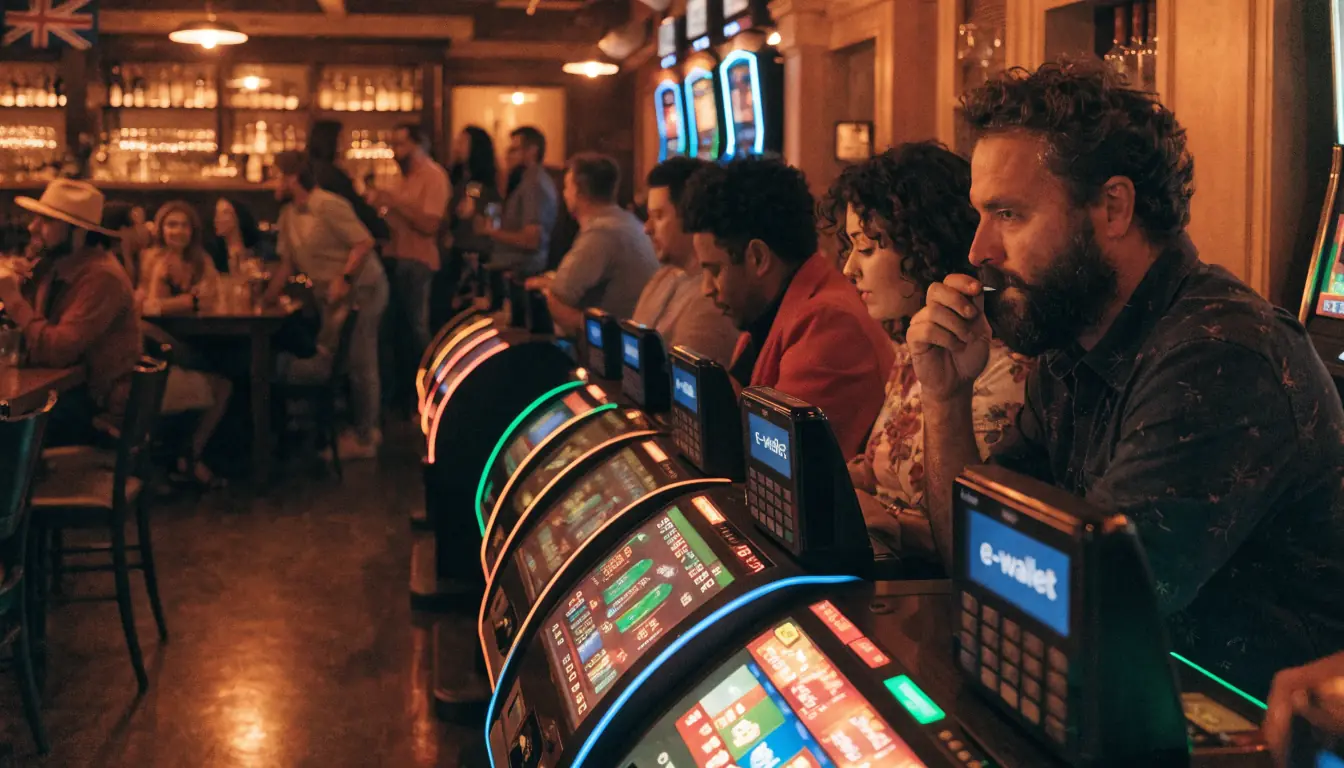
Pokies are widely used in three types of venue: pubs, clubs and casinos. That triad is the standard architecture of the Australian machine landscape, and it explains most of the regulatory geography. A pub or club operates machines under a state-issued gaming licence attached to the venue; a casino operates them under a separate casino licence with its own, heavier compliance obligations. The distinction matters to anyone comparing venues, because the rules that govern a machine in a suburban club are not the rules that govern the same physical cabinet on a casino floor.

Casinos are the most concentrated example. They are licensed at the state level, operate under dedicated casino legislation — NSW, for instance, administers its casinos through the Casino Control Act 1992 — and sit under continuous regulatory oversight. Pubs and clubs are regulated by the liquor and gaming authority of their state or territory, with the Office of Liquor and Gaming Regulation performing that role in Queensland and the ACT Gambling and Racing Commission in the capital. There is no venue type where machines run outside this framework.
Why geography matters more than the machine
A pokie machine in Darwin and a pokie machine in Hobart may carry the same game on the same cabinet. What differs is everything around the cabinet: who may install it, how many a venue may hold, what the venue must do to keep its licence, and which regulator inspects it. Gambling operator taxation also varies by state and by type of gambling service, which shapes how enthusiastically each jurisdiction licenses venues in the first place.
This is also why questions like "which pokie machine is best to play in Australia" have no machine-specific answer worth printing. The cabinet does not change character as it crosses a border; the licensing regime, venue mix and oversight do. A player comparing options is comparing jurisdictions and venue types, not hardware — and no official source publishes a ranking of machines on that basis.
Ownership, sale and the secondary market
Searches for machines "for sale" and machine prices run into a hard wall, and the wall is not commercial but legal. Machines are licensed gambling equipment held by licensed venues. A private individual cannot buy a pokie machine and install it as a working gambling device the way one buys a vending machine; possession and supply of gaming equipment are controlled under the same state and territory statutes that license the venues. Prices for cabinets exist in a trade-to-trade context between manufacturers, suppliers and licensed operators, and that market does not publish a public price list. Anyone offering a working machine for sale to the general public is operating outside the licensing framework, which is precisely the kind of offer that warrants walking away from rather than pricing.
The regulator map
Two layers sit above the venues. State and territory authorities license the machines and the premises. At the Commonwealth level, AUSTRAC supervises the anti-money-laundering side of machine gaming, because the cash-heavy, low-traceability character of pokies makes them a recognised laundering vector — a subject examined in detail elsewhere on this page. The two layers do not duplicate each other: a venue can hold a perfectly valid gaming licence and still fall short of its AUSTRAC obligations, and enforcement runs through both channels independently.
What follows from the geography
The practical reading of the Australian machine landscape is that it is a federation of separate markets wearing one name. Every state and both territories host machines; every jurisdiction decides for itself how many, where, and under what conditions. The machine in front of a player is the visible end of a long permission chain — manufacturer approval, state licensing, venue authorisation, regulatory supervision — and the length of that chain is the reason a pokie in Australia is never just a box that takes coins.
Understanding Pokie Odds and Player Losses
The arithmetic of pokies is not hidden. It is published, audited and — read correctly — it answers the question of what a machine is worth to the person standing in front of it: almost nothing, in aggregate, and the numbers below are the proof.
The volume of bets
In the financial year 2020–2021, Australians placed bets worth almost AUD 150 billion on electronic gaming machines. That figure is turnover: every press of the spin button, counted each time, including money that was won and immediately re-bet. Turnover is the raw material of the pokie economy — the total flow passing through the machines before anyone counts what stayed behind.

What actually stayed behind
Of that AUD 150 billion in bets, about AUD 12 billion was lost by players in the same financial year. That is the operator’s gross take from electronic gaming machines — the difference between what went in and what came back out as winnings.
The ratio between the two figures is the practical illustration of pokie odds. Turnover exceeded losses by more than ten to one, which means the overwhelming majority of every dollar bet was returned as winnings — and then bet again. The loss is not a single catastrophic event; it is a small percentage skimmed continuously from a very large, very fast loop. A player can be "up" during a session and still be feeding the loop that produced a AUD 12 billion national loss.
Per-capita loss
Spread across the adult population, per-capita losses from electronic gaming machines in FY 2020–2021 came to AUD 608 per person. Note the denominator: that is per head of population, not per player. The actual players — those who used the machines — carried losses above the average, in the same proportion as players outnumber the population of non-players. The AUD 608 is what the loss looks like when everyone shares it; no individual’s share of it is that small.
What the numbers say about "winning" machines
There is no publicly identified best pokie machine to win on, and the aggregate figures explain why the search for one is structurally futile. The odds are engineered into the loop itself: bets go in, a slightly smaller amount comes back out, and the difference accumulated AUD 12 billion in one financial year across the country. Individual sessions vary; the aggregate does not. Any machine that reliably beat the player would not be on the floor — the AUD 150 billion in turnover exists precisely because the machines, collectively, do not.
Turnover vs loss example
Example: AUD 150 billion turnover × 0.08 (8 % loss rate) = AUD 12 billion total player loss.
The closest thing to a factual answer on pokie machine odds is therefore not a machine name but a direction of flow: AUD 150 billion in, AUD 12 billion kept. That is the game, stated as a ledger entry.
Real‑Money Pokies: Taxation and Player Winnings
The tax position for players in Australia is unusually straightforward: winnings from gambling are not taxed. A payout on a real pokie machine — whether in a pub, a club or a casino — arrives as a flat amount. No declaration, no deduction, no annual reconciliation. The reasoning behind the treatment is structural rather than generous: gambling is not treated as a profession or a regular income-producing activity for the overwhelming majority of players, so the proceeds fall outside the income base. The corollary is equally flat — losses are not deductible against other income. The tax system’s symmetry here is exact.
This applies to the money itself, not to what surrounds it. Interest earned on winnings once deposited is a different matter, as is any activity that turns gambling into a business. The distinction is between a windfall and an income stream, and it is the pattern of behaviour, not the size of a single payout, that attracts attention.
For real-money play, the obligations sit almost entirely on the operator side. Venues with up to 15 pokies must register with AUSTRAC, keep identification records, and submit suspicious matter reports. That registration threshold is the entry point of the compliance ladder; larger operations carry heavier programs, but the baseline obligations — knowing who is playing and reporting what looks wrong — begin with the smallest licensed venue.
What looks wrong is catalogued rather than guessed at. Red-flag indicators include unusually high cash access, large deposits, cash transfers, casino disbursement checks, and certain occupations. A player cashing out a genuine win is not the target of these rules; the target is money that arrives at a machine as cash and leaves it as "winnings", a conversion the regulator has learned to recognise by its shape. The indicators are published precisely so that venue staff do not have to improvise judgement.
For the player, the practical summary is short. Winnings are received tax-free, losses cannot be claimed, and identification at a venue is not an intrusion but a regulatory requirement the venue itself cannot waive. The friction between the player and the machine is minimal; the friction between the cash and the banking system is where the rules live.
Demo versions — the free simulations of the same games — stand outside this entire framework, for the obvious reason that there is no money to tax, trace or report.
Free Pokie Play and Demo Versions
Real-money online pokies cannot be offered to Australian residents under the Interactive Gambling Act 2001, and no domestic licence exists for that kind of service. What remains legally available online is the other category: pokie simulations that run on credits with no money attached. These free-to-play versions occupy a strange but well-defined corner of the market — legal to provide, untaxed at the player level because there is nothing to tax, and structurally identical to the machines they imitate.
What a demo version actually is
A free pokie simulation reproduces the mechanics of a real machine: the reels, the paylines, the symbols, the bonus rounds, the win animations. The only removed component is the wager. Credits are supplied by the software, depleted by spins and replenished by a button — or, on social casino platforms, by waiting, or by purchasing more credits with real money. That last mechanism is worth noting: a "free" game can still carry a price tag, just not a gambling one. Purchased credits cannot be converted back into cash, which is precisely the line that keeps these products outside the Interactive Gambling Act’s definition of prohibited gambling.
What a demo version includes
A free demo reproduces the reels, paylines and bonus rounds of the real machine, but uses virtual credits instead of real money. Credits are supplied by the software and cannot be cashed out, keeping the game outside gambling legislation.
Why operators and studios offer them
The commercial logic is straightforward. Game studios build pokies as software products, and a demo is the cheapest possible showcase: a venue operator evaluating a cabinet, or a distributor previewing a title, can assess the reels, volatility feel and bonus frequency without a licence or a bankroll. On the consumer side, free versions function as a funnel — players who enjoy a theme in demo form are the same audience land-based venues and licensed offshore platforms monetise later. Studios do not publish per-title payout figures in their demo marketing, and the source material for this page does not identify which specific titles are available in free form, so no list of names is offered here.
Reels, themes and software — what a demo lets you examine
A demo answers the questions a machine’s exterior cannot:
- Reel structure. The number of reels, the presence of a scatter or wild, the shape of the paylines. This is visible in the paytable, which free versions display in full.
- Themes. Australian pokie themes run from historical and outback motifs to licensed entertainment properties. A demo makes the theme legible before any commitment — the same cabinet art, soundtrack and symbol set as the paid version.
- Software behaviour. How quickly the bonus round triggers, how the autoplay settings work, what the denomination options look like. None of this is documented publicly per title; the demo is the documentation.
A note on pokie machines for sale
Second-hand pokie machines are advertised for sale in Australia, and search interest in "pokie machine for sale" is persistent. The ownership question is regulated at state level: a machine that accepts real wagers is a gaming machine regardless of where it sits, and possession is subject to state and territory rules that go well beyond ordinary consumer goods. A private purchase does not create an exemption. Anyone considering this should check the applicable state regulator’s requirements first — the machine’s history, its compliance history and its registration status all travel with it.
Strategies and what a demo cannot teach
Searches for pokie strategies return a predictable genre of advice. The arithmetic does not support it. Pokies are games with a negative expected return built into the software; no betting pattern, stop-switch discipline or "hot machine" heuristic changes that. A demo makes the point visible without charging for the lesson: over enough spins, the credits decline. What a demo is genuinely useful for is familiarity — learning a paytable, understanding a bonus round — rather than for developing a system, because no system survives contact with the payout structure. The machine is not an opponent to be read; it is a calculator with a fixed rate.
Where this sits in the Australian picture
Free pokie play is the one corner of the market where the legal ambiguity disappears. Land-based venues operate EGMs under state regulation, offshore real-money play targets players from outside the Australian enforcement net, and free simulations sit in neither category. They are software, distributed like software, and consumed like software. The distinction that matters to a player is simple: if credits can be bought but never cashed out, the game is a product; if money goes in and money can come out, it is gambling, and in online form it is not something an Australian operator may lawfully provide.
Pokie Apps and Mobile Access: Regulatory Constraints
A search for a pokie machine app in Australia runs into a structural problem before any download happens: there is no domestic licence category for real-money online pokies. The Interactive Gambling Act 2001 makes it an offence to offer online casino games to Australian residents, and no Australian regulator issues licences for them. Any app promising real-money pokie play to an Australian audience is operating from offshore, outside any local licensing framework. There is no public register of licensed online casino operators to check against, because no such licence exists to list.
Illegal online pokies
Offering real‑money online pokies to Australian residents breaches the Interactive Gambling Act and can result in severe penalties for the operator.
That does not make apps a legal grey zone for the operators themselves — it makes them a compliance subject. The rules that apply to machine-based gaming in pubs and clubs travel with the money, not the venue.
AML rules follow the app
AUSTRAC issued a guide in 2024 to help firms recognise money-laundering red flags, and its indicators are not limited to physical gaming rooms. Red flags listed include unusually high cash access, large deposits, cash transfers, casino disbursement checks and certain occupations. Any platform that handles deposits, gameplay and withdrawals through an account — which is exactly what a mobile gambling app does — sits inside this framework.
Operators running up to 15 machines must register with AUSTRAC, keep identification records and submit suspicious matter reports. Above 15 machines the obligations expand: an appointed compliance officer, risk assessments, a formal AML/CFT program, customer due diligence and reporting of cash transactions over AUD 10,000. Mobile and cashless platforms do not escape these thresholds; they inherit them, and in account-based form the audit trail becomes easier to enforce, not harder.
Money mules and app-based accounts
According to complyadvantage.com, money mules are recruited to launder money through pokies — recruited third parties who move funds through gaming accounts so the trail points at someone else. App-based play widens the recruitment surface: an account can be opened, funded and emptied without anyone walking into a venue. Frequent small redemptions across different venues within a short period remain a listed red flag, and refusal of identification or the use of multiple player cards likewise.
What non-compliance costs
The consequences are specified rather than vague: remedial directions, infringement notices, civil fines and reputational damage. An amendment to the Casino Control Act 1992 allows NSW casino operators to be fined up to AUD 100 million for compliance failures — a figure that frames how regulators now price neglect.
Apps marketed to Australian players answer to none of this locally, which is itself the clearest indicator of their status.
Australian Casino Environment and Compliance Requirements
Casinos sit at the regulated end of the Australian pokie machine environment. Unlike the online casino space, where the Interactive Gambling Act 2001 prohibits real-money play and no domestic licence exists, land-based casinos operate legally under state-level oversight — and the compliance burden on them has grown measurably heavier in recent years.
Operator taxation
Gambling operator taxation in Australia is not a single national rate. It varies by state and by the type of gambling service offered. A casino operator in one jurisdiction faces a different tax structure from a club operator in the same state, and both differ again from what applies across the border. Any comparison of operator economics that ignores this state-by-state variation is comparing numbers that were never on the same basis.
AML/CFT obligations for larger venues
The threshold is structural rather than discretionary. Operators running more than 15 pokies must:
- appoint a compliance officer;
- conduct risk assessments;
- implement AML/CFT programs;
- perform customer due diligence; and
- report cash transactions over AUD 10,000.
These are not advisory standards. Non-compliance can attract remedial directions, infringement notices, civil fines and reputational damage — a cost that lands on the operator, not the player.
Recent enforcement and reform
An amendment to the Casino Control Act 1992 allows NSW casino operators to be fined up to AUD 100 million for compliance failures. That figure is worth noting for what it signals: regulators have moved from negotiated outcomes toward penalties sized to be felt.
On the reform side, the 2022 NSW Islington Report recommended making all NSW pokies cashless by the end of 2028. According to complyadvantage.com, this recommendation frames the state’s move toward account-based play. It is a recommendation, not yet an implemented requirement — the distinction matters for anyone treating 2028 as a deadline rather than a proposal.
AUSTRAC issued a guide in 2024 to help firms recognise money-laundering red flags, with indicators including unusually high cash access, large deposits, cash transfers, casino disbursement checks and certain occupations. For casino operators, the guide translates into practical monitoring duties rather than background reading.
The 2024 AUSTRAC guide lists red‑flag indicators such as large cash deposits and frequent small withdrawals, which apply to both physical machines and mobile apps.
What this means for players
For someone choosing a pokie machine in a casino, none of this changes the odds — but it changes the environment around them. Cashless, account-based systems make deposits, gameplay and withdrawals fully traceable, which is precisely why regulators keep recommending them. The casino floor is becoming a documented transaction space, and the pace of that change is set by compliance calendars, not player preference.
Pokie Game Variety: What Types Are Available
Pokies sit in three distinct settings across Australia: pubs, clubs and casinos. The same cabinet in each setting is not the same product — a casino floor machine, a club machine and a pub machine are built, configured and regulated for different venues, and the categories below describe what a player actually encounters.
Classic three-reel machines
The original format: three reels, a single payline, and a short list of winning combinations. Fewer moving parts and no bonus rounds. These machines survive on venue floors because they are cheap to run and familiar to long-term players, though they are a shrinking share of what is installed.
Five-reel video pokies
The dominant format on Australian floors. Video screens replace mechanical reels, which allows multiple paylines, bonus features and animated sequences. Nearly every new cabinet installed in a pub, club or casino falls into this category.
Progressive and linked machines
Machines linked across a venue or a network of venues, with a portion of play feeding a shared jackpot prize. The prize grows until it is won, then resets. Linked setups are more common in clubs and casinos than in small pub rooms.
Multi-terminal and multi-game cabinets
A single cabinet running several game titles, letting a player move between them without changing machines. These have replaced single-title cabinets in most refits, because one unit serves players with different preferences.
Free and demo versions
Free pokie machine games exist as simulations of the real cabinets — the same titles, the same reel layouts, but no money at stake. Venues and manufacturers offer them as demonstrations; how and where they are made available is covered separately below.
Named titles
Which specific pokie machine names a venue carries is not published in any official register. Individual clubs and casinos publish their own floor lists; there is no national source that catalogues titles by machine. Any list claiming to rank them by verified attributes rests on data that official sources do not publish.
The Shift to Cashless, Account-Based Systems
The most significant change in pokie hardware is not the games themselves but how money enters them. Traditional machines take cash, and cash leaves no record of who played.
Account-based machines replace cash insertion with a player account that funds play electronically. According to facctum.com, adopting cashless, account-based pokies improves traceability and reduces anonymity. Transparent account-based systems provide full traceability of deposits, gameplay and withdrawals — every dollar in, every spin, every dollar out, attached to an identified account rather than an anonymous feed of coins.
For the player this changes one practical thing: play stops being anonymous. Where the machine knows the account, the record of a session exists and can be reviewed. Regulators have recommended cashless gaming precisely for this reason — it is covered in the compliance section above. What it does not change is the game itself: a five-reel title plays the same way whether the credit arrives as notes or as an account transfer.
RTP and Tips for Maximising Pokie Returns
Return to Player (RTP) is the share of wagers a machine is set to return over its lifetime. It is a long-run figure, not a promise about any session: a machine with a given RTP can take everything staked on a given night. No official source publishes RTP settings for individual machines in Australia, so any specific percentage quoted online deserves scepticism.
What the numbers do show is the structural position of the player. The house margin compounds with every spin, and betting faster or larger only increases exposure to it over time.
Loss patterns worth naming are also documented in a compliance context: large or repeated cash insertions followed by minimal play and immediate cash-out. That behaviour signals money laundering rather than gambling sense — and venues are trained to spot it.
Practical rules follow from arithmetic, not luck: set a fixed sum before playing, treat any payout as the exception, and stop when the sum is gone. If play stops being a priced entertainment expense, Gambling Help Online exists.
Is online gambling legal in Australia?
Only partly. The Interactive Gambling Act 2001 makes it an offence for operators to offer real-money casino-style games, including pokies, to Australian residents, while online sports betting and lotteries are licensed and legal. Playing at an offshore site is not an offence for the player — the law targets the supply side, not the individual.
Why are there no licensed online pokie casinos in Australia?
Because no Australian online casino licence exists — it is not a matter of finding a compliant operator, the category simply does not exist domestically. Any site offering real-money pokies to Australians operates from outside the Australian licensing system, typically under a foreign regulator such as the Malta Gaming Authority or the UK Gambling Commission, whose rules were written for other markets.
How do criminals launder money through pokies?
They typically insert large amounts of cash into machines, play minimally, then cash out to create a false record of winnings. Other methods include buying winning tickets from genuine players to convert dirty cash into clean, traceable funds, and structuring — spreading smaller cash deposits across multiple venues to stay under reporting thresholds.
Are pokies winnings taxed in Australia?
No, gamblers’ winnings in Australia are not taxed. The tax burden falls on operators instead, and it varies by state and by type of gambling service.
Published by the Casino Regional Guide team.