House of Pokies Casino Australia: Bonuses and Pokies
 Available in AU
Pokies in Australia: Scale, Regulation, and Money‑Laundering Risks
The page title references a specific online casino brand, but the substance behind that phrase — "pokies" — is a physical, regulated, heavily scrutinised industry that operates in every jurisdiction of Australia. Before any discussion of bonus codes or promotional offers makes sense, the underlying machine economy deserves an honest accounting: how large it is, what it actually costs the people who use it, who regulates it, and why it has become one of the most cited laundering channels in the country. This section lays out that ledger.
What "pokies" actually means in Australia
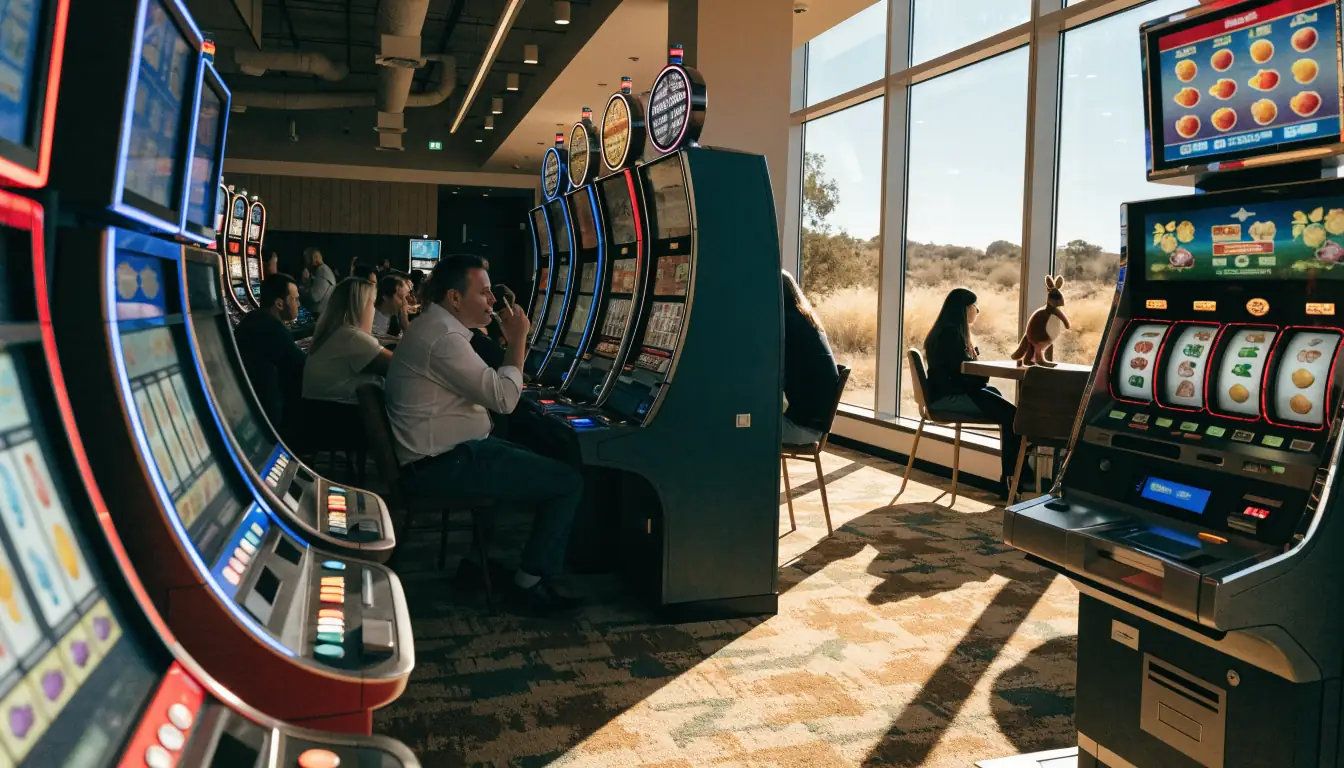
Pokies is the standard Australian term for electronic gaming machines, or EGMs. In regulatory and statistical literature the two terms are used interchangeably — "pokies" in colloquial and political contexts, "electronic gaming machines" in legislation and AUSTRAC guidance. There is no material difference between the two words; the difference lies in where the machines sit. Pokies are operated in all Australian states, the Australian Capital Territory and the Northern Territory, and they are found in three settings: pubs, clubs and casinos. The pub-and-club segment is what distinguishes Australia from most comparable jurisdictions. In most countries, gaming machines are largely confined to licensed casinos. In Australia, they are a fixture of suburban social life — which is precisely why the regulatory and anti-money-laundering picture is more complicated here than elsewhere.
Before signing up at any casino, it helps to know how each operator’s licensing and welcome offer actually stack up, so you can pick a site that suits how you like to play.
License: Curacao Gaming Control Board OGL/2023/174/0082 (Dama N.V.) · Bonus: up to A$5,000 + 300 free spins across 4 deposits Operates under a Curacao Gaming Control Board licence held by Dama N.V., and backs it with a welcome package worth up to A$5,000 plus 300 free spins spread across four deposits.
License: Curacao Gaming Authority (Jumpman Gaming Ltd) · Bonus: up to A$6,600 + up to 250 free spins across 4 deposits Licensed via the Curacao Gaming Authority under Jumpman Gaming Ltd, offering a sizeable welcome bonus of up to A$6,600 with as many as 250 free spins across four deposits.
Bonus: 240% up to A$4,100 + 300 free spins Stands out for a generous 240% match bonus worth up to A$4,100 alongside 300 free spins, making its welcome offer one of the more headline-grabbing in this list.
License: Curacao eGaming OGL/2023/174/0082 (Dama N.V.) · Bonus: up to A$10,000 + 500 free spins across 4 deposits · Min. deposit: A$15 Holds a Curacao eGaming licence under Dama N.V. and pairs it with one of the larger welcome packages here, up to A$10,000 plus 500 free spins across four deposits, with a low A$15 minimum deposit.
License: Curacao Gaming Control Board OGL/2023/176/0095 (Hollycorn N.V.) · Bonus: up to A$5,000 + 300 free spins across 4 deposits Runs under a Curacao Gaming Control Board licence issued to Hollycorn N.V., with a welcome offer of up to A$5,000 and 300 free spins spread over four deposits.
License: Curacao Gaming Control Board OGL/2023/176/0095 (Hollycorn N.V.) · Bonus: up to A$1,500 + 200 free spins across 3 deposits Also licensed through the Curacao Gaming Control Board under Hollycorn N.V., offering a more modest but straightforward welcome bonus of up to A$1,500 plus 200 free spins across three deposits.
License: Curacao eGaming OGL/2024/923/0383 (Antillephone N.V.) · Bonus: up to A$2,000 + 100 free spins across 2 deposits · Min. deposit: A$30 Licensed by Curacao eGaming under Antillephone N.V., with a welcome bonus of up to A$2,000 and 100 free spins over two deposits, requiring a A$30 minimum deposit.
Bonus: up to A$750 + 50 jackpot spins, 35x wagering · Payout speed: crypto ~90 minutes, fiat 1-5 days · Min. deposit: A$30 Offers a welcome bonus of up to A$750 plus 50 jackpot spins with 35x wagering, a A$30 minimum deposit, and notably fast crypto payouts of around 90 minutes, with fiat withdrawals taking one to five days.
License: Curacao · Bonus: up to A$2,000 Licensed in Curacao, with a welcome bonus of up to A$2,000 for new players.
License: Curacao Gaming Control Board (TechSolutions Group N.V.) · Bonus: 100% up to A$250 + 100 free spins (1st deposit) Licensed by the Curacao Gaming Control Board under TechSolutions Group N.V., offering a first-deposit bonus of 100% up to A$250 plus 100 free spins.
That physical, cash-adjacent ubiquity is also the reason an online brand borrowing the word "pokies" is trading on something more grounded than a marketing conceit. The word carries a specific local meaning, and the obligations attached to that meaning — registration, reporting, identification, thresholds — apply to physical venues. How those obligations translate, or fail to translate, to offshore online operations is a separate question, and the legal framework section below addresses it directly.
The scale of the machine economy
The numbers are the place to start, because the scale is the argument.
In the financial year 2020–2021, Australians placed bets worth almost AUD 150 billion on electronic gaming machines. That is turnover — the total value of wagers, not losses. Turnover vastly overstates the economic footprint of gambling, because the same bankroll cycles through machines repeatedly. The more consequential figure sits next to it: total player loss from electronic gaming machines in the same financial year was about AUD 12 billion. That is money that left households and did not return.
Divided across the population, per-capita losses from electronic gaming machines in FY 2020–2021 were AUD 608. Per capita, not per player — every resident, including those who have never touched a machine, is counted in that denominator. The loss is not evenly distributed across that population; problem gamblers account for a disproportionate share of machine revenue, which is a consistent finding of Australian gambling research and the reason harm-minimisation is written into the statutory objectives of the regulators rather than left to operator policy.
More recent turnover figures circulate with less consensus. Complyadvantage.com reports that pokies generated AUD 191.2 billion in gambling turnover in 2023 — a single source, and one that does not align neatly with the FY 2020–2021 baseline. It is reported here as that source’s claim, not as an established market figure. The discrepancy between "almost AUD 150 billion" and "AUD 191.2 billion" across a period that includes pandemic-era venue closures is the kind of gap that warrants caution rather than confident extrapolation. What is not in dispute is the direction: turnover is measured in the hundreds of billions, and losses in the low tens of billions, every year.
Australia’s share of the world’s machines
How many of the world’s gaming machines sit in Australia depends on who is counting, and the counts disagree in a way that should be stated plainly rather than smoothed over.
Conflicting Statistics
The article notes two very different estimates of Australia’s share of global poker machines (3% vs 18%). Both figures are cited, but the discrepancy should be highlighted as uncertainty rather than a definitive fact.
One figure has Australia accounting for 3% of the world’s pub and club poker machines. Another puts Australia at about 18% of the world’s poker machines. The sources diverge, and the divergence is not trivial — a sixfold gap is not a rounding dispute. Two factors likely explain at least part of it. First, the denominators differ: "pub and club poker machines" is a narrower category than "poker machines" overall, since the latter would include casino-based machines. Second, the counts come from different measurement exercises with different coverage of jurisdictions. Neither version should be quoted as settled fact. What can be said without qualification is that for a country of Australia’s population, the density of gaming machines is unusually high, and that density is concentrated in the pub and club sector rather than in casinos.
The honest formulation is this: Australia’s share of the global machine stock is either modest or extraordinary depending on the measure, and both claims are in circulation. Anyone citing a single percentage as gospel is citing one source’s methodology and presenting it as the world’s.
Where the machines live: pubs, clubs and casinos
Pokies are widely used in Australian pubs, clubs and casinos — that much is uncontested. The regulatory structure, however, treats these three settings differently.
Pubs and clubs hold the overwhelming majority of machines nationally. This is the sector that produces the per-capita loss figures above, and it is the sector that state regulators — the Office of Liquor and Gaming Regulation in Queensland, the ACT Gambling and Racing Commission in the Territory, and their state counterparts — supervise through venue licensing, machine entitlements and harm-minimisation requirements.

Casinos are a separate regulatory category, governed by their own legislation. In New South Wales, that legislation is the Casino Control Act 1992, and it has been amended in a way that signals how seriously compliance failures are now treated: an amendment to the Act allows NSW casino operators to be fined up to AUD 100 million for compliance failures. A fine ceiling of that magnitude is not a figure designed to be collected often; it is designed to make non-compliance a board-level financial risk rather than a cost of doing business.
The distinction matters for anyone evaluating an online operation that borrows casino language. A licensed Sydney or Melbourne casino operates under statute, under a named regulator, under a fine regime with a nine-figure ceiling, and under AUSTRAC’s AML/CFT framework. An offshore website using the word "casino" in its brand name operates under none of those things as far as Australian law is concerned — a point developed in the legal framework section below.
The legal framework: what is licensed, what is prohibited, and the gap between them
Australian gambling law is split along a line that is easy to state and frequently misunderstood.
The Interactive Gambling Act 2001 (IGA) is the primary Commonwealth law governing online gambling. It was introduced to protect the public with a focus on harm minimisation, and its central provision is unambiguous: it is an offence for online operators to offer real-money gambling of the casino kind to Australian residents. Online casino-style games — including slots, poker, blackjack and roulette — are prohibited under the Act. It is illegal to offer online casino gambling in Australia, and it is not possible to obtain a licence to operate an online casino domestically. There are no domestically licensed real-money online casino operators available to Australian players. The reference sometimes made to an Interactive Gambling Act 1997 belongs to a different jurisdiction’s statute book; in Australia, the operative instrument is the 2001 Act.
Illegal Online Casino Offers
Offering real‑money casino games to Australian residents breaches the Interactive Gambling Act 2001 and can result in criminal prosecution for the operator.
Three practical consequences follow, and each one cuts against a common assumption.
First: the prohibition targets operators, not players. It is not illegal for individual Australians to play at offshore-licensed online casinos. The offence sits with the person or company offering the service, not with the person using it. This is why "playing online pokies" is not, in itself, a legal exposure for the player — the exposure is financial and practical, not criminal.
Second: because no domestic online casino licence exists, advice of the form "check that the operator holds an Australian licence" is not merely unhelpful — it is incoherent. There is no such licence to check. There is no public register of Australian-licensed online casino operators, because there are no Australian-licensed online casino operators. The licensing checks that make sense elsewhere — against the Malta Gaming Authority or the UK Gambling Commission, for instance — verify an operator’s standing in someone else’s jurisdiction, not any recognition within Australia.
Third: what is licensed online in Australia is narrow. Online sports betting is legal under state and territory licences. Lotteries are licensed. Online casino gaming, online poker and in-play online betting are prohibited federally. Live in-play betting over the internet is illegal, while live betting placed by telephone is legal — a distinction that survives because of how the IGA defines a prohibited communication, not because anyone considers the phone a harm-reduction technology.
The Australian Communications and Media Authority (ACMA) enforces the online prohibition on the supply side, and AUSTRAC enforces the anti-money-laundering framework across the gambling sector. For a player evaluating an offshore site, the practical significance of the IGA is this: the protections of Australian consumer and regulatory law attach to the venues the law recognises, and an offshore casino is not one of them. Complaints about an offshore operator do not travel to an Australian regulator with any force, because the regulator’s jurisdiction over that operator is defined by an offence, not a licence.
One further boundary marker belongs in any honest treatment of this market: the minimum legal gambling age in Australia is 18. That applies to licensed venues and licensed online services alike. Beyond that statutory line, research from the Australian Institute of Criminology’s sphere has documented underage engagement with gambling — almost one in three 12–17-year-olds in Australia gamble in some form, and 46% of 18-year-olds do. Those figures describe the licensed and informal gambling environment around young Australians, and they are the backdrop against which the age-gate and advertising restrictions described later in this section operate.
Tax: what the player keeps and what the operator pays
Gamblers’ winnings in Australia are not taxed. This is a genuine point of difference from many jurisdictions, and it is worth stating precisely because it is so frequently gotten wrong. A windfall from a gaming machine is not assessable income for the player. Gambling is treated as a recreational activity, not a profession, and the proceeds of it do not attract income tax — including, in the general case, winnings from offshore play by Australian residents.
Tax on Winnings
Gambling winnings in Australia are not subject to income tax, whether earned on physical pokies or offshore online sites.
The state, however, is not left empty-handed. Taxation of gambling operators in Australia varies by state and by type of gambling service. Each state and territory sets its own rates and structures for the gambling services it licenses — poker machine duty in pubs and clubs, casino duty agreements, wagering levies — and these arrangements are a material line item in state budgets. The gambling tax base is one reason machine policy is politically contested: a state government simultaneously regulates a harm and depends on the revenue the harm produces. That tension surfaces in every policy debate about machine caps, cashless mandates and venue trading hours.
The practical implication for a player is straightforward and worth fixing in mind: tax does not reduce what a machine pays out to a winner, and winnings do not need to be declared as income. Any offshore operator that describes Australian winnings as taxable — or offers to "handle" the tax — is describing a liability that does not exist. That observation costs nothing to make and is worth making, because invented tax obligations are a documented pattern in consumer-fraud playbooks generally.
The laundering problem: why pokies specifically
Money laundering is where the pokies story stops being a consumer-finance story and becomes a criminal-justice one, and the mechanics deserve a precise description because they explain the entire regulatory response described in the sections that follow.

The attraction of pokies to launderers is structural, not incidental. The high volume of cash transactions and the limited traceability of pokies make them attractive for money laundering. A venue where thousands of anonymous cash transactions occur daily is an environment where one more anonymous cash transaction draws no attention — and where the ordinary paper trail of commerce, the one that makes laundered funds traceable, is thin by design.
Several laundering methods exploit this structure directly.
Insert-and-cash-out. Criminals insert large sums of cash into EGMs, perform minimal gambling activity, and cash out. The machine prints a record, the venue pays out, and the resulting funds carry the appearance of gambling winnings — legitimate, unremarkable, and, in Australia, untaxed. The gambler sacrifices a small margin to the machine; the price of the transformation is the house edge on a few minutes of play.
Ticket purchasing. Offenders purchase winning tickets from other players. A genuine winner, holding a ticket worth a modest sum, sells it for cash — often at face value or close to it — and the buyer redeems it. The dirty cash used to buy the ticket becomes a clean, traceable redemption recorded in the venue’s system. The technique requires no machine play at all; the venue’s payout infrastructure does the conversion.
Structuring. Structuring across venues involves spreading smaller cash deposits across different venues to avoid AML reporting thresholds. Rather than presenting one venue with a sum large enough to trigger reporting obligations, the launderer distributes the activity — many venues, many small transactions, none individually noteworthy. The structure defeats any single venue’s visibility into the pattern, because no single venue sees the pattern.
Money‑Laundering Risks
The article describes several laundering methods – insert‑and‑cash‑out, ticket purchasing, structuring, and use of money mules – that exploit the cash‑based nature of pokies.
Money mules. Complyadvantage.com reports that money mules are recruited to launder money through pokies — individuals, often complicit only loosely or not at all knowingly, who front the cash-in and cash-out activity on someone else’s behalf. That is a single source’s account, but it is consistent with the structuring logic above: distributing activity across persons is the same trick as distributing it across venues, applied to people instead of addresses.
The regulatory response: AUSTRAC’s framework
AUSTRAC — the Australian Transaction Reports and Analysis Centre, the country’s financial intelligence agency and AML/CFT regulator — has responded to this exposure with a framework whose burden scales with venue size.
Operators with up to 15 pokies must register with AUSTRAC, keep identification records, and submit suspicious matter reports. The obligations are real but proportionate: know who you are dealing with to a documented extent, and escalate what looks wrong.
Operators with more than 15 pokies carry the full compliance load: appoint a compliance officer, conduct risk assessments, implement AML/CFT programs, perform customer due diligence, and report cash transactions over AUD 10,000. The AUD 10,000 threshold is the number that gives structuring its purpose — it is the line that, if crossed in a single transaction at a single venue, generates a report. Every structuring pattern described above is, at bottom, an attempt to stay under a threshold that exists at exactly this level.
In 2024, AUSTRAC issued a guide to help firms recognise money-laundering red flags. The guide’s indicators include unusually high cash access, large deposits, cash transfers, casino disbursement checks and certain occupations. The last item — occupation-based flags — reflects the reality that laundering risk is not uniform across customers: a customer whose stated income and occupation sit poorly alongside their gambling activity is a customer whose file warrants a second look.
For venues and their staff, the behavioural red flags AUSTRAC points to map almost one-to-one onto the laundering techniques described earlier:
- Large or repeated cash insertions followed by minimal play and immediate cash-out. This is the insert-and-cash-out method observed from the floor, and it is the single clearest signature of laundering activity at a machine.
- Frequent small redemptions across different venues within a short period. This is structuring observed from outside any one venue — and detecting it requires exactly the cross-venue visibility that fragmented, cash-based systems lack.
- Customers refusing identification, or using multiple player cards. Identification refusal defeats due diligence; multiple cards fragment a single person’s activity into profiles too small to notice.
The enforcement side of the framework is not theoretical. Non-compliant operators may receive remedial directions, infringement notices and civil fines, and suffer reputational damage. The escalation runs from "fix this, on a timetable" to monetary penalties — with the NSW casino fine ceiling of AUD 100 million under the amended Casino Control Act 1992 marking the upper bound of what the legislative framework now contemplates for the most serious institutional failures.
The cashless turn
The structural weakness — cash, anonymity, fragmented visibility — has a structural remedy, and the policy debate has converged on it.
Account-based, cashless pokies change the underlying facts. Facctum.com, an AML-technology provider, argues that adoption of cashless, account-based pokies improves traceability and reduces anonymity — a claim reported here as that source’s position, though the logic it rests on is mechanical rather than contested. Transparent, account-based pokies provide full traceability of deposits, gameplay and withdrawals: every dollar that enters the system is tied to an account, every wager to that account’s history, every payout to the same thread. Under that architecture, insert-and-cash-out laundering becomes visible as a pattern, ticket purchasing becomes attributable, and structuring collapses — because the reporting threshold that structuring evades is a property of cash handling, not of the machines.
Cashless Pokies Benefit
Account‑based, cashless pokies provide full traceability of deposits, play and payouts, making the classic laundering techniques far harder to execute.
Regulators, for their part, recommend tighter customer due diligence, ongoing transaction monitoring and the adoption of cashless gaming systems. The direction of travel is legible in the formal record. The NSW Crime Commission’s work on dirty money in the state’s poker machine sector fed into the 2022 NSW Islington Report, which — according to complyadvantage.com’s account — recommended making all NSW pokies cashless by the end of 2028. That recommendation is a single source’s report of a single inquiry’s proposal: it is not law, it is not a national mandate, and the date attached to it is a recommendation’s horizon, not a legislated deadline. But the fact that a NSW inquiry put a cashless end-state on the table at all marks the shift in this debate from harm-minimisation policy to financial-integrity policy — a reframing that gives the proposal a different coalition of supporters than machine reform has historically attracted.
Cashless gaming is contested on other grounds, and honesty requires acknowledging the shape of that contest: privacy objections to identified gambling accounts, venue-industry resistance, and the technical question of retrofitting a very large installed machine base. None of those objections alters the core analytical point. The laundering techniques that work at pokies today work because the system runs on unattributed cash. Every proposal to attribute the cash is a proposal to close the channel; every argument for keeping the cash is, among whatever else it is, an argument whose consequences include the channel staying open. That is simply the ledger of the trade-off, and it should be argued openly rather than by omission.
What this means for anyone evaluating an online "pokies" brand
Pull the threads together and the picture is sharp enough to state in a few sentences.
Australia’s physical pokies sector is enormous, measurable and intensively regulated. Its turnover is counted in the hundreds of billions of dollars; its losses in the billions; its per-capita cost in hundreds of dollars per resident per year. Its venues are registered with AUSTRAC, bound by identification, reporting and due-diligence obligations that scale with machine count, and exposed to enforcement that now includes nine-figure fine ceilings for the largest operators. Its most serious integrity problem — cash-based laundering — has been diagnosed precisely, and the prescribed remedy, account-based cashless gaming, is in the policy pipeline at least in recommendation form.
Regulatory Gap
Physical pokies are heavily regulated and monitored, whereas offshore online casino brands operate without Australian regulatory obligations.
Australia’s online casino sector, by contrast, is not a sector. The Interactive Gambling Act 2001 prohibits it, no domestic licence exists, and the operators who serve Australians from offshore do so outside every one of the obligations listed above. Playing at such a site is not an offence for the player — but the AUSTRAC registration, the compliance officer, the customer due diligence, the AUD 10,000 cash reporting, the suspicious matter reports: none of it applies to the entity on the other end of that connection. The brand name on the site may evoke pubs and clubs and suburban venues; the legal reality evokes none of them.
That asymmetry is not a moral observation. It is an accounting of which guarantees exist and which do not. A venue with more than fifteen machines must, by law, know who its customers are and report what its cash does. An offshore site accepting an Australian player has no Australian legal obligation to know anything at all. The difference between those two propositions is the difference between the pokies industry Australia regulates and the online pokies market it does not — and no promotional offer, bonus code or welcome package changes which side of that line a given operation stands on.
The next section addresses the deposit bonuses and promo codes themselves: the legal environment they sit in, the tax treatment of what they pay out, and the compliance obligations that attach to bonus offers — where those obligations exist, and where they simply do not.
Deposit Bonuses and Promo Codes for House of Pokies: What Players Must Know
The legal starting point
No deposit bonus codes, free chips and signup incentives for House of Pokies circulate widely online, but every one of them sits inside the same legal frame. Under the Interactive Gambling Act 2001, it is an offence for online operators to offer real-money gambling to Australian residents. There is no domestic online casino licence an Australian operator of this kind could hold, which means no regulator publishes verified bonus terms, wagering requirements or promo code conditions for such a site. Any "house of pokies no deposit bonus code" listed on a third-party page is a claim by that page alone; official sources do not confirm it, and the operator does not publish verifiable conditions in a form a regulator has approved.
This is worth stating plainly: where no licensed domestic framework exists, a bonus code cannot be checked against anything. A code that promises a free chip without deposit has no enforceable terms behind it, and no complaint body with jurisdiction over it.
Tax treatment of winnings
One point in the player’s favour is settled. Winnings from gambling in Australia are not taxed. A payout — where it occurs — is not treated as income and does not need to be declared. What is taxed is the operator side, and there the picture varies: taxation of gambling operators differs by state and by type of gambling service. That variation is one reason interstate comparisons of gambling businesses rarely line up.
What compliance would require
Where gambling is properly licensed, the compliance baseline is strict: identity verification before withdrawal, clear disclosure of wagering requirements before a bonus is offered, no credit card or cryptocurrency deposits, and responsible-gambling messaging in advertising. These requirements exist precisely because the prohibited offshore space operates outside them.
The practical calculation
A bonus code with unverifiable terms has a defined value: zero. Winnings may be tax-free in Australia, but a tax-free gain still has to arrive first. Support services such as Gambling Help Online and the BetStop register operate regardless of where the gambling happens.
Written by the editors at Casino Regional Guide.